It is almost 10 years since we left the age of financial innocence. That time when indebtedness was not, as it is today, a vital necessity to avoid bankruptcy, but an abused tool to grow and make money out of nothing recklessly. The mirage of bonanza began to fade as early as 2007, although for most mortals the collapse was not evident until the stock markets crashed in 2008. Thinking back to that pre-crash era, a real estate deal we came across in 2007, shortly before the systemic disaster, came to mind. Of course, when we look back at the transaction we are now recalling, we could not have ended up in any other way than plunging into the financial abyss:
.
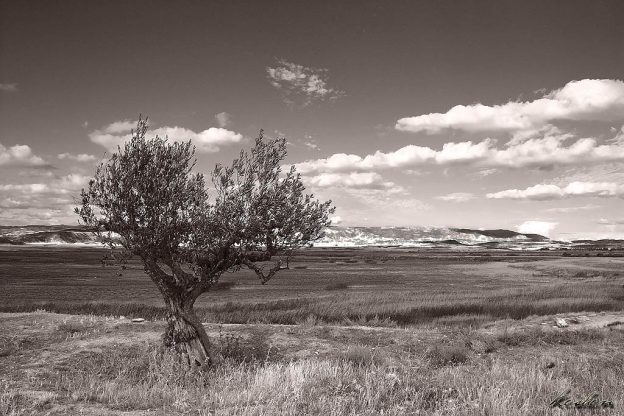
The real estate transaction in question was a plot of land to be developed in Andalusia, of very considerable size and price: 58 million €. The negotiation was already focused on the mere interest to be paid for the 50% of the agreed 3-year deferred payment. Up to this point, everything was normal and the previous contacts between buyer and seller were made with the intermediary on duty, an expert professional, one of those who, if you are careless, sells you the Palacio de Versailles as chateau and with a discount for early payment. However, at a certain point in the negotiation, we were able to deal directly with the sole owner of the land, whom we did not yet know: A middle-aged man with a rustic and prudent appearance. But when we started to get down to business, he told us very seriously that the deferred €29 million had to be paid «...".«at the same interest rate as the bank, olive tree plus one«.
.
We must admit that although we have fought in many bullrings (I would say in almost all of them), it took us a few seconds to react. This was not irony or a joke, or even a metaphor. I was reluctant to believe that someone who confuses the Euro interbank offered rate (Euribor) with the oil yield plus a unit of something I don't even want to imagine, is going to become overnight the owner of 58 million euros: 29 million euros in cash and 29 million euros in 3 years with their corresponding e very interesting olive trees plus one. Comical as well as alarming and scandalous, although many of us envy him from our modest backgrounds.
.
What will have become of this man and his family after 10 years? Unfortunately we were not able to keep in touch, as his banker-friend (sic) took over, at least for a while. Based on our experiences as asset advisors, I don't think they were any happier than they had been up to the time of the sale. Especially now, after 10 years of covering the mistakes with money that was apparently never going to run out. During these years they will have been manipulated, robbed, swindled, flattered, and squandered in the broadest sense of the word. They will have been the fodder of all those around them, whether they are part of the family or not. Cross hatreds that, with their poor training, have possibly ended or will end tragically. The best thing that could have happened to them was to sell land worth no more than a few million euros. In this way they would have tasted the sweetness of abundance but with fewer enemies, and probably in a few years everything would have returned to «normal», at most some residual and usable property for their children. I hope they have been able to realise their dreams, at least temporarily. But paradoxically They will not have had an easy life after the sale, unless they were just robbed by an honest law firm that took pity on their limitations and cleverly insulated them from their fortune.
.
At that time (spring 2007) we wrote the following: «It is an aberration that a farming family's land, which has served to feed their ancestors with more than dignity, should overnight be turned into a fortune for which no one has ever prepared them. Perhaps this is an aberration comparable to that which the purchasers of the houses to be built on this land will have to suffer, with mortgages that their children will inherit if they are not repossessed. In the case of the farmer it seems to me to be a creation of wealth against all the laws of capitalist economics. And in the case of the buyers of these flats it is a creation of poverty, curiously enough at the same interest rate: olive tree plus one».
.
Unfortunately, the financial system could no longer withstand such aberrations, and the nouveau riche rural nouveau riche, the new owners of flats, the construction companies and the banks that financed that nonsense, were caught flat-footed. And the worst thing is that, seen in a decade's perspective, the jungle of the markets and the economy of that time seems like child's play compared to the scenario we face today. Because the collateral effects of dynamiting the price of money to save the unsalvageable have only just begun.