
We look after your interests

(+34) 93 626 47 75

Torres Sarrià, Carrer de Can Ràbia, 3-5, 4ª Planta BCN 08017

(+34) 91 794 19 82

Pº de la Castellana, 93 2nd floor MADRID 28046

Category: Crisis

Greece: The moment of truth.

The time has come. The last cartridge has already been fired, and it is none other than the reunification of the principal payments that Greece owes to the IMF for the month of June until the last day of the month. In other words, 30 June is the moment of truth, since all possible rabbits have already been pulled out of the chisteras of the euro-bureaucrats in these almost 3 years of Greek agony.

Yesterday it was requested in extremis that the June maturities, starting today on the 5th and followed by another due date on the 12th, be combined into a single payment on the 30th. This was the last legally established possibility of postponement without falling into manifest default. No more. The end of the pantomime and theatrics between Varoufakis, Tsipras, the men in black, the iron hand of Dijsselbloem, Merkel and the Vaseline of Draghi and Lagarde. On the last day of June Greece will officially go bankrupt (unofficially it has been bankrupt for years), unless Germany and the rest of the «rich north» give in, i.e. pay the debts of the corrupt south, which is highly unlikely. Let us not forget that some central banks have already prepare contingencies The «Greexit» has been unspeakable for more than 3 years. (more…)

Fixed income: The bubble of the perfect storm

Las políticas de tipos cero que se han venido sosteniendo desde los Bancos Centrales del mundo más desarrollado para evitar el colapso de la deuda, han distorsionado por completo el sistema financiero. Los efectos colaterales de regalar el precio del dinero y la barra libre para evitar que los hiperendeudados (todo el mundo desarrollado) quiebren, son letales para los que deben generar rentas. Es un escenario amable con los insolventes pero muy hostil para los inversores, que se ven abocados a prestar su dinero a cambio de míseros rendimientos ofrecidos por emisores cada vez más peligrosos e insolventes.

A medida en que el dinero de los inversores se desplaza hacia la deuda más insolvente buscando desesperadamente unos puntos de rendimiento, la burbuja en los precios de toda la deuda, tanto desarrollada como emergente y en toda su curva, se hincha más y más. Los emisores más solventes o con bancos centrales dispuestos a comprarlo todo, tienen buena parte de sus curvas de tipos ya en negativo, o sea que los inversores deben pagar por prestarles su dinero. De igual modo los emisores menos solventes viven en una nube de liquidez que les permite endeudarse más y más pagando tipos como si fuesen grandes nombres multinacionales solventes. (more…)

Banco Madrid or the reckless corralito

Banco Madrid is the first bank that the state and its regulators have let fall in this galloping debt crisis. In fact, technically speaking, it has not been allowed to fall, i.e. it has not fallen due to the absence of a bailout with state funds, as other insolvent institutions have been rescued in recent years, but rather, forceful measures have been taken to liquidate it due to its -still- alleged money laundering. What is paradoxical is therefore that the reason for the intervention and the swift liquidation of the institution is not, at least originally, due to the feared insolvency but to criminal practices of great significance.
However, there is no shortage of conjecture pointing to other motivations of a less financial or political nature, as suggested by this article from ElConfidencial,this one from lasfinanzascambian.com or such an authoritative voice as Javier Cremades, chairman of Cremades & Calvo-Sotelo and president of the International Financial Litigation Network (IFLN) in this devastating article. In fact, it is strange, to say the least, that the report of the Sepblac to remain in Minister De Guindos' drawer The report had already warned of indications of various laundering offences before the Anti-Corruption Prosecutor's Office, which had not been processed until the USA demanded that action be taken. We are not therefore dealing with crimes or malpractice that have gone unnoticed until today, but rather with suspicions and indications that the competent bodies detected as early as June last year, but which they surprisingly ignored until the US financial police have come forward. (more…)

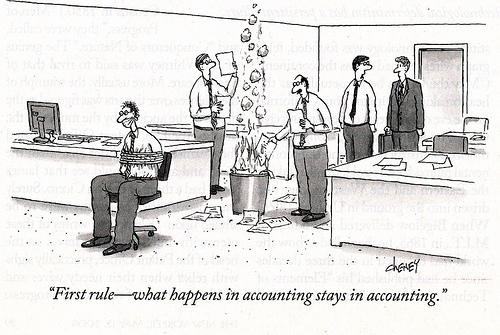
It's not for not collecting, it's for not accounting.

With central banks and their QE, the debt situation in the developed world has reached a surrealistic level worthy of study. Not only because of the unprecedented size of the balance sheets of the FED, ECB, BoE, BoJ, SNB, etc., but above all because of the manipulation of accounts, which has become a macabre and dangerous norm.

Thus, the manifest insolvency of the southern states of the Eurozone is the gigantic elephant in the room of the Troika (now renamed «the 3 institutions»: EU, ECB and IMF) that all these creditors ignore without the slightest blush. The most surreal case is that of Greece, which with Syriza at the head of its government is causing panic among its European partners. And this panic is not caused by the Greek state's inability to repay its massive debt - they have known that for years - but by the new government's willingness to publicly and openly acknowledge its insolvency.. Why? Simply because recognising that Greece will never be able to pay means having to write off losses on its creditors' balance sheets. And that really panics them, since neither the European banks nor the indebtedness and budget deficits of the other Eurozone countries are in such a state that they can count not a single euro of additional losses at the moment. (more…)

The CNMV shields itself against a foreseeable collapse in fixed income.

According to this communiqué issued by the CNMV last Friday, investment funds registered in Spain for marketing will have to publish a series of warnings in addition to those set out in the current regulation. Special emphasis is placed on fixed-income funds and funds that establish a return objective, whether guaranteed or not, and structured funds. These warnings must be included in the prospectus of the funds, as well as in the DFI (Key Investor Information) and in the IPP (Periodic Public Information). In other words, no one, neither investors nor judges, can say that the CNMV is in any way responsible for the losses that any investor may incur in fixed income in the near future. The fact is that they have already seen the lion's ears when the CNMV has had to defend itself in recent years for having acted with slovenliness, incompetence and/or negligence in the pitiful issue of preferential securities. (more…)

The side effects of Central Banks are already here.

various-central-banks

It was to be expected that central bank intervention would not be innocuous. We warned a little more than a year ago and its effects are already blowing up in some people's faces. If to this massive intervention never seen before we add a couple of other ingredients (Madonna, Madonna, just a couple...) such as OPEC's plot to push down the price of oil, the conflict in Ukraine or the radicalisation of the alleged Islamic State in the Middle East (which affects even Paris itself), the amplification of the side effects of central bank intervention can and will be uncontrollable.

Today we are already witnessing brutal price movements, which do not correspond at all to a healthy financial system, nor to corrections or adjustments of excesses, but rather to the delusions of a system that has been in place for years. frankeinsteinian capable of anything. Let us look at some very significant examples in recent weeks which, however, have paradoxically had rather localised devastating effects until today: (more…)

El 2015 puede ser el annus horribilis para el inversor tradicional.

Antes de enumerar algunos riesgos a los que nos enfrentaremos este año, definamos lo que entendemos por «inversores tradicionales». Como tales pueden calificarse la inmensa mayoría de inversores particulares e incluso muchos institucionales. Y son aquellos que invierten su dinero en productos clásicos de renta fija y renta variable comercializados habitualmente por la banca. O sea, bonos y acciones cotizadas y fondos de inversión de todo tipo que invierten en esos mismos activos, pagando jugosas comisiones a los comercializadores (bancos) para que los coloquen entre sus clientes. Activos que han funcionado bien años atrás, cuando el sistema financiero no estaba desbordado por la deuda y la actuación de los bancos centrales.

No debemos perder de vista que el caldo de cultivo para que la mayoría de inversores tengan un año aciago está servido: (more…)

Accounting traps to inflate GDP.

Accounting creativity« is nothing more than a euphemism for falsehood, for cheating in accounting so that it reflects a distorted reality, to suit the interests of those in power. And today those in power are an EU that at all costs needs to simulate solvency and growth in the countries of its periphery, so that investors do not flee those economies. If they did, there would not be enough money - or will - in northern Europe to avoid bankruptcy and the collapse of Eurozone unity.

It seems, therefore, that it is in nobody's interest that the reality of the economic miseries of the PIGS (Portugal, Italy, Greece and Spain... and some others such as France...) becomes evident and scares away national and international investors. That is why the ECB keeps the risk premium at floor level through all kinds of quantitative and pseudo-covert facilities to banks and states. It is also in charge of keeping alive the profits of banks that have their warehouses full of rotting real estate on the basis of free liquidity bars. And European and Spanish regulators look the other way when financial institutions value these properties above their market price on their balance sheets to avoid obvious bankruptcy. Anything goes to feign stability, for the good of all (sic). Accounting engineering or creativity« is also being used in Spain. when it comes to handling unemployment and other macro figures, on the demand of electoral needs and balancing with the impositions overseen by the Troika. (more…)

Bienvenido Mr. Putin.

De la caída del muro de Berlín y de la extinción del telón de acero todos nos deberíamos acordar, puesto que hace apenas un cuarto de siglo de aquellos hechos que cambiaron por completo las influencias geopolíticas. Los países del Este se escindieron de la influencia soviética sin que Rusia pudiese hacer nada para evitarlo, porque su economía comunista se derrumbó como un castillo de naipes. El vacío de poder fue enorme, surrealista en la hasta entonces segunda potencia mundial. Y la órbita de países que estaban bajo su influencia política y económica, fueron recibidos con los brazos abiertos por el libre Mercado occidental, a pesar de su retraso económico evidente. El nuevo orden mundial tenía al fin vendedores y vencidos, y los vencedores eran «los buenos» y el derrotado el «comunismo diabólico». (more…)

What is really happening in Iraq?

Los noticieros se encargan de informarnos en estos últimos días de que el gobierno iraquí está luchando dentro de sus propias fronteras contra un enemigo que abraza el más sangriento yihadismo: El Estado Islámico de Irak y el Levante (ISIL). Es decir, la deriva violenta radical del salafismo que ampara el gobierno saudí, país que por su parte defiende la lectura más literal y puritana del Islam. ISIL, que conquista territorio día a día en Irak y que lucha también contra Bashar Al Asad en Siria (de ahí que añadieran a su acrónimo la palabra «Levante»), es tan sangriento que incluso su antaño aliado Al Qaeda dejó de apoyarlo, al menos directamente.

Sería pues pecar de simplista relacionar directamente el gobierno de Arabia Saudí con el yihadismo de ISIL, que está tratando de tomar el poder en todo el territorio iraquí. Pero si a esta ecuación le añadimos que étnicamente los dirigentes saudíes y los guerrilleros de ISIL son sunitas, y enemigos seculares de la etnia chiíta que gobierna Irak desde la evacuación de las tropas americanas, las piezas comienzan a encajar algo más. Resumiendo mucho, los chiítas de todo oriente medio vienen siendo el pueblo pobre que se extiende alrededor de los pozos petrolíferos que están bajo dominio sunita, es decir propiedad de los emiratos y países como Arabia Saudí, Bahraín, etc. Y ante la radicalización de los yihadistas suníes, occidente es ahora proclive a apoyar la etnia chiíta, que gobierna en Irak. (more…)

Shall we help you search?

Cluster Family Office

We care about transparency both in management and in our own way of working. Leading wealth management and family offices company

Do you need help in capital and wealth management?

How can I avoid the negative effects that my fortune may have on my children?

How and when should I talk to my children about family wealth, and what relationship should they have with money throughout their adolescence?

How can I measure the real risks of my investments and protect my assets adequately?

Do I have sufficient liquidity and stable income to cover my needs on a permanent basis?