We look after your interests

(+34) 93 626 47 75

Torres Sarrià, Carrer de Can Ràbia, 3-5, 4ª Planta BCN 08017

(+34) 91 794 19 82

Pº de la Castellana, 93 2nd floor MADRID 28046

Category: Banca

Funds that make inaccessible funds accessible

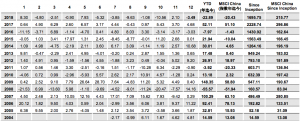
Can you imagine being able to invest in the best institutional funds on the planet, where the strongest hands in the financial world invest, with only 125,000 euros? We are talking about being able to invest in funds and hedge funds with entry barriers of 500,000, one million or five million euros minimum investment. Funds that, although they are still open (for the moment), have prohibitive minimums for portfolios that do not reach at least 10 million, if you want an adequate diversification of managers and geographical areas. Funds that, due to the brilliance of their historical returns, are light years ahead of the catalogue of funds sold by the Spanish banks, as we explained in «Institutional funds and hedge funds, the league in which retail investors cannot play».». We are talking about managers of the stature of Branis, Jiang or Simons of the legendary Medallion, who have demonstrated for decades that they are above the rest, achieving enormous alphas such as those shown in the following tables.

<
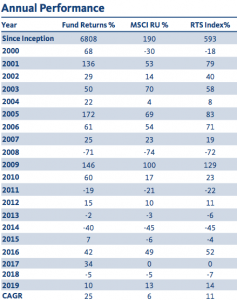
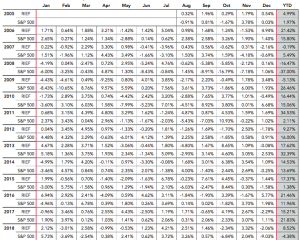
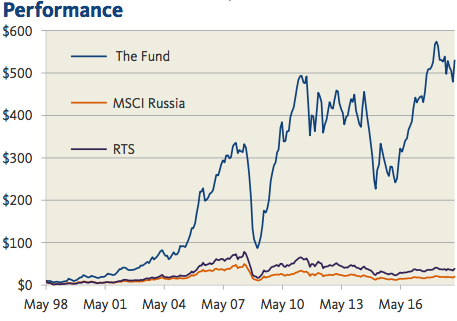
Well, some funds of funds group together large fund managers and institutional hedge funds in their portfolios and «chop up» these prohibitive investment minimums into tickets of as little as 125,000, as we said at the beginning of the article. Logically, this facilitation of access for smaller investors requires an exhaustive analysis and a prior selection of funds that is not free. All these funds of funds charge an additional fee on top of the fees already charged by the underlying funds. In other words, you are paying commission on top of commission. But if the underlying fund of funds portfolio is sufficiently strong in net returns, and the fund of funds fees are moderate, the result will be funds of funds that will continue to outperform their respective benchmarks in a very juicy way.
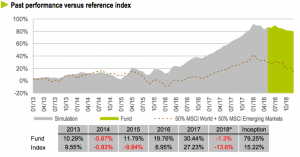
The graph above shows the performance of one of these funds of funds, domiciled in Luxembourg, The fund's performance is based on the three managers mentioned above and half a dozen other leading names in institutional value fund management. As you will see, the fund is benchmarked against an index composed of 50% MSCI World and 50% MSCI EM, which sets the bar very high, because if you look at most benchmark indices used by funds, they tend to be AR (absolute return) or other less understandable definitions. These nomenclatures of most indices or benchmarks «cap» the returns of the index in question against the stock market index of the respective country in order for the fund to visually outperform it more comfortably. This often leads to false alphas, The fund of funds' performance is very poor, which is misleading for investors, as in many cases these funds either do not outperform their pure benchmarks at all or do so very poorly, which does not justify their active management costs. In contrast, in this fund of funds, the comparison is a bare-bones comparison with the MSCI World and Emerging Markets, which is very welcome and speaks volumes about the strength of the underlying funds, as they have been outperforming them by a wide margin.

.

As you can see, although the fund was launched in May 2018 and most of the performance is a simulation of the performance of all these underlying funds over the last five years, already in actual 2018 returns it is more than paying back its fees on commissions.

.

What is the bad news? Well, most of these funds of funds, like the underlying institutional funds, are not marketed in Spain either. And therefore, at present, the only way to access them is to open an account in a Luxembourg bank that accepts smaller clients (a more difficult task than it seems without the proper reference) and subscribe to it from there with a minimum of 125,000 euros.

.

Compare the returns in the tables with those of any passive investment fund and you will see that, despite the general mediocrity of active management, some managers more than earn their fees. It is difficult to find them, but it is even more difficult to access them with smaller amounts. Although, as we always say, there are some, as explained on the Cobas blog.

.

Disclaimer: This article does not represent an investment recommendation for the products mentioned. The funds referred to in the article are not registered for marketing in Spain and are only suitable for qualified investors, with minimums ranging from €125,000 to €5,000,000.


Daniel Lacalle and the nationalisation of the economy perpetrated by Central Banks

Although we may not entirely agree with some of his convictions, there is no doubt that Daniel Lacalle is one of the people who knows the most about macroeconomics. Not only because of his PhD in Economics but especially because of his approach to the abuse of central banks that we have been suffering for more than a decade.



.

Here is the article that lacalle wrote about this abuse and the end of the party a year ago in the website of the Mises Institute. As you will see, we agree very much with Lacalle in the analysis we made two years ago in our article «...".«Negative interests and Darwin«. And you might also be interested in re-reading «What to expect when you are waiting for... QE blackout»

.

It is now 2018 and the Fed is raising rates decisively. And the ECB is finally facing its reality. We hope you enjoy Lacalle's hard-hitting and realistic article:

.

The FT published an article stating that “major central banks now hold a fifth of total government debt”.


The figures are shocking.


1) Without any recession or crisis, major central banks are buying more than $200 billion of public and private debt, led by the ECB and the Bank of Japan.

2) The Federal Reserve holds more than 14% of the total US public debt.

3) The balance sheets of the ECB and BoJ exceed their respective GDPs by 351Tbp3T and 701Tbp3T.

4) The Bank of Japan is currently one of the 10 largest investors in the 90% in the world, and the Bank of Japan is one of the 10 largest investors in the 90% in the world. Nikkei.

5) The ECB holds 9.2% of the European corporate bond market and more than 10% of the total sovereign debt of major European countries.

6 The Bank of England owns between 25% and 30% of the UK sovereign debt.


report Nick Smith, an analyst at CLSA, warns of what he calls “the nationalisation of the secondary market”.


The Bank of Japan, with its ultra-expansionary policy that only expands its balance sheet, is on its way to becoming the largest investor in the Nikkei 225 majors. In fact, the Japanese central bank already accounts for 60% of the ETF (Exchange Traded Fund) market in Japan.


What can go wrong? In general, central banking not only generates greater imbalances and a bad outcome in a “zombified” economy, as extremely lax policies perpetuate imbalances, but also weakens the velocity of money and encourages debt and malinvestment.


Believing that this policy is innocuous because “there is no inflation” and unemployment is low is dangerous. The government issues massive amounts of debt and cheap money promotes overcapacity and misallocation of capital. Thus, productivity growth collapses, real wages fall and the purchasing power of foreign exchange also falls, driving up the real cost of living and debt to grow more than real GDP. Thus, as we have shown in previous articles, total debt has risen to 325% of GDP while zombie companies reach crisis levels, according to the Bank for International Settlements.


Government securities monetised by the central bank are not high quality assets, they are a promissory note that is transferred to the next generations and will be paid off in three ways: with massive inflation, with a series of financial crises or with high unemployment. Destroying the purchasing power of the currency is not a growth policy, it is stealing from future generations. The “placebo” effect of spending the Net Present Value of those IOUs today means that, as GDP, productivity and real disposable income do not improve, at least not as much as the debt issued. We are creating a time bomb of economic imbalances that is only growing and will explode at some point in the future. The fact that the obvious ball of risk is delayed for another year does not mean that it does not exist.


The state is not issuing “productive money”, but only a promise of more revenue through higher taxes, higher prices or confiscation of wealth in the future. The growth of the money supply is a loan the state gets but we, the citizens, pay for it. Repayment comes with the destruction of purchasing power and confiscation of wealth through devaluation and inflation. The “wealth effect” of rising stocks and bonds is non-existent for the vast majority of citizens, as more than 90% of average household wealth is in deposits.


In fact, a massive monetisation of debt is only a way to perpetuate and strengthen the crowding out effect of the public sector on the private sector. It is a de facto nationalisation. Because the central bank does not “go bankrupt”, it only transfers its financial imbalances to private banks, companies and households.


The central bank can “print” as much money as it wants and the government benefits from it, but it is the rest who suffer from financial repression. By generating the ensuing financial crises through loose monetary policies and always being the main beneficiary of boom and bust, the public sector emerges from these crises more powerful and more indebted, while the private sector suffers the crowding out effect in times of crisis and the effect of taxation and wealth confiscation in times of expansion.


It is not surprising that public spending relative to GDP is now almost at 40% in the OECD and rising, the tax burden is at record highs and public debt is rising.


Monetisation is a perfect system for nationalising the economy by passing on all the risks of overspending and imbalances to taxpayers. And it always ends badly. Because two plus two does not equal twenty-two. By taxing the productive to perpetuate and subsidise the unproductive, the impact on purchasing power and wealth destruction is exponential.


To believe that this time it will be different and that the states will spend all this huge “very expensive free money” wisely is simply an illusion. The government has every incentive to overspend, since its goal is to maximise the budget and increase the bureaucracy as a means of power. It also has every incentive to blame its mistakes on an external enemy. Governments always blame someone else for their mistakes. Who cuts rates on 10% or 1%? Governments and central banks. Who gets blamed for taking “excessive risks” when things go wrong? You and I. Who increases the money supply, calls for “credit to flow” and imposes financial repression because “there is too much saving”? Governments and central banks. Who gets blamed when things go wrong? The banks for “reckless lending” and “deregulation”.


Of course, governments can print as much money as they want, what they cannot do is convince us that it has value, that the price and quantity of money they impose is real just because the government says so. Hence the lower real investment and lower productivity. Citizens and businesses are not mad not to fall into the trap of low rates and high asset inflation. They are not amnesiacs.


It is called financial repression for a reason and citizens always try to escape the theft.


What is the trick to make us believe it? Stocks go up, bonds go down and we are led to believe that asset inflation reflects economic strength.


Then, when central bank policy stops working (either because of lack of confidence or because it is simply part of the sell-off) and markets are given the valuations they deserve, many will say it was the fault of the “speculators”, not the central speculator.


When it erupts, you can bet your bottom dollar that the consensus will blame markets, investment funds, lack of regulation and insufficient intervention. The mistakes of perennial intervention are “solved” with more intervention. The government wins either way. As in a casino, the house always wins.


In the meantime, the famous structural reforms that had been promised are disappearing like bad memories.


It is a clever Machiavellian scheme to kill free markets and disproportionately benefit states through the most unfair of powers: having unlimited access to money and credit and none of the risks. And pass the bill on to everyone else.


If you think it doesn't work because the government doesn't do much else, you are simply dreaming.


.


Stop-loss in actively managed funds?

As Machado said, only a fool confuses value and price. From the point of view of the long-term investor, who buys shares in good companies at attractive prices relative to their present and future earnings multiples, it would already be absurd and foolhardy to buy and sell these shares in the short term without associating these decisions with the value of the respective businesses. But it would be even more absurd to do so. short term trading in a portfolio of actively managed mutual funds, The investor can also set up tempting automatic buy and stop-loss (sic) orders, with portfolios at the free will of their respective managers.

.

That is what ING offers to their clients, with the consequent benefit to the bank for this service, obviously. But as it is not as simple operationally to automatically buy and sell a fund at a pre-established price as it is for a share, what they offer their clients is a «warning» service when the fund's price reaches the marked price. It is then that the client will decide whether or not to sign a buy-sell-transfer order for these funds, which will usually take a couple of days to execute. Oh, and of course, this «service» is only available for ING brand funds, which means that everything stays at home.

.

In a review of the practice of share trading (including stop-loss), we have to say that it is the usual modus operandi of savers who are less qualified as investors. In other words, those who move away from long term investment by buying businesses whose good value/price ratio they know, and instead approach the mere bet on any ticker listed, regardless of the good or bad performance of the listed company's business. They are even oblivious to whether there are prospects and an adjusted valuation of a company's business, a commodity, an index or any derivative behind that ticker. For most of them, it is enough to have a ticker or a changing price to bet on more or less frantically, conveniently dressing up this practice with all kinds of trading courses, technical analysis and macros that disguise their gambling with a patina of expert investment.

.

However, generally speaking, an investor who knows the value of the companies in his portfolio will be more interested in buying them the more the price of their shares falls. Conversely, the more expensive the shares are in relation to the value of the company, the more interested he/she will be in selling them. In contrast, short-term stock trading is associated with completely ignoring the real value of the company. This is why technical analysis and other trading methods usually recommend buying stocks when prices are rising and selling them when they are falling. (Here we could make the exception of the very few quantitative hedge funds that have been making money for decades, but they would be the exception that proves the rule and would only be the exception that proves the rule. accessible to well-informed investors and with capital in excess of 300.000′- euro).

.

As we said, ING is now tempting its clients to carry out this trading practice also in their portfolios of actively managed funds. Active management is so called because the manager of each fund actively makes decisions by buying and selling stocks or bonds. From there, the net asset value of the fund will be the -usually- daily quotation of the entire portfolio at market price, after deducting the commissions and expenses of the active management itself and of the fund (on active and passive management you will be interested in the article that Cluster Family Office recently published on the website of COBAS AM, the manager of Francisco García Paramés: «Passive Management, Active Management»). Therefore, it makes even less sense for the saver to make decisions to buy or sell the fund when, not only does he not know the value of the businesses bought, he does not even know which businesses he has bought and sold. The manager of such a fund or the liquidity it accumulates on a daily basis. It would also not allow you to benefit from one of the key investment drivers that every value manager strives to achieve: co buy low and sell high, since such trading and stop-losses would completely detract from good active management.. Moreover, as fund trading is an absurd and rare practice, the saver would not even have the possibility to benefit from the self-fulfilling prophecy that technical analysis sometimes offers.

.

In short, yet another brainstorming strategy of the Machiavellian marketing department on duty, whose priority has never been and never will be the customer's benefit, but that of the financial institution itself. More wood to keep savers away from the right investment path.


Banco Popular: In extremis.

Once again, the disaster has come close to happening. And at the last minute, unspeakable pressure from the government has succeeded in getting Banco Santander to take over the huge hole in Banco Popular. Before it got this far, of course, capital was raised with money from unsuspecting new shareholders, bondholders and any other naïve people who believed in the image of security and solvency of characters such as those used by advertisers.

.

https://youtu.be/xD_4thIw1FQ

.

Most sports personalities, accustomed to selling their image for publicity, do so to the highest bidder without giving a damn whether they are selling more trainers or helping to wipe out the savings of humble families who believe that what Pau Gasol tells them can be trusted. It is difficult to apportion blame fairly: who is more to blame for small savers losing their money in these bank rescue operations: the bank manager, who is increasing capital or going public (Bankia) knowing full well that the investors he is deceiving are going to lose a large part of their savings? The regulator (BdE) who allows it, also knowing the critical situation of these balance sheets? The person who sells his image of credibility to convince those who without it would not trust that entity with their money? The bank employee who lies vilely to all the prey who sit at his table during the aggressive campaign to attract investment? The investor himself with his explosive cocktail of ignorance and greed? As the saying goes, between all of us the scammed and she alone is ruined...

.

In order not to be hypocritical, it is worth reflecting on another point. If the final destination of a failed bank is a bail-in, in other words, more debt that will have to be paid for with increases in our present and future taxes, every euro from a private investor that the bank captures - in collusion with the CEO, regulator, employee or publicist - will be one euro less that those of us who have not been duped by the whole gang will have to contribute. Therefore, leaving ethics aside, if other naive people plug the hole a little with their savings, the rest of us will have to pay less with our taxes. A vomitous political-financial jungle in every sense of the word, of course.

.

In the case of B. Popular, the disaster has been close to the crossbar and has only affected a priori the investors who trusted the institution as shareholders and the subordinated and preferred bondholders, while the depositors and the rest of taxpayers, for once, seem to have been spared another bank bail-in. But the million-dollar question is, in exchange for what? What has the government promised the Botín family to make them swallow such a toad? We will probably never know and it will remain, like the rest of the bail-outs and bank «reorganisations», indecipherably diluted in the tax returns that our children, grandchildren and great-grandchildren will pay for the rest of their lives.

.

The corporate rescue of Popular is nothing more than another symptom of the coming winter. This time the explosion has been controlled and concealed under the carpet at Santander, which today is at least 7 billion euros less solvent. But the persistent zero rates can already engrave another notch in its hilt of underground financial institutions. The problem is that when Germany can't take any more inflation and decides to raise rates, we in the south will need another central bank to keep them at zero. Then our banks and our prices will be able to lift their heads timidly, but our current accounts and assets in the south will be priced at a lower value than those in the north.

Draghi's NIRP, the Reverse Yankees and the DDO

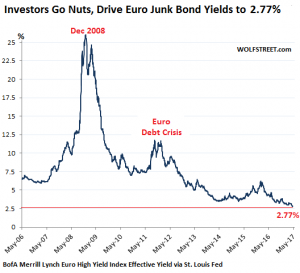
At the end of last week something unheard of happened, something absurd even among the absurdities of this New Normal that Central Banks have put us in: The average yield on junk bonds (the riskiest and most insolvent of corporate bonds) denominated in Euros fell to record lows of 2.77% per annum.

.

Already on 26 April, the absurdity of the ECB's negative yields policy hit a milestone, with yields on the most insolvent debt falling below 3% for the first time in history.

.

Comparatively, the most liquid and safe debt in the world, the 10-year US Treasury bond, yields 2.33% per annum, and the 30-year Treasury yields around 3%.

.

The following chart of the BofA Merrill Lynch Euro High Yield Index shows the madness in the Eurozone:

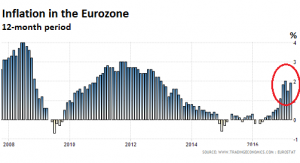
And it is not that these ridiculously low yields are the result of rampant deflation, despite the alarmism created in the last few months, no. The official annual inflation rate has been at 1.91 PPP3T and, as we can see in the following chart, it does not seem to be going away any time soon. Official annual inflation has been running at 1.9% and as we can see in the graph below, it does not look like it is going to disappear in the short term.

In other words, the real average yield on junk bonds, net of officially recognised inflation, as seen in the two indices above is now only 0.87% per annum! That is the return that bond buyers/investors get for lending their money to companies with junk ratings and manifest insolvencies for years, with risks of defaults (recognised by Fitch, Moody's and S&P) on the horizon more than considerable.

.

Against this backdrop, of course, it is not only European companies that want to raise fresh money. Like flies to honey, American companies are also flocking to the euro in search of euros from unsuspecting European investors in exchange for ridiculous interest rates. These are the so-called «Reverse Yankees», or issues by American companies in euros, eager for almost free credit. But why are European investors offering their money to insolvent debtors in exchange for so little? Have European investors gone mad? I'd better not answer you...

.

The answer lies in Draghi's efforts to implement his now reduced QE of 60 billion euros per year, which includes sovereign bonds, covered bonds, investment grade (IG) bonds and ABS. In addition, Draghi cut rates to negative -0.40%, thus intensifying the rise in debt prices and compressing yields on all debt, both sovereign and corporate (financial repression). What the ECB does not buy directly are junk bonds, but that does not mean that it does not end up with them in its cabinets (balance sheets), as it has bought and will buy paper that has become junk over time. And no one will be able to say that this was a misfortune that no one could have suspected, since much of this debt was already junk before it was bought and was given a rating upgrade by hammer and tongs to fit in with the politically correct requirements of the ECB.

.

As a result of this QE and NIRP (Negative Interest Rate Policy), many corporate bonds are now trading at yields below zero. For example the German 5-year bond is at -0.33%, which subjects investors to a very deep -2.23% after deducting official inflation! Obviously investors who want to achieve positive net (inflation-beating) returns, must either jump into the arms of much more insolvent and risky junk debt. Or they must fly into other currencies, such as USD debt. These are the NIRP Refugees, who «migrate» elsewhere to avoid the devastating effects of their indigenous debt.

.

The million-dollar question is why those affected by NIRP are risking so much for so little. Many are institutional investors who are obliged to buy euro bonds, such as insurance companies and euro fixed income funds. Moreover, with rising US rates, it is no longer even almost free to hedge EUR/USD currencies, as it was a couple of years ago. As a result, these institutional investors are condemned to buy wet paper at exorbitant prices and in exchange for ridiculous yields. Nor should we forget that these institutions are managing other people's money and not their own, what we will call DDO (Other People's Money), making it easier to take on bread for today and hunger for tomorrow, when this debt defaults or its price returns to more reasonable prices and generates huge losses for the unwary investors. The fact is that the managers of these institutions are paid to place these gigantic flows of DDOs, and they do so in line with the rest of the institutions. Because when collapse and losses, They will not be alone, as the rest of the institutions will suffer just like them. DDO that will blow up in everyone's face, in a very distributed and not very inculpatory way.

.

The more debt the ECB buys, the lower yields are in a perfect fish-bite, as well as other damage of incalculable consequences. Flooding the bond market with money is the perfect flight forward, satisfying the yields and capital gains needed by those who bought yesterday or last year. Play the game while the music is still playing, and no institution is going to stop before disaster strikes.

.

In addition to institutional investors, junk bonds are also sold at the price of gold to retail savers, unsuspecting investors who put their money in the «safe» and «guaranteed» funds sold to them by their corseted, sympathetic and trustworthy bankers (sic). And what has happened in the last few years, in which the music has continued to play non-stop, proves them right! Who hasn't made money buying this wet paper (sovereign or corporate) in the last 5 years? Why can't it continue to be like this for the next 5 years? Something like this thought the turkey the day before Christmas...

.

But the reality is that more and more issuers are turning to the European open bar. From runaway Spanish banks to the Mexican oil company Pemex, which placed 4.3 billion euros just a couple of months ago.

.

But bonds are not like shares. Bonds pay off (if you hold them long enough) at par. If you come to maturity, with these compressed rates, you can only make money if you have previously bought them at a discount. But in the current scenario, far from that, bonds are being bought in the secondary market above par! So what is the hope of all holders, traders and hedge funds of overpriced euro bonds? To get them out of the way early enough to gain a few pips before it is too late. But for institutional investors who have to hold them to maturity because their business model demands it, there will be no happy ending. Unless some clever institutionalist passes the hot potato in time to other, less experienced and more innocent hands, in the form of banking products that offer three times as much as a deposit, «with total security».

.

Via wolfstreet.com

Selective debt writedown.

A few months ago we wrote an article entitled «The Big Writedown« in which we warned of the possibility that the impasse of massive debt in which the whole world is mired could be circumvented in an imaginative way.

This formula is none other than the selective elimination of debt issues that are almost entirely in the hands of the respective central banks.

In this way, the loss that any default entails would be accounted for on the only balance sheets in the world that can be squared by making money out of thin air and moulded like chewing gum, namely the balance sheets of central banks.

(more…)

Negative interests and Darwin.


The essence of our economic and market system is efficiency and competitiveness driven by profit. It seems a somewhat convoluted phrase, but it assumes that the System is based on concepts as logical and simple as the fact that all the agents that make up the Market and the global Economy want to make money. For this obvious - and at the same time necessary - reason, we try to progress in our jobs, either as employees or as entrepreneurs. We all want to achieve greater well-being, and to do so, we need to progress and our work must be not only well done, but better done than that of our competitors. This is the only way to improve our salary or our company profits, and thus also our ability to enjoy that money, i.e. our present and future well-being.
(more…)

Deutsche Bank: The Big Short.

la-alerta-roja-por-deutsche-bank-apunta-a-un-colapso-europeo-tipo-lehman-brothers

Edward Misrahi, manager of Ronit Capital, ex-partner at Goldman Sachs and Eton Park, recently stated in an interview with Businessinsider.com that his number 1 choice to hedge a portfolio against a generalised fall in the markets would be Deutsche Bank shares. He warns that any European bank has a very uncertain outlook, whether it is Portuguese, Italian or British, affected by Brexit. But his preferred insurance policy in the event of a tail-risk would be to sell the shares of this German bank, for which he predicts a forthcoming nationalisation as the only way out to avoid a general banking collapse. (more…)

It is urgent to wait... and to know what to expect.

espera-porvenir

In today's financial and economic times, as an old friend often says, it is urgent to wait. This is not a time for long-term investment ventures that are susceptible to macroeconomic changes or geopolitical conflicts, which are more uncertain than ever. The steps that investors must take in such a muddy environment must be short, stable and prudent. It is more true than ever that the concept of crisis is synonymous with opportunity, but this does not mean that we should not take ambitious and adventurous steps when a mine-ridden swamp surrounds us. (more…)

Central banks and the rise of extremism.

DanielleblueOs recomendamos una lectura para el fin de semana. Se trata del artículo que encontraréis enlazado al pie de este post, escrito por Danielle DiMartino Booth, analista económica especializada en bancos centrales. Danielle Booth supo prever hace una década la catástrofe que supuso la burbuja inmobiliaria y el abuso de crédito hipotecario ejercido por los bancos norteamericanos. Recordemos que la llamada «crisis subprime» fue el fenómeno que originó el colapso del Sistema Financiero, que hoy en día se mantiene aún en pie sólo gracias a (o por culpa de) la respiración artificial proporcionada por los bancos centrales, a costa del crecimiento y la riqueza de las próximas generaciones.

Antes de que tachéis a esta analista de exagerada y catastrofista, os queremos recordar que Danielle fue la mano derecha del ex-Presidente de la FED de Dallas Richard Fisher durante los 10 años de su mandato. Fisher (y su mano derecha Danielle) se enfrentaron a Bernanke cuando éste inició la fabricación masiva de dinero/deuda. Y en 2013 Fisher y Booth también se mostraron firmemente en desacuerdo por la puesta en marcha de la tercera ronda de Quantitative Easing, por considerarlo ya «one step too far».

Si queréis ponderar un poco más el análisis de Danielle, podéis leer también lo que decían de ella en ZeroHedge el pasado año: «Another FED Insider Quits, Tells The Truth«. Por nuestra parte tan solo recordar las advertencias que hemos reiterado desde el 2013 en artículos como «La Era de los Bancos Centrales«.

Ya sabemos que algunos de vosotros consideráis que nuestros artículos son generalmente demasiado pesimistas. Pero quizá, después de leer a Danielle, los nuestros os resulten incluso un tanto «happy flowers» 😉 En cualquier caso, os deseamos un feliz fin de semana y que este bofetón de crudo realismo titulado «Central Banks and the rise of extremism» no os lo estropee:

«Central Banks and the rise of extremism.»

Shall we help you search?

Cluster Family Office

We care about transparency both in management and in our own way of working. Leading wealth management and family offices company

Do you need help in capital and wealth management?

How can I avoid the negative effects that my fortune may have on my children?

How and when should I talk to my children about family wealth, and what relationship should they have with money throughout their adolescence?

How can I measure the real risks of my investments and protect my assets adequately?

Do I have sufficient liquidity and stable income to cover my needs on a permanent basis?