
We look after your interests

(+34) 93 626 47 75

Torres Sarrià, Carrer de Can Ràbia, 3-5, 4ª Planta BCN 08017

(+34) 91 794 19 82

Pº de la Castellana, 93 2nd floor MADRID 28046

Category: Sin categorizar

Chinese Queen's Gambit

After listening to and reading many Western and Eastern analyses of the Chinese government's move in its financial markets, and largely agreeing with the analysis of Gavekal, What is clear to us is that these are decisions that will benefit China's interests in the medium and long term, entrenching its imminent global dominance. As with gambits in chess, which sacrifice a pawn or other piece at the outset to gain an advantage later, Xi Jinping's government is sacrificing certain sectors and the size of certain companies in a surgical manner, although the collateral effects of such policy decisions may be noticeable in the short term, and especially amplified in the Western media.

.

The exact reasons why Xi has targeted sectors such as technology, online education and the financing of Chinese companies in the US market are known only to his closest and most loyal political circle. But we will now explain 7 reasons that could well be behind the Beijing government's moves.

  1. An exhibition of power, a warning to all, anyone who moves will not be in the photo, a punch on the table or whatever we want to call it. In short, the government is marking its territory with these actions, demonstrating that Xi's pulse is not trembling to lead the flock towards more and better pastures for the common good (of the party and the state). Growth and global economic dominance, yes, but without the government letting go of the reins at all. An empirical demonstration that Capital will not weaken the foundations of the party.
  2. Pre-emptive action in the face of escalating US measures against China. What better strategy than to sacrifice in advance companies dependent on US financing, thus discouraging the potential pressure that Washington could exert on Beijing if it threatened to turn off the tap on Wall Street. China will now be less dependent on US investment, knowing that investment in Chinese companies today already comes from many other countries that are increasingly allied with and dependent on China. There is life (investors) beyond Wall Street, and more and more of it every day.
  3. As for the online education sector, which has been hammered in the markets by measures that would force its companies to become non-profit entities, they seem to be the scapegoats for the extraordinary rise in the cost of education in China. And private education, as widespread as online education can be, could easily escape government control and supervision. In other words, the move will lead to cheaper education (even at the risk of temporarily less access to education as a whole) and greater control, not only of educational content and systems but also of the shareholders in this sector of business.
  4. Another sector crunched by the government's measures is the food and home delivery business. But despite the bombastic headlines warning of the sector's collapse, the measures taken by Xi's government seem entirely reasonable. The main measure he has ordered is none other than the obligation for the wage and working conditions of the riders or delivery drivers to be equal to those of any other wage-earner who reaches the legally established minimum. This is clearly also in the medium and long term interests of the Chinese economy.
  5. Back to industry: The measures that are shrinking the size and influence of some technology and internet-related companies can be read as a return to industry. But that would probably be too simplistic a reading because China is not going to give up on technology companies that lead to progress in R&D - quite the contrary. What seems to be targeted are technology companies that only cater to sterile leisure, i.e. video games and social networks, for example. In other words, companies that encourage distraction and the dedication of hours by users to non-productive activities. That is nothing.
  6. Derived from this concept of back to industry (& back to R+D) we can also sense an intention that reminds us of the Manhattan Project. In other words, China wants its technological talents to focus on research and development of new technologies, such as semiconductors, in order to alleviate the current and future shortages that we are going to have all over the world. They encourage the potential for technological growth to go in the strategic direction that suits China's future, rather than in other directions that would only distract the population from the collective productive objective that Xi has designed and that is leading China to global economic leadership.
  7. Because at the moment China can not only afford to see outflows of foreign investment, but this outflow is also a perfect escape valve for the unwanted appreciation of the Renminbi (RMB). Let us not forget that China has a trade surplus of $50 billion per month and that its currency also supports flows of another $20 billion in the purchase of Chinese debt by investors from all over the world. And that puts upward pressure on the RMB that is difficult to manage. These controlled, surgically designed investment outflows therefore make perfect sense from the point of view of China's strategic interests.

Some will probably say that the radical movements in share prices in some cases, such as Tencent or BABA, generated by politburo decisions, are madness and undermine the confidence of international investors. Others will say that it is Xi Jinping himself who has gone mad, damaging his own companies and sectors, in a fit of anti-capitalist communism in the purest podemite style. But even if that were the case, let us not forget that in the West we are not very sane either, With the hangover from Hurricane Trump and central banks keeping more and more zombies (companies and states) too big to fail. But nothing could be further from the truth. Xi's modern China does not miss a beat, and always governs with horizons that go far beyond a measly Western democratic legislature.


Investing in the midst of a pandemic

After the much read and commented in networks «The lies of the Spanish government and health authorities about the coronavirus«In the third instalment of articles dedicated to the global crisis caused by the SARS-Cov-2 coronavirus and Covid-19 disease. In our first article entitled «Realistic coronavirus figures and the opportunities of an unfortunate crisis»We were already anticipating this: The effects on the entire world economy are devastating in the short term. But only in the short term since the infection has a clear expiry date, Unlike other geopolitical, military or social conflicts, which also generate panic in the markets. Y It is this temporality that should awaken the good investor in us and change our fear for the famous greed that Buffett and other investment greats recommend when the rest of us panic.

.

In this pandemic, which is now beginning to sweep the West, the investment opportunity is one of those that are often called once in a life time, This is one of those rare occasions in the course of a lifetime of investing. This is because, although there is always room for doubt due to imponderables that can complicate scenarios, business activity will probably recover to pre-pandemic levels in the medium term at best. Obviously these imponderables include, for example, a mutation that makes the virus more resistant and/or deadly, war conflicts that add more instability to the world order, or other health crises that could arise and coincide in time with the current pandemic. But if none of these things happen, the recovery in the tone of the economy will be no more than a few months. a couple of quarters, And what should a few quarters mean on the horizon for a good investor? Nothing.


.

Therefore, it's time to go shopping (or hunting, as Buffett would say) and take advantage of the fact that the results of countless good companies around the world are going to be temporarily and exceptionally bad. Because the fall in profits and turnover will not be due to poor business performance but to a lull in global economic activity that is as exceptional as it is temporary. If we talk about airlines, we will find some at half the price of last year. If we look at the energy transport sector, the falls and fluctuations have been insane. And what can we say about the China's health sector, The winning horses, for example, have an exceptional horizon ahead of them because they will be the almost exclusive providers of pandemic and post-pandemic material on a planetary level.

.

But how to find these pearls with such a promising future? Decades ago we learned that it is much more efficient to select the best international fund managers than trying to analyse the best companies on the planet. The knowledge that good local management teams will have of the best companies in their respective countries (Vietnam, India, Brazil, China, etc.) will always be infinitely superior to ours or to that of any multinational management company that tries to make its selection through a manager located in London or New York, even if its forefathers were originally from those countries. We would therefore be well advised to invest our money now in those investment funds who have local and comprehensive knowledge of China (or the specific health sector as mentioned above) or any other country.

.

And those good local managers will not only choose good businesses, but also cheap ones, with bright prospects for recovery. Because if we think that a company may be losing a whole quarter of its turnover due to the pandemic, for example, and we buy it now at a panic price, its growth prospects in terms of turnover over the next 4 or 6 quarters will be spectacular. In other words, we will be investing with Value criteria but with a Growth potential that is as exceptional as it is profitable. If we add to this the fact that we will be selecting companies whose business is based on taking advantage of growing economies and demographics such as those in Asia, the tailwind will further boost our future profits.

.

As the image on the left hand side of the Cobas March Newsletter, It is now, when our neighbours in the 3rd 5th are beginning to realise that perhaps the coronavirus is not just a simple flu, that we should invest without fear and give free rein to our good investor's greed. Now, when our less informed friends and acquaintances are alarmed by the market crashes that are all over the TV news. Just like the lift man who recommended shares to Groucho Marx. in this essential book, or Rockefeller's shoeshine boy invested in the stock market. In other words, when the less informed panic about the coronavirus epidemic and the markets go into a tailspin, it is the most appropriate time to invest in the quality assets that have been exaggeratedly depreciated in recent days. It is perfectly possible, as we have already said, that things will get even more complicated, and that the investments we make today will temporarily lose an additional 20% or 30%. But if they do, and our investments are of quality and made with the good judgement of the best fund managers on the planet, it will be for a very short time. On the other hand, if we remain fearful out of the market, it is likely that we will not see that additional 20-30% fall but a sharp recovery and miss out on much of the upside, having blown this one. «once in a life time».» opportunity.

.

We know that many will read this article but will not follow the recommendation, as it is easy to understand that you have to buy when everyone else is selling, but it is difficult to dare to put it into practice. And thanks to the majority who won't dare and those who don't even agree with our arguments, a few of us will be able to make substantial profits in the coming years.


What are our children going to work for?

Our developed society seems to be frolicking in the sand by the seashore, totally oblivious to the tsunami that is crashing over us. This great wave that will sweep away everything we know is none other than the disruptive change that is already being generated by new technologies, and especially by advances in artificial intelligence (AI). The changes in society that we saw during the industrial revolution or the global implementation of the internet were child's play compared to what is coming our way. Technological and personal adaptation skills with constant training are already what our parents' and grandparents' literacy was. Without such skills and training, our old age, and more seriously, the lives of our children, are condemned to a marginalisation comparable to that of the illiterate of yesteryear.

.

The latest OECD study (Skills Outlook 2019) is devastating. It warns that the percentage of the population in Spain with the capacity to adapt to technological progress and the digitalisation of tasks is only 23%. These figures include people aged between 16 and 65, so if we think beyond the age of (pre)retirement, the scenario is even more terrifying. More than 3/4 of our society will be marginalised in the face of the technological advances that are already being implemented in the workplace. The figures improve slightly in countries with more advanced educational and social systems, such as Norway, Sweden, Finland, New Zealand, etc. But imagine the figures that could come out of less advanced societies such as those in Africa or deep Asia or South America. The extinction of jobs analogue is already and will be overwhelming.

.

But that is only the tip of the iceberg, since the artificial intelligence (AI) is a disruptive breakthrough as momentous as possibly the mastery of fire by early hominids. The AI revolution will eliminate not only the remnants of analogue jobs in the less developed corners of the globe, but also a good part of the digital ones. Until our generation, society and the global economy have been able to cope with, adapt to and take advantage of technological advances despite initial fears. We remember the trade union protests in the industrial revolution, when machines began to replace workers, who had to readapt to other work tasks. Another example would be digital photography, which overnight wiped out giants such as Kodak and their film developers. Or streaming content such as Netflix, HBO, Prime Video, etc., which are forcing the Hollywood empire itself to reinvent itself or die. The same will soon happen with other disruptive changes such as mobility in self-driving cars and a host of imminent changes that will make our society unrecognisable when our children try to enter the world of work. It is true that civilisation has been sufficiently assimilating these advances and more jobs have been created than destroyed, as economies have grown even faster than the population. But the speed of technological advances is exponential, and especially artificial intelligence will overwhelm society without having enough time to react and readapt as it has done in the past.

.

There is no antidote to the incoming tsunami. We continue to fiddle absentmindedly in the sand, wondering whether our children should learn English, Chinese or German, while they go to the university around the corner to get a degree in a subject for which we delusionally think they will have no shortage of work. Unfortunately this will not be the case. Experts warn that our children will have to adapt to work in professions that do not yet exist today and that no less than 75% of today's professions will cease to exist. The million-dollar question is what we can do to be as well prepared as possible for these radical changes. But the honest answer is that the disruptive advances of AI are so brutal and imminent, there is seemingly nowhere to take cover. The tsunami is already upon us, and all we can do is stop fiddling absentmindedly on the shore and face it head on and try to survive occupationally and socially.

.

To this end, we must educate our children at leading universities and in subjects whose employment opportunities will not be cannon fodder in the face of the global deployment of artificial intelligence. There is little else we can do. Professions such as teachers, doctors or manufacturing that can be replaced by 3D printing, to give just a few examples, will have to adapt radically to the new AI rules of the game if they are to survive. Others, such as those involving typing, telephone answering, etc. will probably become hopelessly extinct in the face of virtual assistants, of which Alexa, Siri, etc. are only primitive and crude versions. As the speaker in the video we link to at the end of this article says, they would be what we call «virtual assistants".«narrow AI«.

.

The prestigious MIT University in the US has created a project, 1 billion, no less, to train multidisciplinary students to adopt and combine their education of any degree, even if it is not technological, with artificial intelligence, very present in all their careers. As Gay de Liébana said in his lecture last month in Barcelona, parents must do everything possible to give their children the best training and qualifications for the global world they will face. That is what he did with his own son, who now lives and works in Los Angeles, and sent him to study at an American university. By the way, here you can read the costs and scholarship possibilities for Spanish students at universities in the USA, You will see that you don't have to have brilliant grades or be rich to send your children to the best university education system on the planet. Another of the virtues of the university system in the USA - key in the current and future environment - is the flexibility to transfer and validate credits from one degree to another without losing courses or money. In fact, it is so easy to reorient your studies throughout your college years that 70% of students graduate with a different degree than the one they started with, making decisions and adapting their study programme to their preferences each term. This flexibility, together with the technological edge of American universities, will be a feature of the American university system. It is vital for our children's educational process to be able to adapt more easily to the changes that will also occur during their university years.

.

In short, the machine revolution is already here, and our children will have to cope in a changing world, very different from the one we know. To do so, they will have to train and adapt throughout their lives, since the professional tasks they perform will be as ephemeral as the customs of the society in which they will live. They must avoid professions that will become extinct, and at the same time train constantly to adapt to new professions that will emerge from nowhere at breakneck speed and that we cannot even imagine today. We will experience this too, although it will probably affect us somewhat less as we will be close to retirement or already fully engaged in a contemplative but overwhelming life.

.

Finally, we leave you with this very interesting speech 8-minute film made last year by Michael Harrison, a graduate in Theoretical Physics at the MIT and with a Master's degree in Aerospace Systems Architecture from the USC. Artificial intelligence not only puts many of the present professions at risk at its levels of narrow AI y strong AI, but also the civilisation itself when it reaches the level of super-strong AI. But hopefully our children won't see that... but our grandchildren will.

Warren Buffett, concepts to brand the investor. Chapter 2: Investment.

Después del Capítulo 1: Endeudamiento, vamos con la segunda entrega de los razonamientos, frases y conclusiones del genio Warren Buffett, extraídos de las múltiples Cartas a los Accionistas que ha publicado Berkshire Hathaway a lo largo de décadas, conferencias, coloquios universitarios, entrevistas en múltiples medios de comunicación, ensayos personales o comentarios realizados en la Comisión de Investigación sobre la Crisis Financiera.

.

En este Capítulo 2 trataremos la visión de Buffet del concepto de inversión y la forma en que cada persona aborda esta práctica tan determinante en la vida:

.

Invertir bien no está vinculado a un alto coeficiente intelectual. Con una inteligencia normal se puede invertir de manera excelente. Sólo hace falta carácter para controlar los impulsos irracionales que arruinan a otros inversores inteligentísimos. Para evitar dichos impulsos, es conveniente reflexionar mucho sobre las inversiones. Y para hacerlo, la mejor forma es estar sólo en una habitación y pensar. Si eso no funciona, créeme que nada más lo hará.

.

Cuando fui adolescente pasé 8 años haciendo gráficos para ganar dinero en bolsa (chartista). Entonces álguien me dijo que nada de aquello era necesario, que bastaba con comprar algo por debajo de su valor. Conocer de primera mano el chartismo te hace pisar más firme cuando lo abandonas definitivamente para buscar el valor fundamental en tus inversiones.

.

Invertir con poco dinero mejora las expectativas de rendimientos, contrariamente a lo que muchos piensan. Con poco dinero y pocas oportunidades para invertirlo, solemos elegir mucho mejor. Sin embargo la mayoría de gente atribuye sus fracasos a la escasez de millones y no a sus malas decisiones (desde nuestra visión como Multi-Family Office podemos asegurar que eso es totalmente cierto, cuanto mayor es el patrimonio de un nuevo Cliente que llega a nosotros, paradójicamente más ineficiente suele ser la gestión del mismo).

.

Quiero ser propietario de activos que sean productivos. Parece una obviedad, pero es asombrosa la cantidad de gente que está de acuerdo con esta frase y sin embargo invierten su dinero en activos no productivos, a la espera de que alguien pague más por ellos en el futuro, y esa es la esencia de la especulación.

.

La especulación no es inmoral, ni ilegal, ni engorda, ni es pecado. Pero es jugar a algo totalmente distinto de invertir en algo que te va a producir ingresos con el tiempo. A partir del momento en el que compro algo, sea una granja o cualquier empresa, me olvido de su cotización y me centro en lo que produce cada año, y si esa producción es satisfactoria o no en relación con lo que he pagado.

.

No creo que si el presidente de la FED me dijera al oído las decisiones que fuera a tomar en el futuro cambiara mi opinión sobre mis negocios adquiridos. Simplemente los voy a tener durante muchos años mientras dichos negocios funcionen. Si de verdad entiendes de negocios, probablemente no deberías tener más de 6. Si puedes identificar 6 buenos negocios no necesitas mayor diversificación, porque las probabilidades de que se tuerzan más de uno o dos son realmente bajas si los conoces y analizas correctamente. Si en cambio inviertes en un séptimo y un octavo, en lugar de poner más dinero en tu primero y segundo, vas a cometer un error. Casi nadie se ha hecho rico gracias a su séptima mejor idea.

.

La concentración debe ser directamente proporcional al conocimiento de los activos en los que inviertes. En cambio, para la población en general, sin interés ni dedicación al análisis de los negocios, y por tanto desconociéndolos, la diversificación es la clave de su éxito. Lo mismo puede decirse a los inversores en fondos de inversión. Si no se dedican al análisis y selección de los fondos de inversión activa -o contratan a álguien que lo haga por ellos-, que les permita seleccionar un puñado de fondos que consigan superar a los Mercados, lo mejor que pueden hacer es invertir en fondos de inversión pasiva, que al menos les asegurarán no hacerlo peor que el Mercado. Es cierto que la selección de empresas de Berkshire Hathaway ha obtenido una rentabilidad superior, pero invertir en las empresas de EE.UU. en su conjunto (fondos de gestión pasiva o ETFs) no ha sido hasta hoy una mala inversión, y eso es algo que puede hacer cualquiera si tiene suficiente paciencia.

.

La paciencia es otra de las claves para el inversor. De hecho el Mercado es un sistema que distribuye dinero de los impacientes hacia los pacientes. Y es la obsesión por el precio de las cosas y no por su valor la que genera la fatal impaciencia. Intento comprar un dólar por 60 centavos. Y si veo posibilidades de conseguirlo no me importa cuanto tiempo deba esperar. Pero si veo hoy algo atractivo, no dejaré pasar la oportunidad a la espera de que más adelante pueda aparecer algo aún más atractivo.

.

Si van por la carretera y ven un puente que soporta un máximo de 4,000, no intenten cruzarlo con un camión de 3,950. Vayan por otra carretera y crucen por un puente que soporte 7,000. Ese es el mismo márgen de seguridad que deben mantener cuando realizan una inversión. No deben comprar un negocio que vale 100 por 95, sino buscar uno que valga 100 pero que puedan comprar por 60.

.

Quizá os pueda interesar el artículo publicado en el blog de COBAS: «Gestión activa, gestión pasiva«

Warren Buffett, concepts to brand the investor. Chapter 1: Indebtedness.

Buffett ha sido y será uno de los genios del mundo de la inversión durante generaciones. Un personaje que, al igual que otros insignes como Einstein, Gandhi o Adam Smith, dejan una huella intelectual que hace avanzar y evolucionar a quienes se interesan por beber de sus conocimientos. Por ello, merece la pena que dediquemos algunos artículos a recordar algunas de sus citas y reflexiones más interesantes que ha hecho públicas a lo largo de su larga vida. Los razonamientos, frases y conclusiones que incluiremos en esta sere de artículos están extraídos de las múltiples Cartas a los Accionistas que ha publicado Berkshire Hathaway a lo largo de décadas, conferencias, coloquios universitarios, entrevistas en múltiples medios de comunicación, ensayos personales o comentarios realizados en la Comisión de Investigación sobre la Crisis Financiera.

.

En este Capítulo 1 trataremos algunos pensamientos relacionados con el endeudamiento que resultarán deliciosos para cualquier inversor:

.

Esencialmente existen dos tipos de endeudamiento, el público o del Estado, y el privado  o de la población (nos centraremos en el endeudamiento privado, ya que de todos es sabido que el público suele utilizarse de manera nefasta y abusiva hasta niveles de endeudamiento tan descomunales como los actuales en los Estados desarrollados). Dentro del endeudamiento privado también es imprescindible distinguir dos tipos: El endeudamiento para el consumo y el endeudamiento de inversión/ahorro.

.

El endeudamiento para el consumo es algo malo, ya que tan sólo drena potencial de inversión y reduce las posibilidades de ganar dinero en el futuro. Ejemplos de deuda para el consumo sería un crédito para comprarse un coche, para hacer unas buenas vacaciones o las mismísimas tarjetas de crédito. Mientras que el endeudamiento de ahorro o inversión tiene un componente más positivo, ya que permiten cambiar fracciones de capital a lo largo del tiempo por otros activos que, teóricamente, deberían apreciarse durante ese mismo periodo de tiempo. El ejemplo más comunmente conocido es el de una hipoteca, en la que cambiamos dinero, que devolveremos fraccionadamente, por la adquisición de ladrillos que en principio van a mantener o superar el valor del dinero invertido en el tiempo. Otros endeudamientos para inversión son por ejemplo las líneas de crédito que permiten ampliar un negocio, bien comprando otras empresas o expandiéndose con nuevas instalaciones, maquinaria, personal, etc. Todo ello con la intención de que ese capital que se amortizará en el tiempo se transforme en otros activos que mantengan o superen su valor inicial.

.

Sin embargo (o con él), las recomendaciones para evitar endeudarse de manera importante son diáfanas: Si eres inteligente no necesitas crédito, y si no lo eres no deberías utilizarlo. El endeudamiento es la única manera de arruinar a una persona inteligente. Si estás libre de deuda evitas meterte en problemas cuando las cosas no salen como habías planeado, cosa que ocurre en la mayoría de ocasiones.

.

Comprar una empresa utilizando gran cantidad de endeudamiento, o asumiendo una gran deuda existente en esa empresa, generalmente da un resultado negativo. Es como conducir con un puñal en el volante apuntando a tu corazón. Más te vale ser un excelente conductor y ser extremadamente prudente, lo cual te evitará muchos accidentes, pero cuando tengas uno será mortal. Ese es el efecto perverso del endeudamiento, que contrarresta los muchos beneficios que te puede conllevar si todo sale sorprendentemente bien. Es como el alcohol, una copa es satisfactoria, pero 10 copas traen muchos problemas y te pueden arruinar la vida fácilmente.

.

El endeudamiento, además, es adictivo. Cuando las cosas salen bien uno cree ser el más listo de la clase, y sus amigos, vecinos y entorno parecen confirmarlo con su admiración y aplausos. Cuando eso ocurre, nuestra naturaleza humana nos impide parar y bajarnos del tren. Lo mismo ocurre cuando Mr. Market sube y sube sin parar, los codiciosos inversores sólo ven su meritoria capacidad para ganar dinero en bolsa. No importa el precio de las empresas que está comprando, sólo los beneficios que consigue día tras día. Hasta que alguna cosa se tuerce. En ese momento el puñal del volante atraviesa, rápida e irremediablemente, el corazón del eufórico conductor endeudado.

Institutional funds and hedge funds, the league in which retail investors cannot play.

Unfortunately, ordinary investors are almost completely unaware of the world of institutional funds. We are referring to retail investors, of course, but also to those who have several million and are looked after by the most luxurious private banking departments in Spain. Both are condemned to invest in a universe of national and international funds that are authorised for marketing in Spain, which leaves out practically no less than 90% of existing funds worldwide, as we have already explained in articles such as «The Spanish fund of funds", "The Spanish fund of funds" and "The Spanish fund of funds".«Investment Funds: There are still classes«We recommend you to read it.

.

As we have explained on other occasions, the most economical and viable solution for small and medium-sized investors is to have a own Luxembourgish vehicle. But even so, it will be very difficult for investors who do not have several million euros at their disposal to play in the Champions League of funds: Institutional funds and hedge funds. How do they differ from other international funds? Well, they do not have classes suitable for smaller investors, which makes these funds a select club to which only well-informed investors with enough millions to exceed the minimum investment in these funds and to have a properly diversified portfolio have access.

.

The minimum investment in these funds ranges from USD 500,000 to USD 1, 5, 10 or even USD 25,000,000. Not to be confused with traditional funds that have, in addition to retail classes, institutional classes, as these would not be considered truly institutional, but rather retail funds with commission rebates for the volume contributed. Truly institutional funds are those that do NOT have accessible classes with amounts that are affordable for ordinary investors. Some of you may be wondering why a fund manager would want to skip a retail class, thus disregarding the inflow of money from small investors. The answer is very simple: they are usually successful funds that sooner or later will end up closing their doors, even to institutional clients, because they have already reached the limit of assets under management that allows the correct execution of their different investment strategies. These successful funds and hedge funds have no need at all for the «traffic» of small amounts in and out of their portfolios constantly, simply because they already make enough money with their large and loyal investors. The question that should be asked is the reverse, why does a fund need to create retail classes and accept inflows and outflows of small amounts, which consume time and resources and are a real administrative headache for the fund managers. Obviously the answer is that they would not earn enough from their institutional or large investors alone, which leads to the conclusion that they are not successful enough in meeting the return expectations of their investors.

.

There are, of course, honourable exceptions of excellent funds whose managers do not give up retail investors as a matter of principle. And despite their proven success over decades, they continue to accept small inflows and outflows. But it is undeniable that many other extremely successful funds do not show such deference and decide to do without retail investors. It is in this Champions League of institutional funds and hedge funds that access to small and medium-sized investors is unfortunately denied to them as a matter of size.

.

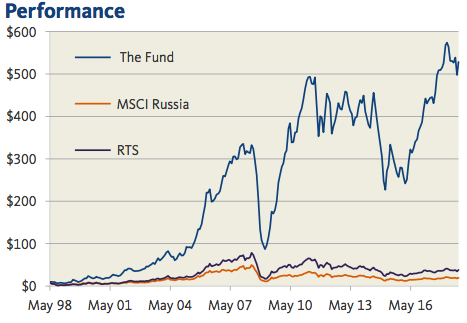
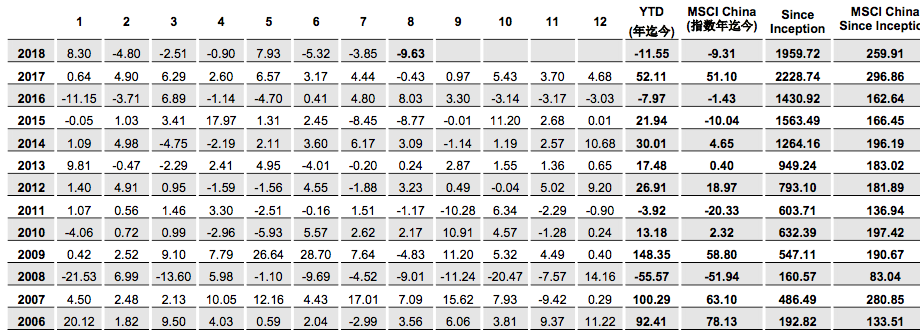
Fortunately, there are funds of funds that «slice and dice» these investment minimums required by institutional funds in exchange for a fee on top of the original fee. In other words, the small investor can invest in these funds of funds, which in turn invest in institutional funds with prohibitive minimums, with tickets as low as 125,000, which is the minimum regulatory amount to be considered a qualified or well-informed investor. Not in all, but in some cases the potential of the underlying funds is such that it is more than worth paying the double commission toll. Or is it not worth being able to invest from as little as 125,000 euros in such inaccessible funds as the heirs to the famous Medallion, Bridgewater or emerging funds with such spectacular alphas as the ones we see in the images published in this article?


Is it worth holding on to an upgradeable investment in exchange for further deferring accumulated capital gains?

The simple and straightforward answer is NO. And to argue this, we will explain the calculations made by the platform below. InbestMe and that they have published in fundssociety.com. At Cluster Family Office we often see the reluctance of most investors to sell their current portfolios of funds or shares, in order to continue deferring the withholdings that would be applied to the capital gains accumulated in them over the years. On the face of it, this seems like a good decision, but it is not unless the portfolio's returns are at least minimally improvable. And that is the first surprise for the majority of investors hypnotised by the mediocrity of the funds sold by the big international fund managers in Spain, that there is life beyond the open architecture sales catalogues.

.

It is true that in Spain there is the possibility of transferring assets from one fund to another while maintaining tax deferral, with the corresponding registration with the CNMV, a minimum volume of unit-holders and that they are considered by the regulator as transferable. The disadvantage is that, as we have already explained in other articles such as «....«Investment Funds: There are still classes«The universe of investment funds registered in Spain is very limited compared to those existing worldwide. As limited as 10%, which means that because of the desire to take advantage of this tax deferral to infinity and beyond, investors are locked into an investment universe that ignores the 90% of existing funds worldwide. (The Spanish banks refuse to underwrite funds beyond their sales catalogue, for which we have also explained the solution in «...").«The advantages of investing from Luxembourg«). Let us now look at the example figures calculated by InbestMe:

.

For example, with an average annual return of 3.4% (return over the last 25 years), the difference in return between deferring capital gains to the end or taxing them every year is only one 4.2% cumulative over 20 years, or, in other words, a 0.21% APR. That is, if an investor is able to improve the performance of his portfolio by at least 0.21% per annum, by replacing mediocre funds with funds that consistently outperform their respective benchmarks in a clear and sustained manner, You should not mind the fact that the new funds are not transferable and you will have to pay tax on the capital gains on an annual basis. Here it is worth remembering that the tax cost of unrealised capital gains is money that is not ours but that we have borrowed from the Treasury and that has to be paid back sooner or later. Therefore, using the money we owe the Treasury to make a profit loses all sense if we use it in a mediocre way, condemning the rest of the money that is ours to mediocrity.

.

In the example above, improving returns by 0.21% per annum by being able to invest in 100% of existing funds and not just 10%, is not only perfectly possible but practically a must. In fact, the sooner you trade your bland investments for more powerful ones, the sooner you will recoup the withholding taxes on the sales of your mediocre portfolio. More importantly, once the sold portfolio is taxed, in addition to having the freedom to invest at a higher yield in any fund in the world, you will also be able to defer taxation forever if you have a Luxembourgish vehicle 300,000, even if you change funds or investments in the future and they are not transferable., as we have explained on other occasions.

.

So why so much fear of taxing latent capital gains if they are easily recoverable and surmountable with a portfolio of good funds that consistently outperform their indices? This is where Spanish banks come into play, of course. Firstly, no bank is going to propose to its client that he liquidate the funds it has sold him and take the money to another (Luxembourgish) entity in order to have an investment vehicle in which the best funds on the planet can fit - and be deferred indefinitely. And secondly, to avoid temptation, they warn their clients vehemently of the tax «axe» that they would get if they liquidate their positions. In this way they keep the investor captive in the institution, with mediocre portfolios that are perpetuated over time, with an enormous opportunity cost.

.

Certainly, the investor who has the capacity to invest beyond the 10% of funds registered in Spain to be marketed by Spanish banks would do well to seek to increase the quality of his portfolio and not be intimidated by his banker and his tax simulations. After all, just a few tenths of a point more return from higher quality funds will more than compensate you for the compound interest of the tax deferral. In other words, you would do well to stop deferring in order to invest better and return to defer indefinitely with a much stronger portfolio. Not doing so is bread for today and hunger for tomorrow, i.e. being trapped sine die in the mediocrity of the funds sold to you by the bank on the corner, very happy, of course, to be reinvesting. mediocrely the taxes owed to the tax authorities.

Daniel Lacalle and the nationalisation of the economy perpetrated by Central Banks

Although we may not entirely agree with some of his convictions, there is no doubt that Daniel Lacalle is one of the people who knows the most about macroeconomics. Not only because of his PhD in Economics but especially because of his approach to the abuse of central banks that we have been suffering for more than a decade.

.

Here is the article that lacalle wrote about this abuse and the end of the party a year ago in the website of the Mises Institute. As you will see, we agree very much with Lacalle in the analysis we made two years ago in our article «...".«Negative interests and Darwin«. And you might also be interested in re-reading «What to expect when you are waiting for... QE blackout»

.

It is now 2018 and the Fed is raising rates decisively. And the ECB is finally facing its reality. We hope you enjoy Lacalle's hard-hitting and realistic article:

.

The FT published an article stating that “major central banks now hold a fifth of total government debt”.


The figures are shocking.


1) Without any recession or crisis, major central banks are buying more than $200 billion of public and private debt, led by the ECB and the Bank of Japan.

2) The Federal Reserve holds more than 14% of the total US public debt.

3) The balance sheets of the ECB and BoJ exceed their respective GDPs by 351Tbp3T and 701Tbp3T.

4) The Bank of Japan is currently one of the 10 largest investors in the 90% in the world, and the Bank of Japan is one of the 10 largest investors in the 90% in the world. Nikkei.

5) The ECB holds 9.2% of the European corporate bond market and more than 10% of the total sovereign debt of major European countries.

6 The Bank of England owns between 25% and 30% of the UK sovereign debt.


report Nick Smith, an analyst at CLSA, warns of what he calls “the nationalisation of the secondary market”.


The Bank of Japan, with its ultra-expansionary policy that only expands its balance sheet, is on its way to becoming the largest investor in the Nikkei 225 majors. In fact, the Japanese central bank already accounts for 60% of the ETF (Exchange Traded Fund) market in Japan.


What can go wrong? In general, central banking not only generates greater imbalances and a bad outcome in a “zombified” economy, as extremely lax policies perpetuate imbalances, but also weakens the velocity of money and encourages debt and malinvestment.


Believing that this policy is innocuous because “there is no inflation” and unemployment is low is dangerous. The government issues massive amounts of debt and cheap money promotes overcapacity and misallocation of capital. Thus, productivity growth collapses, real wages fall and the purchasing power of foreign exchange also falls, driving up the real cost of living and debt to grow more than real GDP. Thus, as we have shown in previous articles, total debt has risen to 325% of GDP while zombie companies reach crisis levels, according to the Bank for International Settlements.


Government securities monetised by the central bank are not high quality assets, they are a promissory note that is transferred to the next generations and will be paid off in three ways: with massive inflation, with a series of financial crises or with high unemployment. Destroying the purchasing power of the currency is not a growth policy, it is stealing from future generations. The “placebo” effect of spending the Net Present Value of those IOUs today means that, as GDP, productivity and real disposable income do not improve, at least not as much as the debt issued. We are creating a time bomb of economic imbalances that is only growing and will explode at some point in the future. The fact that the obvious ball of risk is delayed for another year does not mean that it does not exist.


The state is not issuing “productive money”, but only a promise of more revenue through higher taxes, higher prices or confiscation of wealth in the future. The growth of the money supply is a loan the state gets but we, the citizens, pay for it. Repayment comes with the destruction of purchasing power and confiscation of wealth through devaluation and inflation. The “wealth effect” of rising stocks and bonds is non-existent for the vast majority of citizens, as more than 90% of average household wealth is in deposits.


In fact, a massive monetisation of debt is only a way to perpetuate and strengthen the crowding out effect of the public sector on the private sector. It is a de facto nationalisation. Because the central bank does not “go bankrupt”, it only transfers its financial imbalances to private banks, companies and households.


The central bank can “print” as much money as it wants and the government benefits from it, but it is the rest who suffer from financial repression. By generating the ensuing financial crises through loose monetary policies and always being the main beneficiary of boom and bust, the public sector emerges from these crises more powerful and more indebted, while the private sector suffers the crowding out effect in times of crisis and the effect of taxation and wealth confiscation in times of expansion.


It is not surprising that public spending relative to GDP is now almost at 40% in the OECD and rising, the tax burden is at record highs and public debt is rising.


Monetisation is a perfect system for nationalising the economy by passing on all the risks of overspending and imbalances to taxpayers. And it always ends badly. Because two plus two does not equal twenty-two. By taxing the productive to perpetuate and subsidise the unproductive, the impact on purchasing power and wealth destruction is exponential.


To believe that this time it will be different and that the states will spend all this huge “very expensive free money” wisely is simply an illusion. The government has every incentive to overspend, since its goal is to maximise the budget and increase the bureaucracy as a means of power. It also has every incentive to blame its mistakes on an external enemy. Governments always blame someone else for their mistakes. Who cuts rates on 10% or 1%? Governments and central banks. Who gets blamed for taking “excessive risks” when things go wrong? You and I. Who increases the money supply, calls for “credit to flow” and imposes financial repression because “there is too much saving”? Governments and central banks. Who gets blamed when things go wrong? The banks for “reckless lending” and “deregulation”.


Of course, governments can print as much money as they want, what they cannot do is convince us that it has value, that the price and quantity of money they impose is real just because the government says so. Hence the lower real investment and lower productivity. Citizens and businesses are not mad not to fall into the trap of low rates and high asset inflation. They are not amnesiacs.


It is called financial repression for a reason and citizens always try to escape the theft.


What is the trick to make us believe it? Stocks go up, bonds go down and we are led to believe that asset inflation reflects economic strength.


Then, when central bank policy stops working (either because of lack of confidence or because it is simply part of the sell-off) and markets are given the valuations they deserve, many will say it was the fault of the “speculators”, not the central speculator.


When it erupts, you can bet your bottom dollar that the consensus will blame markets, investment funds, lack of regulation and insufficient intervention. The mistakes of perennial intervention are “solved” with more intervention. The government wins either way. As in a casino, the house always wins.


In the meantime, the famous structural reforms that had been promised are disappearing like bad memories.


It is a clever Machiavellian scheme to kill free markets and disproportionately benefit states through the most unfair of powers: having unlimited access to money and credit and none of the risks. And pass the bill on to everyone else.


If you think it doesn't work because the government doesn't do much else, you are simply dreaming.


.


Types from the North. Types from the South (Part 2)

For those of you who have not yet done so, we recommend that you read  the first part of this article, in which we described a future that is much closer than some believe. In that near future, interest rates in the north of the EU could no longer be anchored to interest rates in the south. This break between the price of money in the rich countries and the price of money in the poor countries will inevitably lead to a different exchange rate for the other currencies. And as the old man said, if it walks like a duck, flies like a duck, swims like a duck and quacks like a duck, it is a duck. In other words, if it has different rates, it will have different exchange rates, and therefore the single currency will cease to be single, which means that we will have at least two Euros, if the nomenclature is maintained.

.

For the most sceptical we bring you today the article prepared by Yves Longchamp's Director of Analysis Yves Longchamp from Ethenea Advisors. In this article Longchamp quantifies the interest rates that economies as disparate as Germany's or Italy's can bear. And it is not just that they can bear different rates but that they must be able to have them, thus adapting them to the needs of each of their economies. No reader should be unaware of the terrible consequences for economies when the price of money does not adjust to the cycle and the needs of the economic machine. And unfortunately, economic convergence ceased to be plausible for northern and southern Europeans years ago.

.

Thus, Ethenea says that while Germany could currently operate with a rate range of between EUR 1.5 and EUR 1.5 per cent, it would be possible for the EU to operate with a rate range of between EUR 1.5 and EUR 1.5 per cent. 4,8-6,1%, Italy would not be able to withstand rates - at least - higher than 0,6-1,5%. The difference between one economy and another is abysmal, and three quarters of the same could be said about the needs of rates between other countries in the North and the South. I recommend that you read the aforementioned study Longchamp because for more than one person it will be a slap in the face of reality that will, at the very least, give them pause for thought.

.

The inevitable consequences of such disparate interest rate requirements (and moreover increasing day by day) are the breakdown of the uniformity of the price of the Euro. Germany will not be able to withstand rising inflation for many more years, while in the south of the EU we are mired in debt for many decades, which requires a quasi-free price of money in order to be able to continue paying the interest. Remember that in the south we are still running budget deficits, i.e. we owe more and more money every day, despite having negative interest rates for years! The consequence of this is that in the south it is not materially possible to keep up with the rate hikes that the north of the EU will soon be demanding, following in the footsteps of the US Federal Reserve.

.

We have warned many times over the last 7 or 8 years. The single currency is doomed to cease to be unique. And investors would do well to prepare their money, their custodian banks, their investment vehicles and of course its investments for such a scenario of different rates and prices, even if the bureaucrats continue to dissemble and come up with a creative euphemism for the break-up of the Euro. Studies such as the one by Ethenea's Director of Analysis can say it louder, but not clearer. And since Cluster Family Office We will never tire of warning of the risk unwittingly taken by investors in the South who do not prepare for their investments to be priced and priced in the North and to be geographically and qualitatively safe. As Longchamp says in his article: «Ignoring a reality does not make it less real».»


Is it worth investing in a pension plan in exchange for the tax benefits?

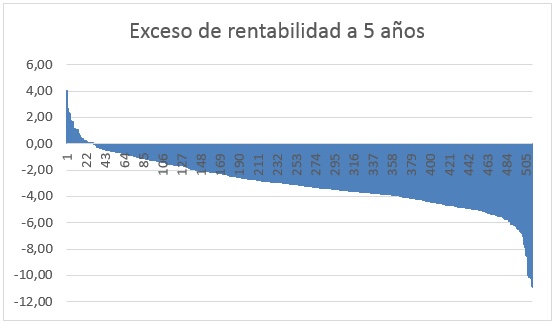
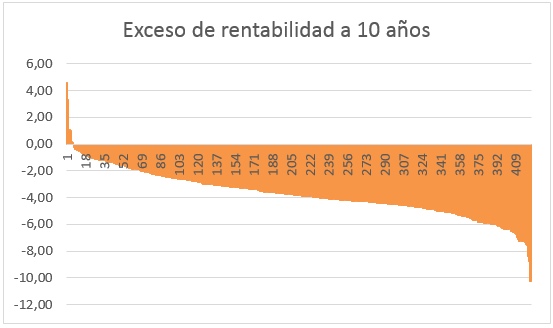
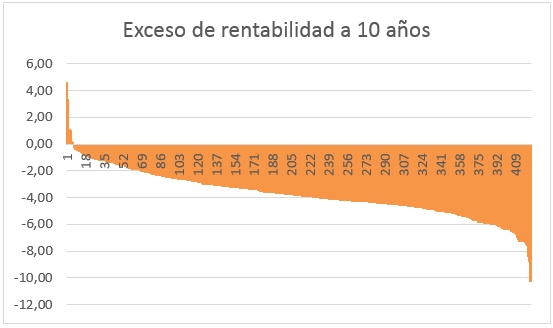
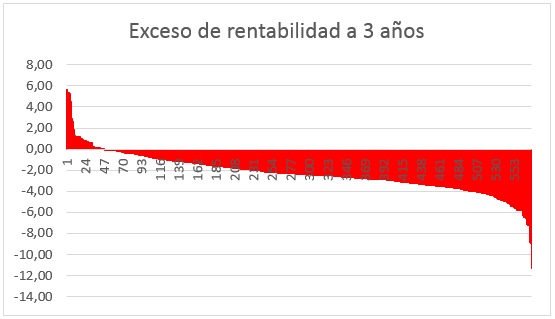
La respuesta es NO, a no ser que se tenga la rarísima virtud de escoger uno de los escasísimos planes de pensiones que superan a su índice de referencia a 10 años. Y aún así, 10 años son muy pocos si tenemos en cuenta que la vida inversora suele ser muy larga cuando hablamos de pensiones para la vejez. Pero la pregunta secundaria que debemos hacernos es: ¿Qué probabilidades realistas tenemos de invertir en un plan de pensiones que no nos condene a la mediocridad? Ahí es cuando la respuesta empieza a resultar más incómoda si queremos ser objetivos y sinceros. Y es que el porcentaje de fondos de inversión que no superan a sus respectivos índices de referencia es muy bajo, digamos que entre el 1% y el 12%, dependiendo de la fuente, el plazo y los sectores en los que nos fijemos. Pero si miramos la rentabilidad de los planes de pensiones respecto a sus índices, el porcentaje de los fondos que justifican su comisión es aún menor.

.

Veamos los gráficos del último informe que ha elaborado Morningstar de los planes de pensiones que superan en rentabilidad a sus respectivosa a tres, cinco y diez años. Demoledor:


Lógicamente, a mayor plazo más se minimiza el efecto Montecarlo del que ya hablamos hace una década. Fijaos que si nos centramos en el periodo de 10 años, lo cual no es ningún disparate ni mucho menos si estamos hablando de planes de pensiones que se supone que no vamos a utilizar hasta la edad de jubilación, el porcentaje de fondos que superan a su índice es inferior al 1%! Pero es que para la jubilación a muchos les faltan más de 20 o 30 años, con lo que el porcentaje de probabilidades de superar al índice a través de un plan de pensiones se acerca peligrosa e indignantemente a cero.

.

¿Cuál es la conclusión a la que debemos llegar con este bofetón de cifras? Pues que si en el universo de fondos invertibles desde España ya es difícil encontrar un fondo de inversión «normal» que supere a largo plazo a su índice, encontrar un plan de pensiones que lo consiga a más de 10 años vista es casi misión imposible para la mayoría de mortales. ¿Y cómo consiguen los bancos y demás vendedores de pescado colocar tantos miles de millones en planes de pensiones si éstos son tan mediocres? Pues para eso están las baterías de cocina de regalo, las smart tv, los porcentajes de dinero de regalo ingresados en cuenta y… las bonificaciones fiscales. Sí, esas mismas bonificaciones que muchos defienden como la panacea para ahorrar impuestos mientras preparamos nuestro retiro.

.

El problema de base es que quienes defienden que es fiscalmente más interesante invertir en un plan de pensiones que en un fondo de inversión al uso, a pesar del hachazo en renta cuando llega el momento de la verdad, no tienen en cuenta que el nivel de mediocridad en la gestión de los planes de pensiones es sustancialmente mayor que el de los fondos de inversión en general. Por tanto, el principal motivo para huír de los planes de pensiones NO es que pagaremos en renta el día de mañana los impuestos que ahorramos hoy en las exenciones de las aportaciones (podríamos discutir si compensa o no tal bonificación fiscal), sino que los equipos que gestionan planes de pensiones consiguen resultados aún peores que el promedio de fondos de inversión al uso que se comercializan en España.

.

Por todo ello, si un inversor es capaz de encontrar fondos cuyos gestores superen a su índice de referencia a largo plazo de manera consistente (haberlos haylos y os remitimos a este artículo que publicamos en COBAS hace unos meses), jamás debe sacrificar esa joya por un plan de pensiones cuya gestión sea peor, por muchos beneficios fiscales o regalos que le hagan sus comercializadores. Bonificaciones fiscales y regalos de dinero o en especies que, por muy tentadoras que sean, no dejan de ser un pan para hoy que nos condena a la mediocridad en rendimientos durante el resto de nuestra vida inversora. Otro tema es cómo conseguir poder invertir en fondos que superan consistentemente a sus índices y que pertenecen a ese universo del 90% de fondos que NO son invertibles desde España. Pero eso ya lo hemos explicado repetidamente en artículos como «The advantages of investing from Luxembourg«.

Shall we help you search?

Cluster Family Office

We care about transparency both in management and in our own way of working. Leading wealth management and family offices company

Do you need help in capital and wealth management?

How can I avoid the negative effects that my fortune may have on my children?

How and when should I talk to my children about family wealth, and what relationship should they have with money throughout their adolescence?

How can I measure the real risks of my investments and protect my assets adequately?

Do I have sufficient liquidity and stable income to cover my needs on a permanent basis?