
We look after your interests

(+34) 93 626 47 75

Torres Sarrià, Carrer de Can Ràbia, 3-5, 4ª Planta BCN 08017

(+34) 91 794 19 82

Pº de la Castellana, 93 2nd floor MADRID 28046

Category: Crisis

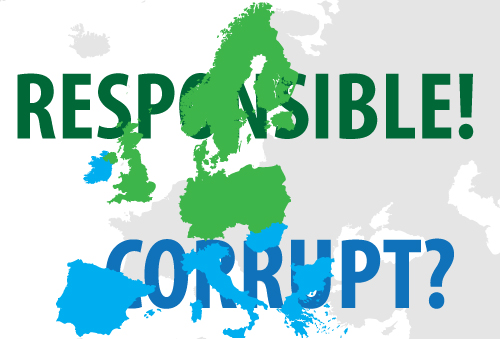
Eurozone tested positive for Covid-19

Those of you who read us regularly will know that we have been saying for years that the Eurozone, as we know it, is neither viable nor sustainable. We warned this almost a decade ago (how time flies!), when the banking crisis was straining the seams of the Eurozone to the limit, and the dreaded Men in Black (MIB) of the Troika were scrutinising the public accounts of the Mediterranean countries of the south. The much-vaunted and politically correct concept of «More Europe» repeatedly hit the wall of the rich and productive North, which preferred a simple and profitable market union to a political, monetary and fiscal union.

.

Thus, the MIBs more or less discreetly shielded the Memorandums of Understanding (MoU) to avoid the free bar that we demanded from the South. Only in exchange for this and the stubbornness of the Eurobureaucrats to kick the can down the road and postpone the moment of truth, the Eurozone went ahead with all its incompatibilities and manifest unsustainability. The hope - in which nobody believed any more - was that with the help of the ECB's QE, and a few years of pseudo-bonanza, the South would, macroeconomically speaking, catch up with the North for once and for all. But the circle has remained unsquared for all these years.

.

The final blow to the economies of the South has come in the form of the SARS-CoV2 coronavirus pandemic, also known as Covid-19 disease. In this mother of all health crises, which is as bloody as it is short-lived, economies as large as Italy or Spain would need a shower of billions in debt (Coronabonds, Eurobonds or whatever you want to call them), which the northern Europeans are not prepared to finance jointly. Paradoxically, this time Merkel is not the standard-bearer of the NO to the free bar but the Netherlands, although it is also true that it is easy for the Germans to play the good cop with the bad Dutch cops. For whatever reason, the South (including France) is trying to take advantage of the final stretch of Merkel's political career to make some desperate concessions in spite of fierce Dutch opposition. The fact is that whatever comes after Merkel is likely to be much less inclined to make concessions to the South, remember the populism that Wolfgang Schaeuble achieved with his proposal to expel Greece from the System. A proposal that, on the other hand, made all the economic sense in the world.

.

Today, what the Netherlands and its circle of influence openly propose is a Europe as a simple common market (sound familiar?). And this idea of the EU coincides with the UK's idea of the EU, which has always been so vilified by Euro-bureaucrats. So this drift towards a «Less Europe» with which the North would feel comfortable could be the way forward, despite the opposition of the countries of the South, since we know that he who pays the piper calls the tune. But there is one small detail that complicates this idea of Europe: the Euro. A Common Market loses much of its meaning and simplicity if the monetary policy of all its members must necessarily be the same. In other words, having the same currency exchange rate, the same price of money (interest rates) and a single issuing bank (ECB), puts us back at the same starting point where we are right now. In other words, the South urgently needs trillions to survive, as well as a depreciation of the currency to regain competitiveness and hopes for growth, but the North is not willing to grant it at the expense of its economies. And this constant refusal is generating the rejection also of the European project by the countries of the South, since they know that the - insufficient - financial aid granted by the North will bring with it the relentless return of the dreaded IMFs, which entail the absolute loss of budgetary, fiscal and economic sovereignty in the countries of the South. The EU seems to be finally facing the final wall of the cul-de-sac along which it has been kicking the can down the road since 2011.

.
The glimmer of lucidity in the face of this permanent flight forward that the coronavirus has precipitated seems to be coming from France. Emmanuel Macron told none other than the Financial Times this week that the pandemic has brought the EU to a «moment of truth».». It is no coincidence that  Shahin Vallée, former advisor to the President of the European Council and strongman of the French Ministry of Finance, proposes to create what he calls «the coalition of the will» within the EU. In other words the EU to split into groups according to their intention to evolve towards «More» or «Less» Europe. Thus, countries that want more integration could keep their single currency and monetary policy, giving up sovereignty in exchange for a growing and irreversible fiscal and political union. But what is more curious is that those countries that want less integration, once freed from those who want «More» Europe, could also remain integrated. That is to say that the two incompatible parts would accommodate each other once they are freed from each other, resulting in a Europe not only with two speeds but with two different currency rates, two central banks and two different monetary policies. It would not be a Europe in perfect equilibrium, but it would be much more stable than the unsustainable powder keg in which Covid-19 leaves us.

.

All this could well be covered up under the same Europeanist sheep's clothing, of course. That is to say, using euphemisms that might even keep the less informed in European inopia (continue to call both currencies the Euro, continue to call both issuing banks the ECB, etc.). But there would be undeniable differences, such as, for example, the value of the euro in the southern countries, which could be 20 or 30% lower than the euro in the north. Of course, they would initially be quoted at par, intervened by the ECB, to avoid as far as possible the implementation of corralitos in order to prevent the flight of assets from the south, but they would necessarily drift apart over time. Post-covid19 rates would not diverge in the short or medium term, as everyone needs zero or negative rates at the moment. But in the medium term, Northern Europe could finally follow in the footsteps of the Fed. gradually increased the price of its strong Euro. Maybe we could even see a political and fiscal union beyond the mere common market in one of these - at least - two distinct zones, who knows, since the circle is much easier to square with truly converging economies and a club with fewer members and more common interests.

.
So, how should southern wealthy individuals position themselves in the face of such a post-pandemic scenario? Well, obviously they should avoid accumulating assets in the South or in the South, i.e. avoid having real estate anchored in the less wealthy EU countries (Spain, Italy, Greece, Portugal and even France). Instead, they could hold them in countries that are likely to be able to sell in Euros that are not affected by the depreciation against the Euro in the North. Or hold them directly outside the EU, for example real estate in the USA, buying them still with the only existing Euro and not with the future devalued Euro of the South. As for financial assets, obviously shares of companies from these southern countries should also be avoided in portfolios, and of course their public and private debt. Moreover, as we have said countless times before, and today more emphatically than ever, the more safety steps we can add between our money and the need to collect or confiscatory In the southern states, we will sleep better at night. We must be aware that in times of extreme situations, extreme solutions will be taken, which we would never have foreseen just 6 months ago.

.

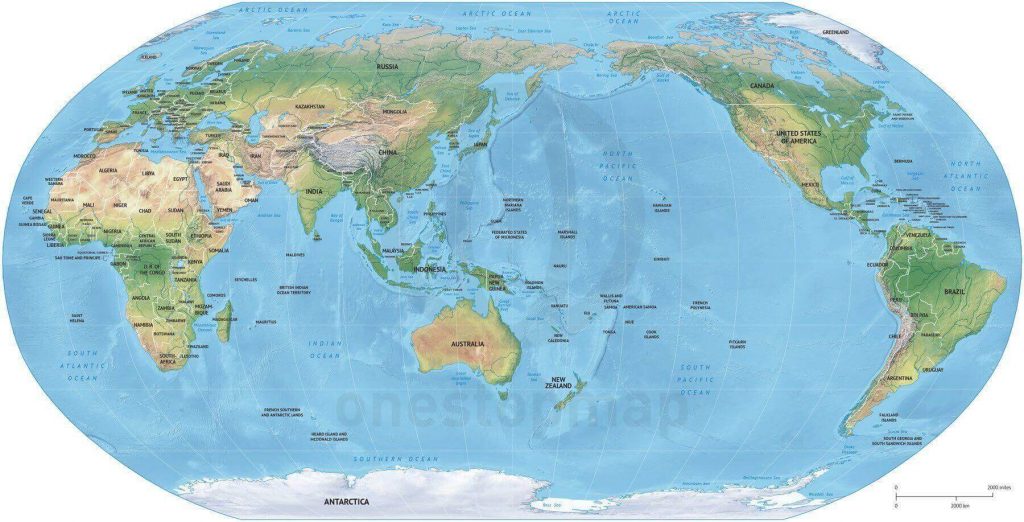
What is undeniable is that even if this EU evolution takes more or less time to arrive and Euro-bureaucrats keep banging their heads against reality, this pandemic is going to leave the West's economic and political supremacy mortally wounded. Covid-19 will have a clear winner, if anyone is going to win in this pandemic, and that winner is none other than China. Not only because it has coped and preserved its economy in an exemplary manner during the epidemic, but also because the rest of the world will inevitably set back several years of economic growth. And that will radically accelerate the leadership of China and its very powerful economic orbit (Vietnam, Korea, Malaysia, Australia, Japan, Indonesia, etc., even India itself), making Asia the new centre of the world. It is true that many will say that the figures of contagions and deaths from the coronavirus in China are unreliable. But let's not kid ourselves, because the figures for many Western countries are not reliable either, and very few question them.

.

In these weeks and months of the pandemic, we have seen how each country has handled the health crisis in very different ways. The results are as diverse as the idiosyncrasies of the respective governments and citizens. And in the European Union, especially in the South, we find countries (read Spain and Italy) that are managing the health crisis in a more than dubious way. Once again we are seeing the differences between North and South within the EU, also in health policy management. The only thing that will probably remain of this European union after the pandemic will be the relative resilience of the northern economies, and the common market that has always been advocated by the most realistic.

.

Golden times for the awakened investor. We warned mid-March and also last day 1st April (by the way, the markets have risen close to 30% since the lows of that time). This crisis will change a lot of things in Europe, and at the same time it is uncovering huge opportunities. Imagine if we can take advantage of the restructuring of the Eurozone and the Euro, if we can invest in healthcare companies around the world and especially in China, or if we can take advantage of the pull of the stock markets and economies of what will be the new centre of the world. And all this with the wind at the back of every central bank on the planet. Unfortunately times are bad for the local investor with local assets.
 

How much will those who invest today earn?

For those of you for whom the trees of panic and volatility prevent you from seeing the forest of opportunities and returns that lie in the palm of your hands, let us explain Nick Maggiulli's simple, mathematical analysis of Ritholtz Wealth, which we fully endorse.

.

The crux of the matter is to shed light on asset purchases during times of panic. But first let us put the current crash in context.

.

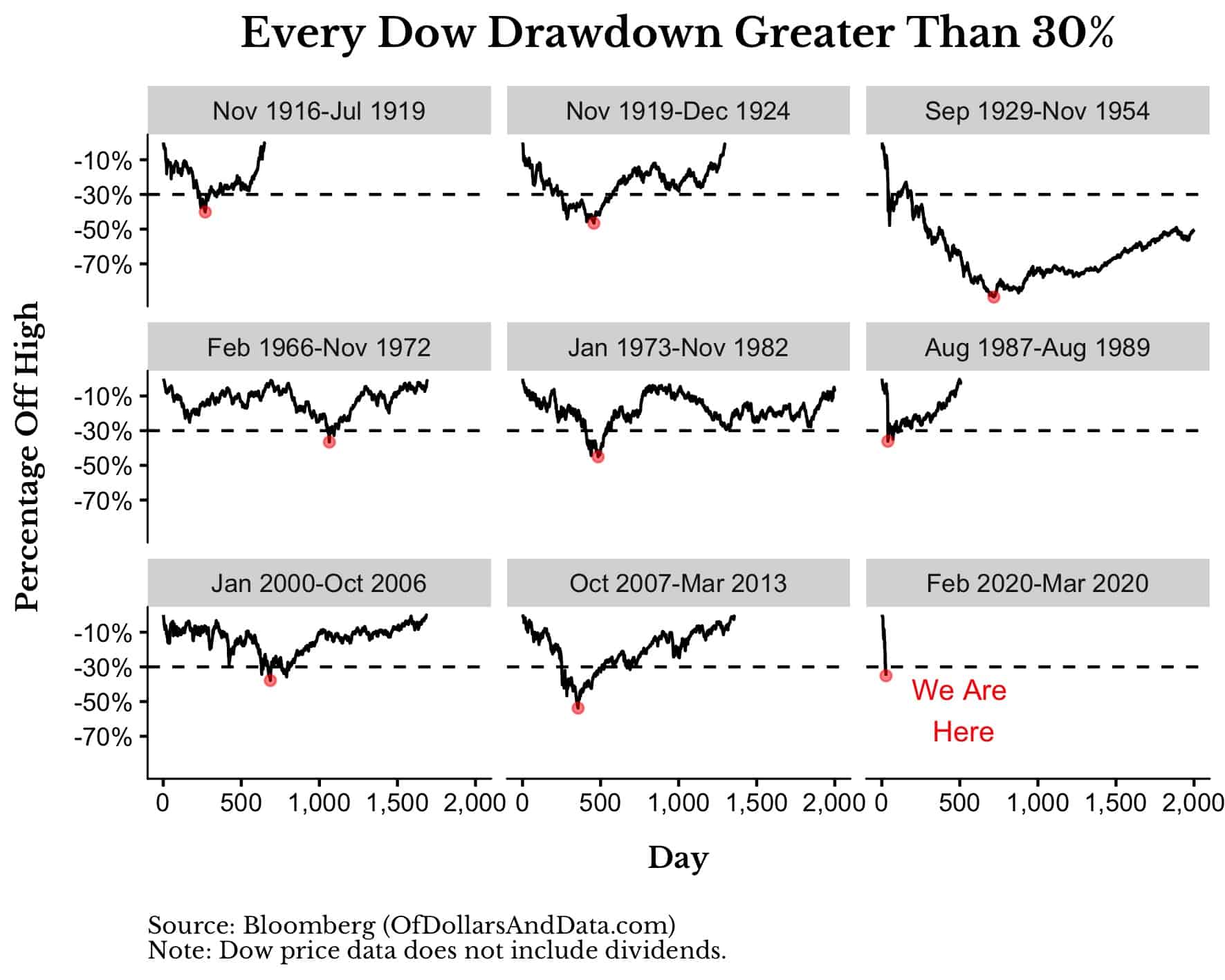
As of today, the low for the Dow Jones has occurred on 23 March 2020 and has been 35% from its highs, making it one of the worst months in the history of the US stock market.

.

If we analyse all the crashes above 30% since 1915, we see that this crash is one of the fastest and fastest we have ever had.

Moreover, while in the past we see the little red dot that signals the floor, at this moment we still do not know if we have already seen the low of last week or if it is still to come in this coronavirus crash.

.

Nevertheless, there is no doubt that these are golden times for investors buying equities now. Every euro or dollar we invest in today's markets will grow much more than those invested in previous months as soon as the markets recover. Because we all assume that sooner or later the markets will recover and humanity as a whole will eventually beat this virus as it has beaten other health crises before, right?

.

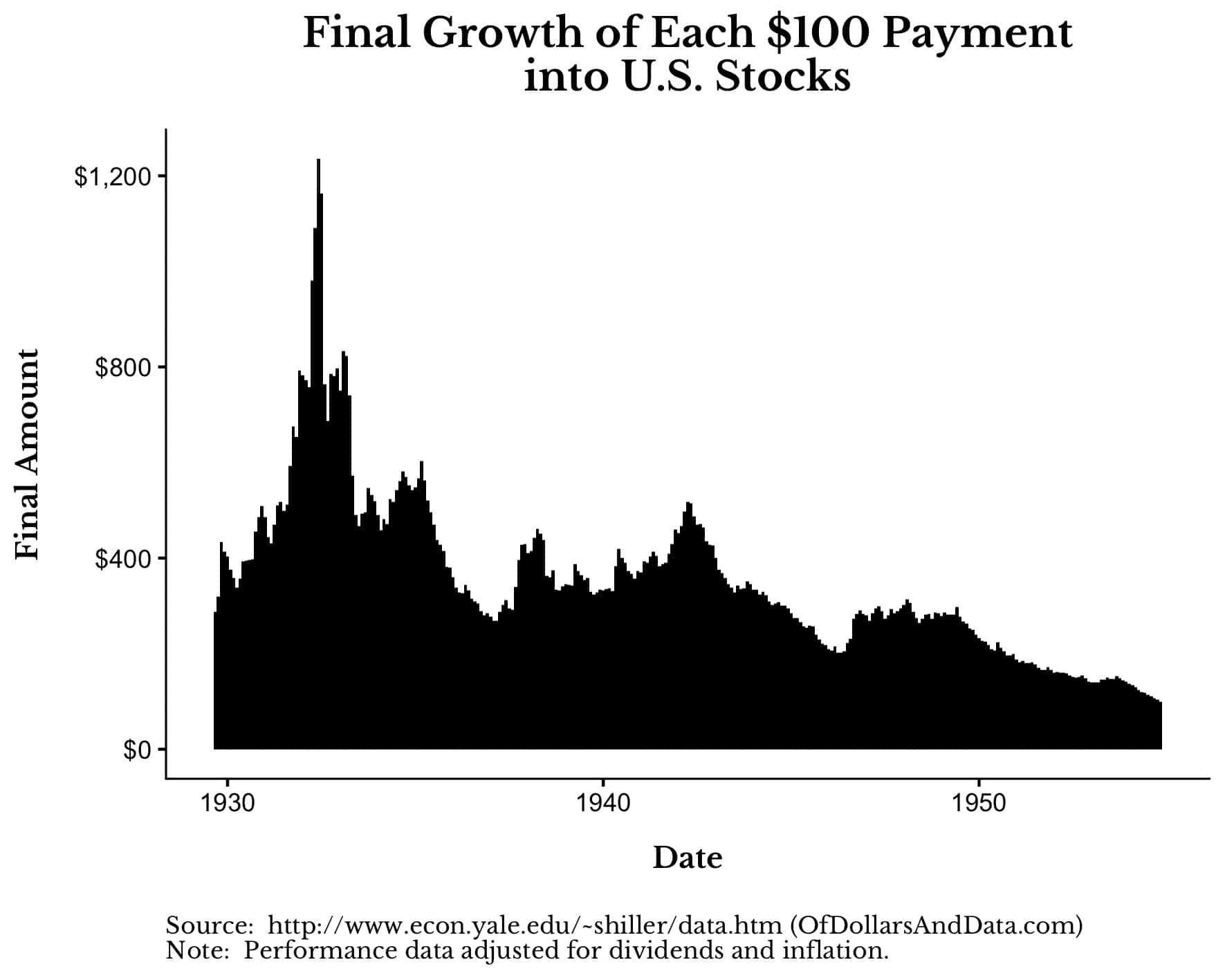
To demonstrate that every dollar invested today will yield much more than those invested before the crash, let us imagine that we decide to invest $100 every month in the US stock market from September 1929 to November 1954 (crash of 1929 and its subsequent long recovery).


.

If we had followed this strategy, this is what each $100 packet would have earned (including dividends and adjusted for inflation) until the recovery was completed in November 1954:

As you can see, the closer we bought to the low in the summer of 1932, the greater the long term benefit of that purchase. Each $100 invested at those lows grew $1200, which is three times as much as the $100 packs bought in 1930 ($400).

.

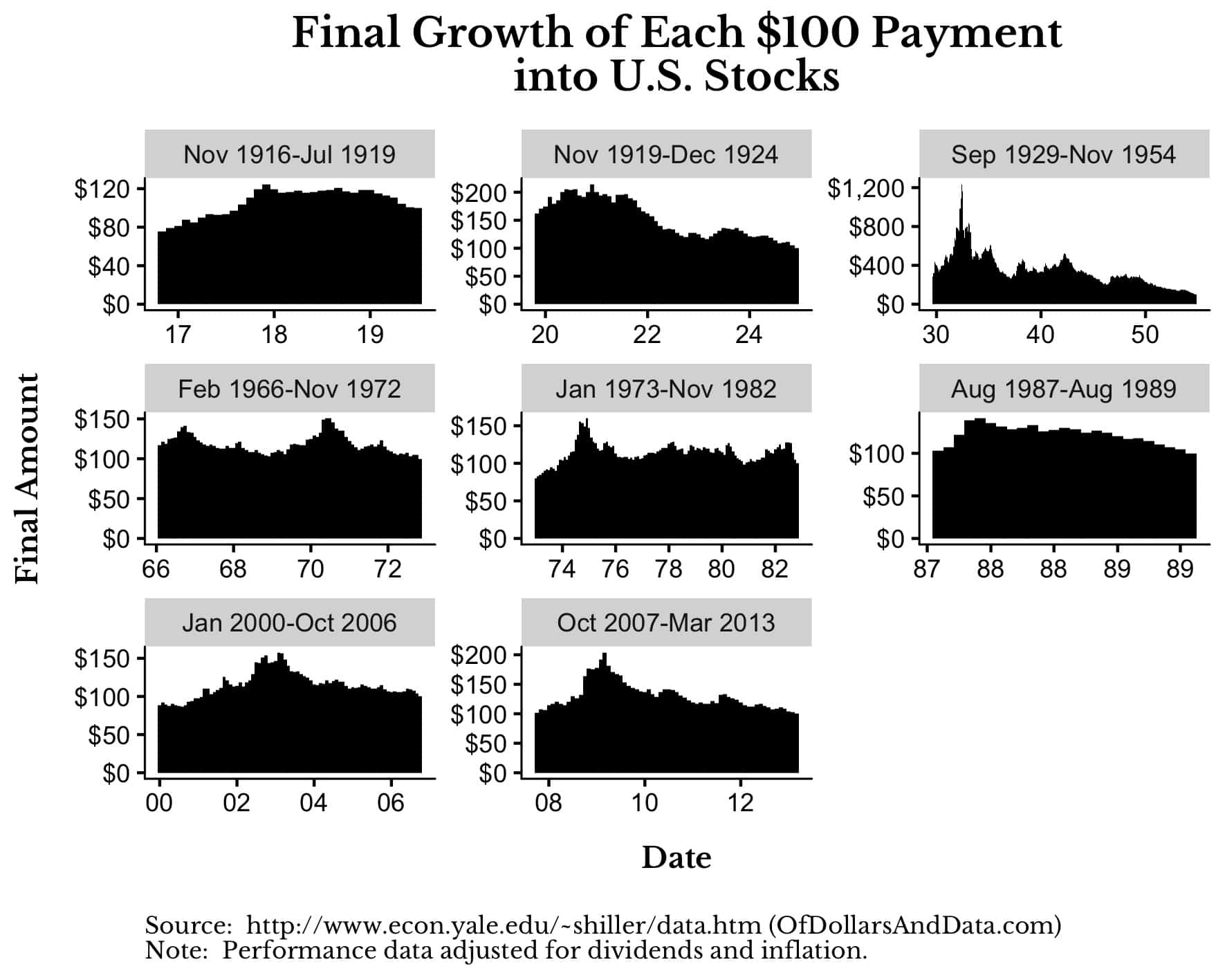
However, even if we look at the other falls above 30% shown in the first chart, we still see much higher profits if we buy during times of major panic and market declines:


This chart shows that buying near crashes (even if we don't hit their lows exactly) provides between 50 and 100% more profit compared to an investment at other times. That means that your $100 will grow $150 or $200 more (adjusted for inflation) when the market has recovered again.

.

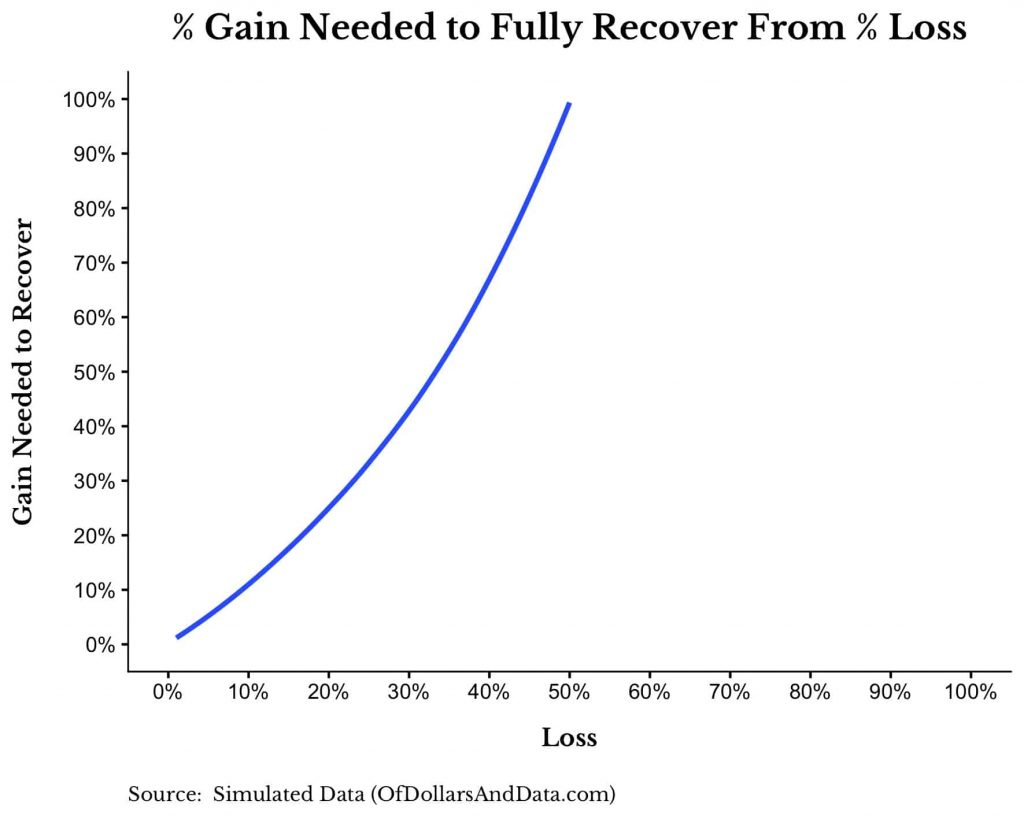
But where does such a spectacular increase come from? Well, besides being intuitive, its origin lies in simple mathematics: Every percentage loss requires a higher percentage gain to compensate for it. At this point in the film, it should not escape anyone's attention that a 10% fall requires an 11,11% rise to recover that loss. In the same way that a 20% loss requires a 25% rise and a 50% fall requires a 100% rise. You can see this exponential relationship very clearly in the graph below:


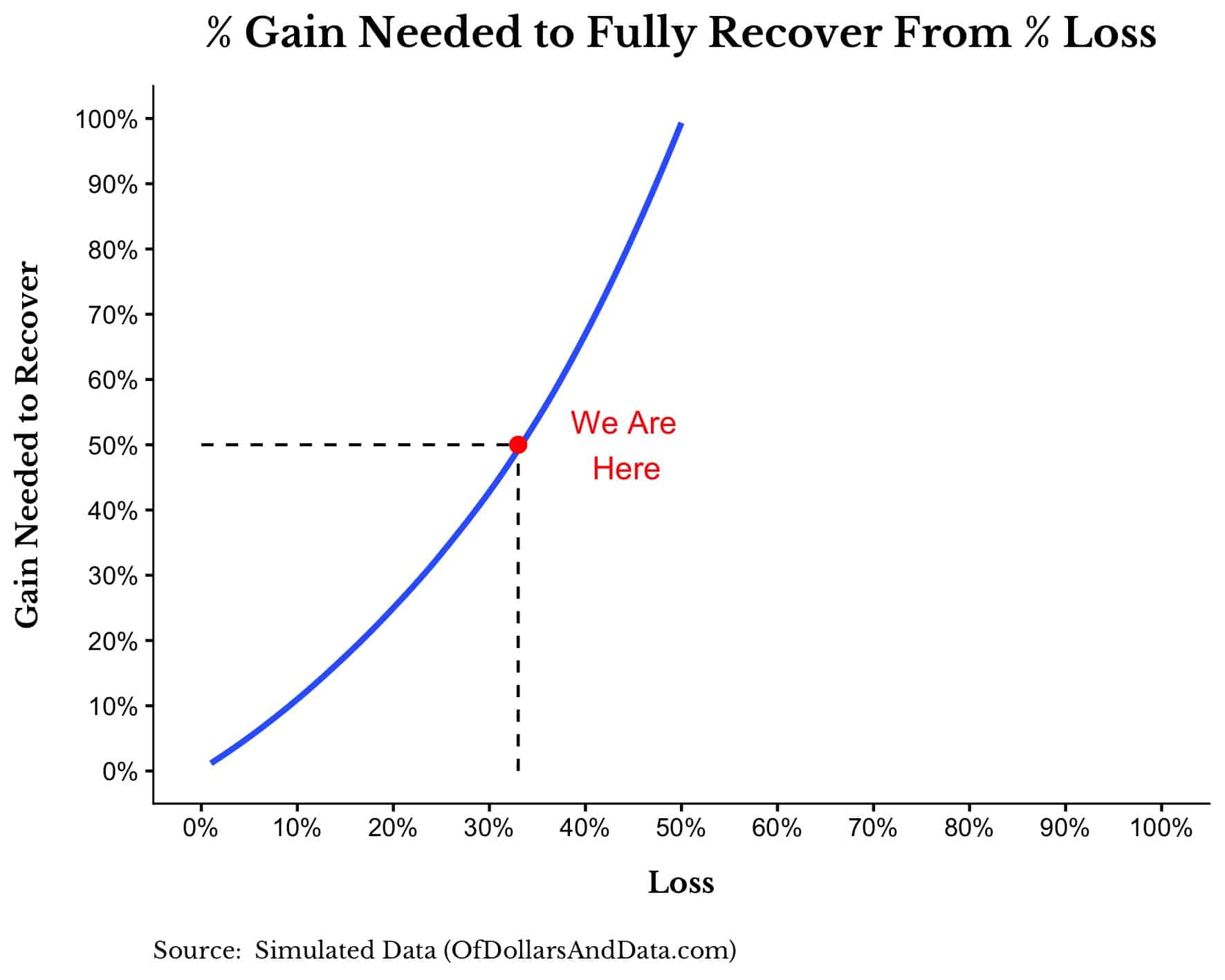
Let us now see what the chart would look like adapting it to the fall in the markets up to last week (-33%) and see the profit that would be needed to recover it:


If we do not see new lows, the recovery needed is 50%. And what a coincidence, for every $100 invested now they will generate $150 (a further 50%) when the recovery materialises.

.

But despite the obvious benefit of buying during the current panic, most investors are not doing so at all. Including those who have a lot of cash, either because they had it in other assets or because they sold during the crash in panic. And thank goodness they don't, because if they did, the crashes would no longer be crashes, and therefore the opportunities for good investors would vanish before they materialised. Excuses for not doing so can be diverse and very convincing for less good investors. Among them are «this time it's different» or «we don't know if it will fall further». As if a good investor is only one who is lucky enough to buy just on the day when the markets quote what will be the historic low of that crash. Remember that in graph 2 we talk about buying "as close as possible" to the low, without aiming to buy right on the bull's eye.

.

Let us now honestly answer the following question: How long do you think it will take for the markets to recover to the pre-pandemic highs? A month, a year, a decade? How long will it take for the indices to recover from that 33% decline? Answer yourselves.

.

Based on that answer, let us return again to the expected annual return in the future for our current investment. The equation is as follows:

Expected annual return = (1 + % Gain needed to recover)^(1/Number of years to recovery) - 1

But since we know that the percentage gain needed to recover is 50%, we can simplify it as follows:

Expected annual return = (1.5)^(1/Number of years to recovery) - 1

Therefore, if you think that the market will take time to recover:

  • 1 year, then your expected annual return = 50%
  • 2 years, then your expected annual return = 22%
  • 3 years, then your expected annual return = 14%
  • 4 years, then your expected annual return = 11%
  • 5 years, then your expected annual return = 8%

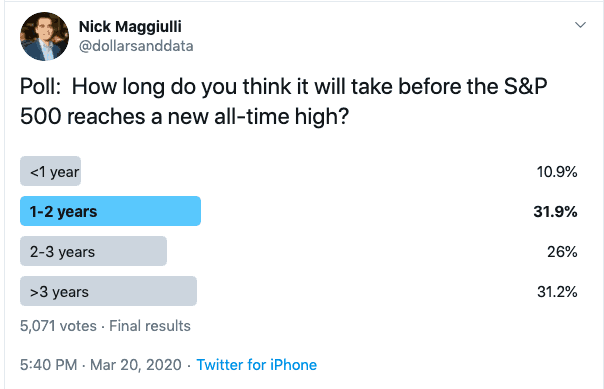
Even taking 5 years for a full recovery, the market would be offering you the same return as the US stock market has historically yielded. Nick Maggiulli asked this same question on twitter and found that two out of three of his poll participants believe that the recovery will come within 3 years.


That means that if the majority of respondents are correct, any investment made now, is going to yield between 14% and 50% annualised until the market recovers. Think about what this means. Investors who choose not to buy at this time are either giving up an annualised return in excess of 14% for the next 3 years, or they believe that the market will take more than 5 years to recover and despise annualised returns of less than 8%. In short, the only reasonable reason not to do so is if you already have all your money invested and have no more at the moment (time to sell grandma to invest more in the stock market, as he said...).

.

Of course, new black swans may occur on the planet, delaying the recovery of markets, as has been the case for decades in Japan, for example. But it seems unlikely, especially in efficient economies such as the US and growing economies such as China and the other Asian economic orbit. Moreover, note that throughout the article we are referring to the market, i.e. the indices. But imagine the figures that will be achieved by those who also have the possibility of investing in actively managed funds that significantly outperform the benchmark indices. In other words, those who invest in portfolios where the management team selects the companies with the greatest potential for recovery at this time (Healthcare sector in China, for example). And we will not tire of repeating that, although the vast majority of actively managed funds do not outperform their benchmarks, especially within the limited universe of funds marketed in Spain, there are world-renowned managers who have been doing so for decades. Unfortunately, however, they are not easily accessible to the average Spanish investor, as we explain in detail in «Why don't large international investors invest in the same funds as you?«.

.

As he once said Jim O'Shaughnesy, Many people confuse possibility with probability, and the two are almost opposites. Keep this in mind as you face new challenges that will come in these days.

.

One of the things that still surprises me is to see how simple mathematics can help us to clarify the thickets in which our own minds entangle us. Our fears and passions are our worst ally in the face of the crash caused by the covid19 virus. Objective figures are certainly a glimmer of sanity to handle Mr. Market's schizophrenia. And the numbers show us that, assuming the market (and even more so our well selected stocks by the world's best managers) will recover in the coming quarters or semesters, the returns we will get are very, very attractive. And therefore, any hypothetical new low in the stock markets would be nothing more than an additional buying opportunity and even higher profits. Fortunately for a minority, the majority do not see it this way and are still waiting to see the floor, like those who are permanently waiting to catch the next train, which will probably be an AVE train that does not stop at their particular station.

Investing in the midst of a pandemic

After the much read and commented in networks «The lies of the Spanish government and health authorities about the coronavirus«In the third instalment of articles dedicated to the global crisis caused by the SARS-Cov-2 coronavirus and Covid-19 disease. In our first article entitled «Realistic coronavirus figures and the opportunities of an unfortunate crisis»We were already anticipating this: The effects on the entire world economy are devastating in the short term. But only in the short term since the infection has a clear expiry date, Unlike other geopolitical, military or social conflicts, which also generate panic in the markets. Y It is this temporality that should awaken the good investor in us and change our fear for the famous greed that Buffett and other investment greats recommend when the rest of us panic.

.

In this pandemic, which is now beginning to sweep the West, the investment opportunity is one of those that are often called once in a life time, This is one of those rare occasions in the course of a lifetime of investing. This is because, although there is always room for doubt due to imponderables that can complicate scenarios, business activity will probably recover to pre-pandemic levels in the medium term at best. Obviously these imponderables include, for example, a mutation that makes the virus more resistant and/or deadly, war conflicts that add more instability to the world order, or other health crises that could arise and coincide in time with the current pandemic. But if none of these things happen, the recovery in the tone of the economy will be no more than a few months. a couple of quarters, And what should a few quarters mean on the horizon for a good investor? Nothing.


.

Therefore, it's time to go shopping (or hunting, as Buffett would say) and take advantage of the fact that the results of countless good companies around the world are going to be temporarily and exceptionally bad. Because the fall in profits and turnover will not be due to poor business performance but to a lull in global economic activity that is as exceptional as it is temporary. If we talk about airlines, we will find some at half the price of last year. If we look at the energy transport sector, the falls and fluctuations have been insane. And what can we say about the China's health sector, The winning horses, for example, have an exceptional horizon ahead of them because they will be the almost exclusive providers of pandemic and post-pandemic material on a planetary level.

.

But how to find these pearls with such a promising future? Decades ago we learned that it is much more efficient to select the best international fund managers than trying to analyse the best companies on the planet. The knowledge that good local management teams will have of the best companies in their respective countries (Vietnam, India, Brazil, China, etc.) will always be infinitely superior to ours or to that of any multinational management company that tries to make its selection through a manager located in London or New York, even if its forefathers were originally from those countries. We would therefore be well advised to invest our money now in those investment funds who have local and comprehensive knowledge of China (or the specific health sector as mentioned above) or any other country.

.

And those good local managers will not only choose good businesses, but also cheap ones, with bright prospects for recovery. Because if we think that a company may be losing a whole quarter of its turnover due to the pandemic, for example, and we buy it now at a panic price, its growth prospects in terms of turnover over the next 4 or 6 quarters will be spectacular. In other words, we will be investing with Value criteria but with a Growth potential that is as exceptional as it is profitable. If we add to this the fact that we will be selecting companies whose business is based on taking advantage of growing economies and demographics such as those in Asia, the tailwind will further boost our future profits.

.

As the image on the left hand side of the Cobas March Newsletter, It is now, when our neighbours in the 3rd 5th are beginning to realise that perhaps the coronavirus is not just a simple flu, that we should invest without fear and give free rein to our good investor's greed. Now, when our less informed friends and acquaintances are alarmed by the market crashes that are all over the TV news. Just like the lift man who recommended shares to Groucho Marx. in this essential book, or Rockefeller's shoeshine boy invested in the stock market. In other words, when the less informed panic about the coronavirus epidemic and the markets go into a tailspin, it is the most appropriate time to invest in the quality assets that have been exaggeratedly depreciated in recent days. It is perfectly possible, as we have already said, that things will get even more complicated, and that the investments we make today will temporarily lose an additional 20% or 30%. But if they do, and our investments are of quality and made with the good judgement of the best fund managers on the planet, it will be for a very short time. On the other hand, if we remain fearful out of the market, it is likely that we will not see that additional 20-30% fall but a sharp recovery and miss out on much of the upside, having blown this one. «once in a life time».» opportunity.

.

We know that many will read this article but will not follow the recommendation, as it is easy to understand that you have to buy when everyone else is selling, but it is difficult to dare to put it into practice. And thanks to the majority who won't dare and those who don't even agree with our arguments, a few of us will be able to make substantial profits in the coming years.


The lies of the Spanish government and health authorities about the coronavirus

It is regrettable to see the differences in the handling of the emergency situation in the coronavirus pandemic between different countries around the world. But what is worrying is the attitude of the Spanish political and health authorities in the face of this crisis, as they strive time and again to distort the facts and data in order to minimise its stark reality. A mixture of cowardice and misunderstood paternalism that justifies, in the eyes of some, the absence of courageous decisions. The Spanish authorities' determination to deceive the public stands in sad contrast to the realistic and serious warnings of other governments and global health organisations.

.

The Minister Spokesperson of the Government, Maria Jesús Montero, has declared in different media, and without any blushes, that Covid-19 is nothing more than a «...a new and unacceptable project".«new flu, similar to normal flu and with an even lower mortality rate than normal flu».» (for example in minute 10 of the following interview with him on RAC1 last week).

.

.

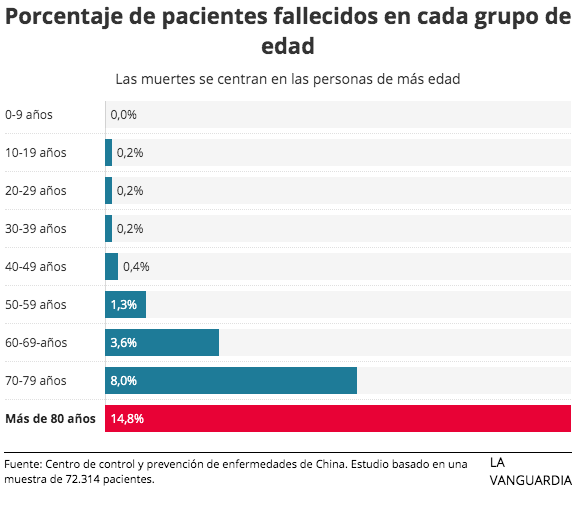
The unfortunate reality is that the lethality of this virus is much higher than that of seasonal flu. And any well-informed scientist, whose rigour is not contaminated by the government's political slogans, will admit statistical figures of around 3 or 4 deaths per 100 infected. Some Spanish authorities use mortality figures for normal 2% flu, but for hospital admissions and not for those infected, thus inflating the mortality rate and making it incomparable with that of Covid-19. On the other hand, also maliciously, they proclaim that the mortality of the coronavirus is 0.7%, taking the death figures for those infected just at the beginning of the epidemic in Europe, which means that the sick who are going to die have not yet done so. To further embarrass the minister, here is the official comparison between the mortality rate of the common flu and the US CDC's Covid-19:


.The most statistically reliable figures are found in China, where there are more and older cases of coronavirus. And those figures are now in the 3,75% mortality3012 deaths out of 80409 infected. Unfortunately, a fraction of those infected today will also die, while the number of new infections is already declining, so that this percentage is also tending to increase by about 0.04% per day, as it has done in the last few days. In other words, if the official figures in China are to be believed, mortality is indeed frighteningly close to 4%. And if we don't believe the official figures (I personally do) and think that the Chinese government is making up the mortality, then that's the end of the story. You can follow the daily evolution of the official figures in China at this page from Wikipedia, and the official figures for the rest of the world at this one.

.

However, some news which many people dismiss as being tremendist, infodemic or fake news, are in line with what is published in the majority of the world's media. international media with up-to-the-minute timelines of any new developments regarding the coronavirus,and spare no means or adjectives to keep the people of their respective countries on alert and on the lookout for health emergency. Because this state of alert and emergency does indeed punish the economy in the short term, but it saves lives. Thus, countries such as the US, where the spread of the virus is currently still proportionally lower than in Spain, are giving unequivocal instructions to their citizens to be prepared for imminent confinement o emergency situation This is because, mortality rate aside, what is clear is that this coronavirus is highly contagious, and its spread across the planet is unstoppable. Mortality rates aside, what is very clear is that this coronavirus is highly contagious, and its spread across the planet is unstoppable. That is why responsible governments are alerting and preparing their citizens for a massive infection. According to the calculations of Harvard Professor of Epidemiology Marc Lipsitch, Between 20 and 60% of the world's population will be infected by the coronavirus if we do not take drastic measures as China has done and/or an effective and viable drug does not emerge for everyone. And pending such a drug, our only option is to slow the pandemic. That means, even with optimistic mortality rates, millions and millions of deaths across the globe, at a brutal cost at all levels. What a contrast to the statements happy flowers of our ministers and health spokespersons who keep talking about «new flu that kills less than normal flu», right?

.

.

It is undeniable that a realistic warning about what is coming makes the population radically modify its usual activity, and with it consumption, productivity and therefore the economy plummets, as has happened in China. But courageous (albeit belated) measures, such as those taken and implemented with martial rigour by Xi Jinping, will save his country's economy in the medium and long term. Because an uncontrolled epidemic, with the mortality rate that this coronavirus entails, would have a far greater impact on the economy in the medium term than the short-term slump. Economically we could see a V-shaped economic downturn and recovery, but without bold measures by the already growth-anemic developed economies, we in the West will not even see a U-shaped recovery.

.

In Italy, the epidemic is just a few weeks ahead of us, and yesterday the decision was taken,The government's decision to close all schools and universities in the country, albeit belatedly, was a belated one. In Spain, on the other hand, despite recognise at least 3 infections in children school-age children, the closure of schools is not (yet) being considered. Not only that, but in one case it was the mother who insisted time and time again that her daughter be tested for the coronavirus, while the health authorities kept telling her to find a family member (as both parents had to stay at home because they were infected) to take her to school normally! What a botched job we are doing on such a serious issue in which we all have so much at stake! Because the fact that the vast majority of children and young people overcome the infection with mild or even asymptomatic symptoms does not in any way prevent these children and young people from infecting their parents, grandparents and teachers. These are all groups that will suffer serious consequences and whose mortality is very high, as we have seen above. Moreover, it is absurd to try to contain the epidemic by keeping infected parents at home and letting their children, who are also infected but many of them do not know it, move freely in the streets, buses and other environments with which they usually interact.

.

Another example: In Spain, the authorities have gone out of their way to emphasise that the existing infections were not from the EU (locally infected) but imported, from Italy, China, etc. They insistently stressed that this was a very important detail, trying to convince the population that Spain was in a perfectly controlled situation since our infections were all imported, ignoring the fact that it is only a matter of time before there are, as there have been, community infections in Spain. However, when faced with infections whose origin is not imported, the Spanish authorities still describe them as of «unknown origin», without yet recognising that they are already Community infections, i.e. local.
.

On the other hand, in the United Kingdom, despite having fewer people infected than in Spain today, there are already clearly warn The population should be made aware that community infections are an imminent reality and that the population needs to be aware of this in order to be better prepared.

.

Even in the American universities clearly warns that if students take advantage of spring break (similar to Easter holidays in Spain) to leave the country or visit areas with a high incidence of the virus, they will have problems to be readmitted back, unless they stay in the country for the rest of the year. two-week quarantine in a suitable location before returning to their rooms on campus. Just like here...

.

The situation is very serious, because unless a medication emerges within a few days that drastically reduces mortality and is feasible for mass administration, what is happening in Italy will only be the tip of the iceberg in the rest of Europe. And neither the health services (already overstretched in Italy) nor the logistics of essential supplies will be able to cope with a massive contagion. That is why it is vital to take courageous measures of blockade and isolation as China has done, even if it means a short-term economic collapse. However, the first decision the EU took was to take the option of closing intra-European borders off the table, thus paving the way for the free movement of Europeans and Covid-19 from Lisbon to Berlin. Yes, those same intra-European borders they did not hesitate to close instead, unilaterally suspending the agreement on Schengen, The refugees were arriving by the millions in the heart of Germany.

.

The paradox that China will now face is that it will have to continue to close its borders (to people, not goods) to prevent, once its domestic epidemic has been controlled, the virus from infecting them again, now coming from countries like the Europeans where the infection will be out of control due to late and cowardly political decisions. This is why we will see the recovery of the courageous Asian giant sooner than that of the old and cowardly Europe, which represents an extraordinary investment opportunity, as we already advanced in «Realistic coronavirus figures and the opportunities of an unfortunate crisis«. China begins its path back to business. And it does so having acquired a priceless technological know-how to handle the next health crises, as we can read in this WeekInChina article.

.

In short, the handling of information and alerts to the public say a lot about each country. And unfortunately in Spain we have authorities who are more concerned with bread for today than with deaths and hunger for tomorrow. They focus the State's communication efforts on keeping the population in the dark, who consequently live without any foresight in the face of a health emergency, i.e. without stockpiling food and medicines or any family or personal contingency plan whatsoever. Even the Director of the Alerts and Emergencies Coordination Centre, Fernando Simon, has gone so far as to say that wearing a mask in the street is counterproductive because people would laugh at us or believe that we are infected, insisting time and again that masks do not protect us from infection in any way. And then admitting with a small mouth that if the population buys masks, health professionals will not have enough, proving that they are an efficient and necessary element of protection. Let us remember that in countries like China they are compulsory masks for the entire population in risk areas and punish those who go out on the streets without them. Other governments, such as the French or German directly confiscate or prohibit the export of facemasks so that their health professionals can have them, without treating their citizens as imbeciles by telling them that they are no protection against infection and that they will make fools of themselves if they put one on.

.

It is true that some young and healthy readers may dismiss this article as being tremendist, but they should bear in mind that although they would overcome the infection with hardly any symptoms, they would probably fatally infect other less healthy and younger people in their family and professional environment, or simply strangers with whom they share, for example, a simple public transport. In the end, it is better to continue informing ourselves in international media and preparing ourselves for the worst, while we cross our fingers that we will soon have a medication available to everyone that will reduce the real mortality rate to the levels of a simple flu.


Adiós al Patrón Solvencia. El dinero infinito es el nuevo Patrón.

Aunque la mayoría de inversores no han conocido más allá del Patrón Solvencia, no hay que olvidar que hace ya 48 años que las autoridades monetarias norteamericanas decidieron abandonar el Patrón Oro, es decir el anclaje del valor del dólar al del metal precioso. El patrón de anclaje del dinero a una commodity que le confiriese un valor intrínseco fue una práctixa muy extendida no solo en la antigüedad sino también durante el s. XIX y XX, y por tanto su supresión a principios de los años setenta generó una sensación de vértigo muy importante para los ahorradores norteamericanos acostumbrados a dormir tranquilos pensando que podían cambiar sus papelitos bancarios por una proporción de oro. Las dificultades por parte de los emisores para mantener la contrapartida de valor a sus monedas fue in crescendo, de modo que cada vez la proporción de valor intrínseco del dinero emitido iba siendo menor, con lo cual el dinero en circulación podía aumentar más allá del límite establecido originalmente por la propia riqueza material (commodity).

.

A partir de ese momento se empezó a sustituír de manera paulatina y más o menos sutil el valor intrínseco por la confianza (fiat) en el emisor. De hecho en algunos países como China, en una parte de lo que ahora es Canadá u otros países y reinos europeos se inició ese camino de no retorno hacia el fiat money hace siglos. El nuevo Patrón Fiat Money se impuso rápidamente en occidente durante el s. XX, empujados por las apreturas económicas fruto de las guerras mundiales, arrojando el valor del dinero ya totalmente en brazos de la confianza (fiat) en los Estados, que estuvieron lógicamente encantados de las posibilidades de manipulación política del dinero que eso les proporcionaba. Con el finiquito del acuerdo de Bretton Woods en 1971, los EE.UU. enterraron definitivamente el valor intrínseco de su divisa, y el fiat money posó a ser el patrón global, por si a alguno le quedaba aún alguna duda. A partir de ahí, obviamente, unos Estados lo hicieron mejor que otros, léase por ejemplo EE.UU vs Argentina, Venezuela o las repúblicas bananeras y sus hiperinflaciones. Pero incluso para los mejores de la clase, la confianza de la mayoría de los ahorradores en sus respectivos Estados no ha podido evitar perder poder adquisitivo a lo largo de los años.

.

El Patrón Fiat Money vino para quedarse, evidentemente, y jamás volveremos a ver nuestro dinero anclado a ningún activo real. Es demasiado goloso para los Estados disponer de la creación de dinero electrónico (otrora impreso) infinito. Pero a pesar de esa posibilidad inacabable, de la que han venido abusando las repúblicas bananeras hiperinflacionistas, dicho Patrón Fiat se autolimitaba con un criterio que ha sido clave durante los casi 50 años: La Solvencia. De ese modo, anclando la posibilidad de crear dinero infinito a los límites de la solvencia para repagar deudas, el Fiat Money ha venido siendo en realidad la sustitución del Patrón Oro por el Patrón Solvencia. Es decir, que la confianza en el Estado tenía un límite, que no era otro que la posibilidad material de repagar sus deudas y de cuadrar sus cuentas entre gasto público y cobro de impuestos a la población sin que la inflación se dispare. Por eso, durante décadas, han habido países cuya moneda se depreciaba respecto a otras por su mala gestión, que obligaba a esos Estados a cubrir sus desmanes presupuestarios con dinero nuevo o deuda pública, que a su vez generaba inflación. Una deuda pública que el dinero privado de inversores nacionales y extranjeros, debían considerar atractiva para financiarla. Inversores que por tanto exigían a cambio un interés acorde con el riesgo de que ese Estado no pudiese pagar sus deudas sin imprimir billetes, y por tanto que la inflación devorase su poder aquisitivo. Es decir, unos tipos de interés que a su vez ponían precio a esa divisa emitida por cada Estado, en función de su capacidad de cuadrar sus cuentas y su inflación, es decir su Solvencia.

.

Por tanto teníamos un sistema cuya insolvencia lo autorregulaba, ya que quien caía en una espiral imparable de deuda a tipos crecientes e inflación galopante tardaba pocos años en hacer un default, llevando su economía y la de sus conciudadanos mal asesorados a la ruina. Pero como los políticos nunca han sabido pilotar la economía, el abuso del endeudamiento, incluso en los países que mantenían el control de su inflación, empezó a burbujear. Hasta que llegó la crisis de deuda del 2007 y el consiguiente crash de 2008. Ahí el abuso de la deuda estaba tan generalizado y la insolvencia era tan elevada, que el riesgo de default de los insolventes era sistémico, empezando por todo el sistema bancario occidental. Solución: La famosa frase de Draghi «whatever it takes«. Es decir, los bancos centrales generaremos el dinero que haga falta para convertir a los insolventes en solventes y salvar así el sistema. Porque con liquidez infinita el insolvente jamás quiebra, simplemente amplía y renueva sus deudas hasta el infinito y más allá, permitiendo a los acreedores que no tengan que provisionar más pérdidas incobrables que las que sus balances puedan soportar. Algo así como la avestruz que esconde su cabeza bajo tierra.

.

El nuevo patrón es por lo tanto el del dinero fiat, pero desde hace ya una década además es infinito por decisión de los bancos centrales más poderosos del planeta. Es decir, que se crea y se creará el dinero que sea necesario para mantener a flote bancos, grandes empresas sistémicas y a los propios Estados como ocurre en el sur de la Eurozona, añadiendo ceros a su deuda y con tipos de interés bajo cero (ya hablamos de ello hace 6 años en financial repression). Algunos de los inconvenientes obvios son que estamos permitiendo la supervivencia de empresas zombies, ineficientes y endeudadas hasta las cejas, que repagan sus vencimientos con nuevo dinero creado por los bancos centrales a cambio de su papel mojado. Otro inconveniente letal es que los tipos bajo cero no solo mantienen a flote a los insolventes públicos y privados sino que incentivan aún más el endeudamiento privado. Por todo ellos la solvencia ya no es un ratio a tener en cuenta. También será un caos el hecho de que todo esos tipos ultra-bajos se llevan por delante a todo aquel que haya hecho de la renta su modus vivendi u operandi, es decir rentistas particulares, fondos de pensiones, aseguradoras, fondos soberanos y demás dinero que quiera evitar la volatilidad de las bolsas. Hasta hoy llevamos sólo una década de tipos cero, pero el daño que van a hacer a medio y largo plazo las facilidades cuantitativas son letales para el mantenimiento de sistemas de pensiones de capitalización (tanto como el lo es para los sistemas de pensiones de reparto el vejecimiento de la población que estamos también sufriendo).

.

No obstante, lo más curioso de la situación actual es que puede ser sorprendentemente sostenible, ya que tiene ventajas como por ejemplo el hecho de que podemos chutar la lata de las quiebras masivas durante décadas, quian sabe si incluso generaciones. Tan solo debemos acostumbrarnos (ya lo estamos haciendo) a que las deudas por ejemplo soberanas superen ampliamente el 100% o incluso el 200% del PIB. Al fin y al cabo qué importa el porcentaje de deuda si la solvencia es un problema que los bancos centrales han dejado atrás con su nuevo Patrón de Dinero Infinito. Así, vemos como los Estados se mantienen solventes a ellos mismos y a sus bancos a base de fabricar dinero sin que su circulación sea significativa, puesto que la inmensa mayoría de esos flujos no salen del circuito de deuda perpetrado entre bancos centrales, bancos privados y empresas estatales y para estatales o sistémicas. En una palabra, estamos viviendo en el paraíso del «too big to fail». En el camino de este nuevo patrón de liquidez infinita se pueden reducir los efectos del temido austericidio, defendido por los halcones alemanes, puesto que se fomentan ineficientes y anémicos crecimientos económicos a la vez que se mantiene una inflación en mínimos y se ahuyenta también la temida deflación. Pero los beneficios miopes no acaban ahí, en este entorno vicioso los políticos puden renovar sus legislaturas sin tener que tomar decisiones valientes ni pensar más allá de una o dos legislaturas, que es su horizonte intelectual habitual.

.

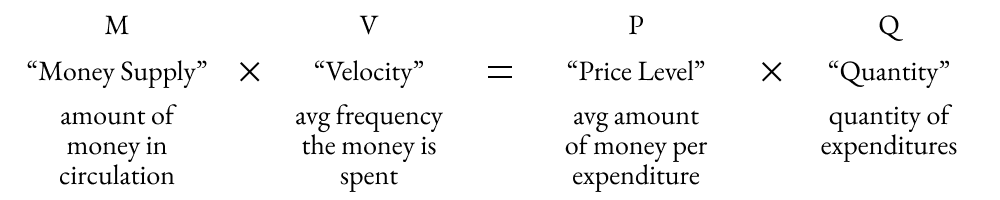
¿Cuáles son pues los riesgos de esta liquidez infinita? Pues además de suponer el caldo de cultivo perfecto para la asignación ineficiente de un dinero cuyo precio es próximo a cero, la hiperinflación sería otro factor que podría acabar haciendo que este nuevo patrón estallase por los aires. Pero como vimos hace 10 años en «La ilusión de la riqueza y la Teoría Cuantitativa«, el aumento de masa monetaria sin velocidad de circulación no es suficiente para generar aumento de precios. Y el grifo de la velocidad a la que el dinero fluye por las venas de la población, o sea de la llamada economía real, lo dominan absolutamente bancos centrales, gobiernos y bancos privados.

Por tanto nos adentramos en una profunda era donde el Patrón Solvencia ha quedado obsoleto, y donde la liquidez infinita va a mantener a flote empresas, bancos, Estados y gobiernos zombies, dándoles además un aspecto de normalidad al que nos estamos ya acostumbrando escandalosamente. Olvidémonos pues de la escasa volatilidad y la cómoda vida del rentista de antaño, de la selección natural de los insolventes e ineficientes y de un precio del dinero razonable.

.

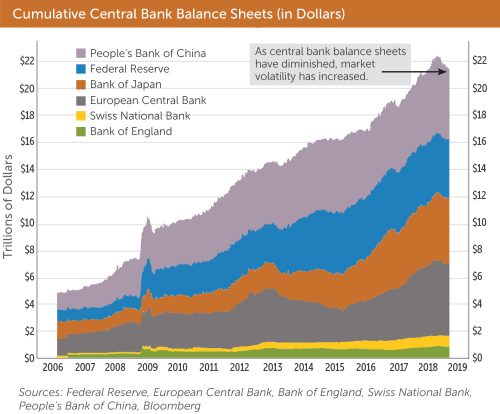
El Dinero Infinito es el Nuevo Patrón, y hay que aprender a sobrevivir financieramente en esta nueva era que ha venido para quedarse durante varias décadas (ya llevamos una). Fijaos si no la que se ha liado en cuanto se ha pretendido cerrar el grifo en 2018 (gráfico del encabezado del artículo). Como consecuencia del terremoto en los mercados, los bancos centrales han comenzado la marcha atrás para volver a abrirlo en 2019 y 2020. Los rentistas y los inversores conservadores (sic) que aún creen que pueden superar la inflación con escasa volatilidad, están siendo engañados por sus asesores financieros y/o banqueros. En este entorno de tipos cero y sobreendeudamiento, ni hoy ni en los próximos muchos años va a ser posible generar rentas sólidas y sostenibles que superen la inflación sin asumir un enorme riesgo. Y ese riesgo no es otro que prestar nuestro dinero a emisores de deuda y productos estructurados, garantizados y demás ingeniería bancaria, que materialmente son zombies que sólo el dinero infinito mantiene en pie.

.

La pregunta del millón es si podemos arrojar los ahorros de los más conservadores a los brazos de productos bancarios virtualmente zombies confiando en que el patrón de dinero infinito ha venido para quedarse. La respuesta es que muchos lo vienen haciendo desde hace una década y les ha funcionado relativamente bien (aunque difícilmente han superado la inflación real), puesto que ningún depósito, producto garantizado ni cartera de renta fija ha saltado por los aires bajo la batuta de Draghi, Yellen o Bernanke. Pero que políticamente se haya decidido mantener a flota la insolvencia no convierte en solventes esas inversiones. Por tanto, salvo contadísimas excepciones de activos alternativos generadores de rentas, como life settlements o cierto mercado hipotecario norteamericano, cuya volatilidad es moderada pero de liquidez trimestral y acceso selectivo, los inversores más conservadores harían bien en aceptar la volatilidad de las bolsas de países cuyas economías aún crecen y crecerán durante al menos una década. Y para invertir en esos activos y mercados crecientes deben buscar los mejores fondos del planeta, sin las enormes limitaciones que suponen los importes mínimos o las regulaciones de comercialización en España.

.

En este patrón de dinero infinito que vino para quedarse, como rezaba el famoso culebrón podría decirse que sin volatilidad no hay paraíso.

Daniel Lacalle y la nacionalización de la economía que perpetran los Bancos Centrales

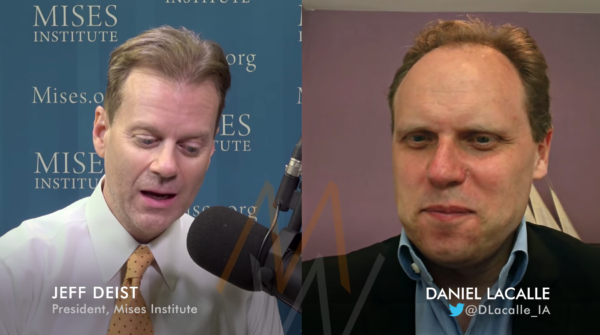
Aunque en algunas de sus convicciones podemos no estar del todo de acuerdo, no cabe duda que Daniel Lacalle es una de las personas que más sabe de macroeconomía. No sólo por su PhD en Economía sino especialmente por su enfoque ante el abuso de los bancos centrales que venimos sufriendo desde hace más de una década.

.

A continuación os dejamos con el artículo que sobre dicho abuso y fin de fiesta escribió lacalle hace un año en la web del Mises Institute. Como veréis, coincidimos mucho con Lacalle en el análisis que hicimos hace dos años en nuestro artículo «Intereses negativos y Darwin«. Y quizá os interese también releer «Qué esperar cuando se está esperando… el apagón del QE»

.

Estamos ya en 2018 y con la FED subiendo tipos de manera decidida. Y el BCE se enfrenta, por fin, a su realidad. Esperamos que disfrutéis con el duro y realista artículo de Lacalle:

.

El FT publicaba un artículo que decía que “los principales bancos centrales poseen ahora un quinto de la deuda pública total”.


Las cifras son estremecedoras.


1) Sin ninguna recesión o crisis, los grandes bancos centrales están comprando más de 200.000 millones de dólares de deuda pública y privada, liderados por el BCE y el Banco de Japón.

2) La Reserva Federal posee más del 14% de la deuda pública total de EEUU.

3) Los balances del BCE y el BdJ exceden en un 35% y un 70% sus respectivos PIB.

4) El Banco de Japón es actualmente uno de los 10 mayores inversores en el 90% del Nikkei.

5) El BCE posee el 9,2% del mercado de bonos corporativos europeos y más de 10% de la deuda soberana total de los principales países europeos.

6 El Banco de Inglaterra posee entre el 25% y el 30% de la deuda soberana de Reino Unido.


informe reciente de Nick Smith, analista de la CLSA, advierte acerca de lo que llama “la nacionalización del mercado secundario”.


El Banco de Japón, con su política ultraexpansionista que solo expande su balance, está en camino a convertirse en el mayor inversor en las grandes empresas del Nikkei 225. De hecho, el banco central japonés ya cuenta con el 60% del mercado de ETF (Exchange Traded Funds) en Japón.


¿Qué puede ir mal? En general, el banco central no solo genera mayores desequilibrios y un mal resultado en una economía “zombificada”, ya que las políticas extremadamente laxas perpetua los desequilibrios, sino que debilita la velocidad del dinero e incentiva la deuda y las malas inversiones.


Creer que esta política es inocua porque “no hay inflación” y el desempleo es bajo resulta peligroso. El gobierno emite cantidades masivas de deuda y el dinero barato promueve un exceso de capacidad y una mala asignación de capital. Así, el crecimiento de la productividad colapsa, los salarios reales caen y el poder adquisitivo de las divisas también cae, llevando al alza el coste real de la vida y a la deuda a crecer más que el PIB real. Por eso, como hemos mostrado en artículos anteriores, la deuda total ha ascendido hasta el 325% del PIB mientras que las empresas zombis llegan a niveles propios de una crisis, de acuerdo con el Banco de Pagos Internacionales.


Los títulos públicos monetizados por el banco central no son activos de alta calidad, son un pagaré que se transfiere a las próximas generaciones y se liquidará de tres maneras: con inflación masiva, con una serie de crisis financieras o con un gran desempleo. La destrucción del poder adquisitivo de la moneda no es una política de crecimiento, es robar a futuras generaciones. El efecto “placebo” de gastar hoy el Valor Presente Neto de esos pagarés significa que, como PIB, la productividad y la renta disponible real no mejoran, al menos no tanto como la deuda emitida. Estamos creando una bomba del tiempo de desequilibrios económicos que no hacen más que crecer y que explotará en algún momento del futuro. El hecho de que la evidente bola de riesgo se retrase otro año no significa que no exista.


El estado no está emitiendo “dinero productivo”, sino solo una promesa de más réditos mediante mayores impuestos, mayores precios o confiscación de riqueza en el futuro. El crecimiento la oferta monetaria es un préstamo que obtiene el estado pero que pagamos nosotros, los ciudadanos. El pago viene con la destrucción de poder adquisitivo y confiscación de riqueza a través de la devaluación y la inflación. El “efecto riqueza” de acciones y bonos en aumento es inexistente para la gran mayoría de los ciudadanos, ya que más del 90% de la riqueza familiar media está en depósitos.


De hecho, una monetización masiva de la deuda es solo una manera de perpetuar y fortalecer el efecto expulsión del sector público sobre el sector privado. Es una nacionalización de hecho. Porque el banco central no “quiebra”, solo transfiere sus desequilibrios financieros a bancos privados, empresas y familias.


El banco central puede “imprimir” todo el dinero que quiera y el gobierno se beneficia de ello, pero los que sufren la represión financiera son el resto. Generando las consiguientes crisis financieras a través de políticas monetarias laxas y siendo siempre el principal beneficiario del auge y el declive, el sector público sale de estas crisis más poderoso y más endeudado, mientras que el sector privado sufre el efecto de expulsión en tiempos de crisis y el efecto de los impuestos y la confiscación de riqueza en tiempos de expansión.


No sorprende que el gasto público con respecto al PIB esté ahora casi en el 40% en la OCDE y aumentando, la carga fiscal esté en máximos históricos y la deuda pública aumente.


La monetización es un sistema perfecto para nacionalizar la economía pasando a los contribuyentes todos los riesgos del exceso de gasto y los desequilibrios. Y siempre acaba mal. Porque dos más dos no es igual a veintidós. Al gravar a los productivos para perpetuar y subvencionar a los improductivos, el impacto sobre el poder adquisitivo y la destrucción de riqueza es exponencial.


Creer que esta vez será distinto y que los estados gastarán sabiamente todo ese enorme “dinero gratuito muy caro” es sencillamente una ilusión. El gobierno tiene todos los incentivos para gastar demás, ya que su objetivo es maximizar el presupuesto y aumentar la burocracia como medio de poder. También tiene todos los incentivos para culpar de sus errores a un enemigo externo. Los gobiernos siempre culpan a algún otro por sus errores. ¿Quién rebaja los tipos del 10% o al 1%? Gobiernos y bancos centrales. ¿A quién se culpa por tomar “excesivos riesgos” cuando las cosas van mal? A vosotros y a mí. ¿Quién aumenta la oferta monetaria, reclama que “fluya el crédito” e impone represión financiera porque los “hay demasiado ahorro”? Gobiernos y bancos centrales. ¿A quién se culpa cuando las cosas van mal? A los bancos por los “préstamos imprudentes” y la “desregulación”.


Por supuesto, los gobiernos pueden imprimir todo el dinero que quieran, lo que no pueden hacer es convencernos de que tiene un valor, en que el precio y cantidad de dinero que imponen es real solo porque el gobierno lo diga. De ahí la menor inversión real y la menor productividad. Ciudadanos y empresas no están locos por no caer en la trampa de los tipos bajos y la alta inflación de activos. No son amnésicos.


Se llama represión financiera por una razón y los ciudadanos siempre tratan de escapar del robo.


¿Cuál es el truco para que nos lo creamos? Las bolsas suben, los bonos bajan y se nos hace creer que la inflación de activos refleja fortaleza económica.


Luego, cuando la política del banco central deje de funcionar (ya sea por falta de confianza o porque es sencillamente parte de la liquidación) y los mercados reciban las valoraciones que merecen, muchos dirán que fue culpa de los “especuladores”, no del especulador central.


Cuando estalla, podéis apostar hasta vuestro último dólar en a que el consenso culpará a los mercados, los fondos de inversión, la falta de regulación y la insuficiente intervención. Los errores de la intervención perenne se “resuelven” con más intervención. El gobierno gana en todo caso. Como en un casino, la casa siempre gana.


Entretanto, las famosas reformas estructurales que se habían prometido desaparecen como los malos recuerdos.


Es un inteligente sistema maquiavélico para acabar con los mercados libres y beneficiar desproporcionadamente a los estados a través de la más injusta de las competencias: tener acceso ilimitado al dinero y el crédito y ninguno de los riesgos. Y pasar la factura a todos los demás.


Si pensáis que no funciona porque el gobierno no hace mucho más, estáis sencillamente soñando.


.


Tipos del Norte. Tipos del Sur (2a parte)

Para los que no lo hayáis hecho todavía, os recomendamos que leáis  la primera parte de este artículo, en el que describíamos un futuro mucho más cercano de lo que algunos creen. En ese futuro próximo los tipos de interés del norte de la UE ya no podrían seguir por más tiempo anclados a los tipos de interés de los países del sur. Esa ruptura del precio del dinero de los países ricos respecto al precio del dinero de los países pobres, inevitablemente nos llevará a una cotización respecto a las otras divisas distintas. Y como decía aquel, si anda como un pato, vuela como un pato, nada como un pato y grazna como un pato, es un pato. O sea que si tiene tipos distintos va a tener cotizaciones distintas, y por tanto la moneda única va a dejar de ser única, con lo cual tendremos cuando menos dos Euros, si es que se mantiene la nomenclatura.

.

Para los más escépticos os traemos hoy el artículo elaborado por el Director de Análisis Yves Longchamp de Ethenea Advisors. En dicho artículo Longchamp cuantifica los tipos de interés que pueden soportar economías tan dispares como la de Alemania o Italia. Y no sólo es que puedan soportar tipos distintos sino que deben poder tenerlos, adaptándolos así a las necesidades de cada una de sus economías. A ningún lector se le deberían escapar las terribles consecuencias que suponen para las economías que el precio del dinero no se ajuste al ciclo y las necesidades de la maquinaria económica. Y lamentablemente, la convergencia económica hace años que dejó de ser plausible para los europeos del norte y los del sur.

.

Así pues, Ethenea dice que mientras que Alemania podría funcionar en estos momentos con una horquilla tipos de entre el 4,8-6,1%, Italia no podría soportar unos tipos -atención- superiores al 0,6-1,5%. La diferencia entre una economía y otra es abismal, y tres cuartos de lo mismo podríamos decir de las necesidades de tipos entre otros países del norte y del sur. Os recomiendo que leáis el citado estudio de Longchamp porque para más de uno será un bofetón de realidad que, cuando menos, le dará que pensar.

.

Las consecuencias inevitables de unas necesidades de tipos de interés tan dispares (y además crecientes día tras día) son la ruptura de la uniformidad del precio del Euro. Alemania no va a soportar una inflación creciente por muchos más años, mientras que en el sur de la UE estamos enfangados en deuda para muchas décadas, que nos exige un precio del dinero cuasi gratis para poder seguir pagando los intereses. Recordad que en el sur seguimos teniendo déficits presupuestarios, es decir, que cada día que pasa debemos más y más dinero, y eso a pesar de tener tipos negativos desde hace años! La consecuencia de ello es que en el sur no es materialmente posible seguir la subida de tipos que el norte de la UE exigirá en breve, siguiendo los pasos de la Reserva Federal de los EE.UU.

.

Lo hemos avisado infinidad de veces desde hace 7 u 8 años. La moneda única está condenada a dejar de ser única. Y los inversores harían bien en preparar su dinero, sus bancos depositarios, sus vehículos de inversión y por supuesto sus inversiones para ese escenario de tipos y cotizaciones distintas, aunque los burócratas sigan disimulando y se inventen un eufemismo creativo para la ruptura del Euro. Los estudios como el del Director de Análisis de Ethenea lo pueden decir más alto, pero no más claro. Y desde Cluster Family Office no nos cansaremos de advertir del riesgo que, inconscientemente, asumen los inversores del Sur que no se preparen para que sus inversiones cotizen a precios y tipos del norte y se depositen geográfica y cualitativamente a salvo. Como dice Longchamp en su artículo: «Ignoring a reality does not make it less real»


Tipos del norte. Tipos del sur.

Europa año dos mil veintipico. Después del trauma que supuso la negociación in extremis del Brexit, la UE tuvo que afrontar el siguiente elefante blanco en su habitación: La inflación. Aunque crecía tímidamente, era ya un tema que los tipos del norte no querían ignorar por más tiempo. La demografía y el crecimiento económico anémico, lastrado por la ingente deuda en toda Europa, había permitido aplazar la gran decisión a pesar de que en los EE.UU. ya habían normalizado el precio de sus dólares y el resto de su política monetaria.

.

Las comparaciones entre la economía norteamericana y el babel europeo eran odiosas. Y los tipos del norte, germánicos y escandinavos, con sus economías fuertes y saneadas no podían ni querían soportar el riesgo de una inflación descontrolada. Sus empresas multinacionales habían soportado admirablemente un Euro caro (que no fuerte), pero con la devaluación de la moneda única potenciada por unos tipos negativos, la inflación amenazaba ya muy seriamente la decisión del BCE de mantener la represión financiera bajo cero.

.

Los tipos del sur, los mediterráneos, en cambio seguían necesitando que la inflación se les comiera un endeudamiento impagable. Rezaban para que un aumento generalizado de precios y sueldos, aunque acompañada de pérdida de poder adquisitivo, hiciera más pagadero un papel mojado que sólo el BCE les estaba comprando desde hacía ya una década. Pero los tipos del sur seguían sangrando déficit en sus presupuestos. Debían más y más, año tras año. Y ni sus gobernantes populistas ni sus niveles de productividad eran capaces de conseguir el equilibrio presupuestario necesario para detener la hemorragia.

.

Sin crecimiento económico consistente que incrementase los ingresos de los Estados del sur, y sin una inflación persistente que devaluase la deuda impagable, la única opción que quedaba para evitar el default masivo de los tipos del sur era el austericidio, pero esa vía se había demostrado también inútil para salvar a los griegos. La lata chutada desde hacía años, por fin topaba contra el muro que los tipos del norte y los del sur tenían ya frente a sus narices.

.

Los tipos del norte y los tipos del sur tenían idiosincrasia, productividad, datos económicos y necesidades opuestas. Pero paradójicamente unos tipos tan distintos tenían unos tipos iguales: Los tipos de interés. La cobardía y la obstinación de los euroburócratas de los últimos 25 años les había condenado a compartir moneda y tipos de interés a tipos muy distintos. Quizá había llegado el momento de que los tipos del norte y los del sur se adaptasen a sus respectivas economías.

.

Pero que nadie se equivoque llegado el momento de los tipos distintos: Aunque le sigamos llamando euro, si su precio es distinto para los tipos del norte y para los tipos del sur, cotizarán distinto y la moneda única será, de facto, historia. Y algunas pistas de ello no faltaron para los más suspicaces en todos estos años.

.

La pregunta del millón es si la separación de tipos norte y sur es inevitable o hay alguna opción más. Hace un par de años bautizamos como «The Big Write-down» y «Wtrite-down selectivo de deuda» la única forma de conseguir que los tipos del norte y los del sur siguieran compartiendo tipos, al menos durante algunas décadas más. Quizá en pocos años la UE esté ya muy cerca de tener que tomar la decisión final: Tipos distintos norte y sur, o bien write-downs selectivos del único acreedor que puede permitirselo, el BCE.

.

Hasta hoy la UE no ha hecho lo correcto sino lo necesario para aplazar el desastre, veremos a partir de ahora qué camino deciden tomar los tipos poderosos. Porque como bien dice Jonathan Tepper en este tuit, la decisión no la votaran los tipos del sur sino que la tomarán los tipos del norte cuando no tengan más remedio.

.

La segunda pregunta del millón es si los inversores están preparados, no sólo para evitar los efectos negativos de cualquiera de los dos caminos que la UE va a tomar, sino para aprovecharse de ellos.

Banco Popular: In extremis.

Otra vez se ha rozado el desastre. Y en el último minuto las presiones inconfesables del Gobierno han conseguido que el Banco Santander se haga cargo del agujero descomunal que supone el Banco Popular. Antes de llegar hasta aquí, por supuesto, se ha ampliado capital con dinero de incautos nuevos accionistas, bonistas y cualquier otro ingenuo que haya creído en la imagen de seguridad y solvencia de personajes como los que suelen utilizar los publicistas.

.

https://youtu.be/xD_4thIw1FQ

.

La mayoría de personajes del deporte, acostumbrados a vender su imagen para publicidad, lo hacen al mejor postor sin importarles un pimiento si con ello están vendiendo más zapatillas deportivas o contribuyendo a acabar con los ahorros de humildes familias, que creen que lo que les dice Pau Gasol es de fiar. Es difícil repartir culpas en su justa medida. ¿Quién es más culpable de que los pequeños ahorradores pierdan su dinero en estas operaciones de rescate bancario? ¿El responsable del banco, que está ampliando capital o saliendo a bolsa (Bankia) sabiendo perfectamente que los inversores a los que está engañando van a perder buena parte de sus ahorros? ¿El regulador (BdE) que lo permite, conocedor también de la situación crítica de esos balances? ¿El personaje que vende su imagen de credibilidad para convencer a quienes sin ella no confiarían en esa entidad su dinero? ¿El empleado de banca que miente vilmente a todas las presas que se sientan ante su mesa durante la campaña agresiva de captación de inversión? ¿El propio inversor con su cócktail explosivo de ignorancia y codicia? Como diría el refrán, entre todos la estafaron y ella sola se arruinó

.

Para no ser hipócritas, cabe hacer otra reflexión. Si el destino final de un banco quebrado es el rescate con dinero público (bail-in), o sea más deuda que tendrá que ser pagada con aumentos de nuestros impuestos presentes y futuros, todo euro de inversor privado que capte la entidad -en connivencia con consejero delegado, regulador, empleado, o publicista- será un euro menos que tendremos que aportar los que no hayamos sido engañados por toda esa banda. Por tanto, dejando la ética a un lado, si otros ingenuos tapan un poco el agujero con sus ahorros, menos nos tocará tapar al resto con nuestros impuestos. Una selva político-financiera vomitiva en toda regla, desde luego.

.

En el caso del B. Popular, el desastre ha rozado el larguero y sólo ha afectado a priori a los inversores que confiaron en la entidad como accionistas y a los bonistas subordinados y preferentistas, mientras que los depositantes y el resto de contribuyentes, por esta vez, parece que nos salvamos de otro bail-in bancario. Pero la pregunta del millón es ¿a cambio de qué? ¿Qué le ha prometido el Gobierno a los Botín para que se traguen tal sapo? Probablemente jamás lo sepamos y quedará, como el resto de rescates y «reordenamientos» bancarios, indescifrablemente diluído en las declaraciones de impuestos que pagarán durante toda su vida nuestros hijos, nietos y biznietos.

.

El rescate corporativo del Popular no es más que otro síntoma del invierno que llega. Esta vez la explosión ha sido controlada y disimulada bajo la alfombra del Santander, que hoy es al menos 7.000 millones de euros menos solvente. Pero los persistentes tipos a cero ya puden grabar otra muesca en su empuñadura de entidades financieras bajo tierra. El problema es que cuando Alemania no aguante más inflación y decida subir tipos, los del sur vamos a necesitar otro banco central que nos los mantenga a cero. Entonces nuestros bancos y nuestros precios podrán levantar cabeza tímidamente, pero nuestras cuentas corrientes y activos del sur serán cotizados con un valor inferior a los del norte.

Para hacer la tortilla de las 2 velocidades hay que romper la cáscara del Euro.

El Euro sube. Y lleva ya casi un 5% de recuperación desde sus mínimos por debajo del 1,04 respecto al dólar. Pareciera que puede más la fortaleza de la locomotora alemana que la debilidad del Sur y el Este de la UE. Como si por el hecho de haber reconocido que se avanzará a -al menos- dos velocidades, ello permitiera que la divisa única dejase atrás sus incertidumbres.

.

Es como si la cifra publicada por el IFO alemán (112,3) superior a la esperada (111), fuera capaz de reafirmar y acelerar la subida de tipos en Europa, al más puro estilo norteamericano. Es cierto que esa y otras cifras reafirman la recuperación económica germana, pero esos árboles de optimismo inequívoco no nos deben impedir ver el bosque en el que está sumido la moneda única. Y ese bosque no es otro que la inviabilidad precisamente de su cualidad de única. O sea, que aún se comparte el Euro entre muchos países que están lejísimos de ni tan siquiera imaginar una relajación de las facilidades cuantitativas con las que inunda el BCE las economías del Sur. Y ello hace imposible una subida de tipos que, paradójicamente está descontando el Mercado con la recuperación del Euro respecto al dólar.

.

¿A dónde nos lleva esta paradoja? Pues a que cuanto más descuente el Mercado una subida de tipos del Euro y una reducción de la relajación cuantitativa por parte del BCE, más próximos estaremos a la materialización de las dos velocidades de la Eurozona, y por tanto de la ruptura de la cotización única del Euro. Ya que, o bien el Euro pierde su condición de moneda única y empieza a cotizar de manera distinta en cada velocidad de la Eurozona, o bien la subida de tipos es imposible, en cuyo caso el precio del Euro respecto al dólar y resto de hard currencies debería volver a cotizar el riesgo de explosión de la propia Eurozona (según el adjetivo utilizado por los propios dirigentes de la UE para justificar esas dos o más velocidades) y caer de nuevo a mínimos.

.

Si se mantiene una única cotización del Euro, es imposible subir los tipos, puesto que en el Sur no nos lo podemos permitir. Aquí necesitamos tipos cero e inflación abundante que se coma la deuda poco a poco. Sin embargo, en el núcleo duro alemán, lo que no pueden ni van a permitir es no subir tipos y que su temidísima inflación les repunte más allá de lo deseable. Por lo tanto, ante tal dicotomía, o bien Mr. Market está caminando en dirección contraria, o bien las ya anunciadas dos velocidades están a la vuelta de la esquina.

.

Tampoco es baladí la ruda reacción de Dijsselbloem, que denota que muchos europeos del norte ya no se sienten obligados a tener ni siquiera corrección política con quienes consideran que de facto ya no forman parte de su core o núcleo duro europeo. Sus disculpas, forzadas, ligeras y tardías delatan ese sentimiento de desapego y desconexión que los habitantes e inversores del Sur parece que todavía no hemos comprendido. Lo curioso es que el inversor de a pie del Sur ha asumido lo de las dos velocidades sin percatarse de que ello implica dos cotizaciones de divisa y dos tipos de interés diferenciados. No en balde Guy Verhofstadt (sí, el mismo que está supervisando desde la UE la negociación del Brexit) ya dijo públicamente que debía crearse un segundo banco central en Bruselas. Dos velocidades, dos autoridades monetarias… Blanco y en botella, y hay que estar preparado para ese escenario.

.

Para hacer la tortilla de las dos velocidades hay que romper la cáscara del Euro. Hay que partir la moneda «única» en dos. Y aunque aunque lleven el mismo nombre y tengan prácticamente la misma cotización inicial para evitar pánicos, tendrán valoraciones distintas y tipos de interés distintos al cabo de poco tiempo. Serán diferencias de tipos y cotización acordes con las necesidades de las distintas economías, como no podría ser de otra manera. Y lo más curioso es que incluso algunos inversores institucionales, que sí llegan a imaginarse la materialización de esas dos velocidades y dos políticas monetarias, confían sorprendentemente en que España estará en la primera velocidad! ¿Por qué? Pues porque el gobierno español así lo ha dicho, enarbolando el mayor crecimiento de PIB de la Eurozona, pero obviando el déficit presupuestario, el endeudamiento y el paro estremecedor y endémico. Y ya se sabe, los gobiernos, especialmente los de la periferia europea, siempre aciertan en sus pronósticos ¿verdad?

Shall we help you search?

Cluster Family Office

We care about transparency both in management and in our own way of working. Leading wealth management and family offices company

Do you need help in capital and wealth management?

How can I avoid the negative effects that my fortune may have on my children?

How and when should I talk to my children about family wealth, and what relationship should they have with money throughout their adolescence?

How can I measure the real risks of my investments and protect my assets adequately?

Do I have sufficient liquidity and stable income to cover my needs on a permanent basis?