We look after your interests

(+34) 93 626 47 75

Torres Sarrià, Carrer de Can Ràbia, 3-5, 4ª Planta BCN 08017

(+34) 91 794 19 82

Pº de la Castellana, 93 2nd floor MADRID 28046

Category: Reflexion

Russian Queen's Gambit

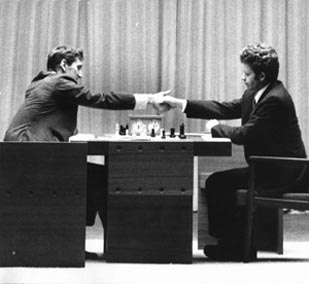
You will probably be familiar with this title, since only six months ago we published the article entitled «.«Chinese Queen's Gambit»in which we analysed the reasons why Xi Jinping had taken certain internal control measures. Well, now we are witnessing another chess game, this time on the European international geopolitical chessboard with Biden and Putin as opponents, under the watchful eye of Germany, the rest of the European countries and of course China, always waiting to take advantage of any resulting scenario.

.

It is worth noting that this conflict between NATO (Biden), Ukraine and Russia (Putin) coincides with the US's negotiations with Iran on the nuclear issue and the applicable sanctions. The background to the whole conflict is none other than the global energy flow in the coming years. We could call it the New World Energy Order.

.
How many images of NATO troops and heavy weapons in Ukraine have been seen on our Western television screens? And yet there are plenty of them, but only the menacing Russian troops appear again and again everywhere. In fact, the press conference held by the State Department spokesman on Thursday, February 3, was a very good example of this. Ned Price is not wasted. In it Price accused the veteran journalist Matt Lee of preferring the official Russian version to the US version of the alleged existence of the preparation of a false flag attack, while Lee only repeatedly asked the US State Department spokesman for proof, who said that the proof was simply the official statement he had just made. Here is the excerpt from the video with the tense moment from last Thursday's press conference. Incidentally, Ned Price has already has not appeared The icing on the western propaganda cake is the mistake of none other than Bloomberg publishing fleetingly the headline «Russia invades Ukraine» before the alleged false flag attack or any other move for which the headline is designed. These are all examples of the news bias that we also suffer from in the West, and not only in the Chinese- or Russian-controlled media in the East.

.

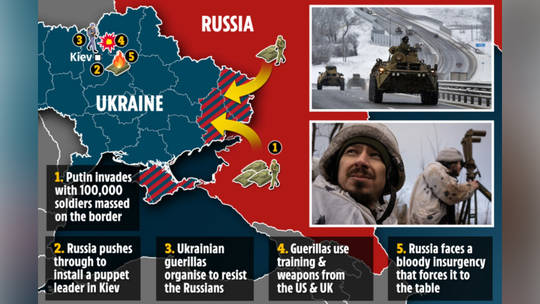
That is why it should be recalled time and again that the start of the conflict was caused by the threat of Ukraine's imminent NATO membership, insistently urged by the USA, in order to be able to place heavy weapons on the Russian borderline itself. That and no other was the opening of the chess game and the conflict, in which Biden made the first hostile move. And this threatening opening has generated a logical response from Russia, which, baring its teeth, has amassed troops around Ukraine in an attempt to get Biden and NATO to return to square one and leave the chessboard as it was. We are therefore facing a confrontation that would not have occurred if Biden had not actively pushed for Ukraine's inclusion in the Western military alliance, despite the Western media's insistence on selling the idea that it was Putin who started the conflict by threatening to invade Ukraine unilaterally, something the Kremlin has denied to no avail. So we are dealing with a US action and a Russian reaction, and not the other way around, as all the Western media are selling it without the slightest rigour or blushes.

.

Having made this necessary preamble, let us now turn to the conclusion itself. Let us start from the premise that any political-military conflict that does not lead to a classic open war, in disuse in the developed world since the Second World War, has relative winners and losers. And that often the most feasible outcome is the most plausible one, i.e. the one in which all parties involved suffer the least possible economic damage.

.

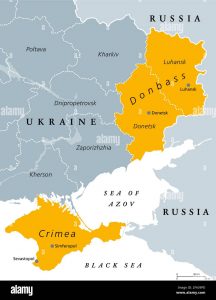
In this US-NATO-Ukraine-Russia conflict, the least hurtful outcome would be a commitment by Ukraine not to join the Atlantic Alliance club, at least for a decade, in exchange for Russia also renouncing the incorporation of new Russophile territories in Eastern Ukraine or even giving back some of the territories it already holds in the Donbass. That is, more or less, back to square one of just a few months ago. Logically, to get to that point, Putin «demands» the major, i.e. that the NATO line returns to the borders where it was in 1999, when Estonia, Latvia, Lithuania, Slovenia, Romania, Slovakia and Bulgaria joined the Atlantic alliance. A Western military goal to what was then a very weak Russia. And Putin's impossible demand is the chrome he will be more than willing to concede if he gets a few more decades of Ukrainian independence from the Western military alliance.

.

An agreement would make perfect sense for both parties, as explained by Gavekal in his report on Russia, as it would allow Ukraine's economic progression and the pacification of its endemic low-profile armed conflict with Russia in the east of the country, both of which are impossible to achieve if the conflict escalates. For Putin it would put out the fire on a new front of NATO's threatening rapprochement with Moscow for at least a few years. And for the EU it would be the lifeline it badly needs to avoid the energy suffocation it would face in the event that Russia decides to turn off the tap, not only on gas but also on oil.

.
.

On the other hand, if the conflict escalates with galloping sanctions against Russia, the logical response will be to turn off the tap to Europe, and with that we will see fuel prices rise to infinity and beyond and an outrageous inflationary spike. That in turn would generate a radical increase in interest rates in an anaemic economic environment, i.e. a textbook runaway stagflation, which would trigger all sorts of market dislocations, risk premiums and also economic costs that would take a long time to recover (especially in Southern Europe). Putin knows this and is therefore willing to use his power to get the chessboard reversed to the starting position, i.e. 2021. Energy self-sufficient Biden does not have as much to lose as Europe. But the destabilisation of an EU with already semi-ripped north-south seams would create a scenario in which the Western bloc would be at a distinct disadvantage vis-à-vis a China-Russia alliance that is going through one of its best moments. As shown by this button in the form of a new gas pipeline and a 30-year supply agreement between Putin and Xi, which to top it all off is denominated in Euros.

.

However, resolving the conflict via pact and de-escalation does not mean that there will not be some bombings and deaths, unfortunately. Negotiations are usually concluded in-extremis, both in time and in form, i.e. after skirmishes that seem to foreshadow imminent and inevitable military escalations. But let us remember that the economic cost of open war (read ground invasion and open NATO-Russia military confrontations) is unaffordable for Europe, high for Russia and extremely dangerous for the stability of the Western bloc USA-EU.

.
.

Therefore, an agreement seems the most likely outcome. But it is likely to be an unofficial agreement, i.e. without light and stenographers or photos of the leaders shaking hands in front of journalists, but an agreement nonetheless. The only ones who would clearly lose in a scenario of de-escalation and a pact between Russia and the West would be the Russophobic and ultra-nazionalist Ukrainian politicians (yes, with a «z» for Nazis), once nurtured by the West to perpetrate the 2013 coup d'état that was whitewashed under the name of the Euromaidan revolution. Which by the way was not such but a violent regime change orchestrated by the West, as Rafael Poch well explained in this prescient article in 2014, which had little media coverage as was to be expected. As we said, these Ukrainian ultranationalists are perfectly sacrificable, in exchange for Europe not being blown apart by the energy suffocation that could result from the culmination of Ukraine's NATO membership.

.

It is true, however, that a priori Biden has the least to lose if the conflict escalates, and that adds risk and uncertainty to the situation. Moreover, Putin knows that he will not get concessions if his military threat is not credible, and for that some bloodshed will probably be unavoidable. But, as we have already said, usually the options that end up being given in any conflict are the least costly economically for the parties, and in this case it is undoubtedly a temporary backtracking on Ukraine's inclusion in NATO and a return to square one in 2021 (not 1999 as Putin initially stated in his letter to the Three Wise Men). The Normandy Quartet knows that it is the four of them who have the most at stake in this conflict, and they are rushing to negotiate without the interference of those who have the least to lose, namely Biden and NATO.

.

In all this turmoil, the gains of fishermen investing in Russia at the height of the conflict will, as always, be obvious only after the event. And as always the Chinese, the smartest in the class, They are already benefiting strategically from the Russian-European turbulent river and continue unstoppably towards world hegemony.
Seven traits you must have to be a great investor. Mark Sellers' speech to Harvard students.

More than a decade ago, shortly before the crash of 2008, the manager of the Hedge Funds Mark Sellers of Sellers Capital gave a great speech to a group of Harvard MBA students entitled «So you want to be the next Warren Buffett? What does your writing look like?» Sellers pulled no punches when he talked about the difficulty of becoming a great investor who can earn returns at 20% compounded annually saying: «I know everyone in this room is extremely smart and has worked hard to get to where they are. They are the brightest of the bright. However, there is one thing you should remember from my talk: You have almost no chance of being a great investor. You have a very, very low chance, like 2% or less».

.

Here is an extract from that speech:

.

One thing I will tell you up front: I am not here to teach you how to be a great investor. On the contrary, I am here to tell you why very few of you can expect to achieve this status.

.

If you spend enough time studying investors like Charlie Munger, Warren Buffett, Bill Miller, Eddie Lampert, Bill Ackman and others who have had similar success in the investment world, you will understand what I mean.

.

I know that everyone in this room is extremely intelligent and has worked hard to get to where you are. You are the brightest of the bright. And yet, there is one thing you should remember if you remember nothing else from my talk: You have almost no chance of being a great investor. You have a very, very low chance, like 2% or less.

.

And I'm pondering the fact that you all have high IQs and are hard workers and will soon have an MBA from one of the best business schools in the country. If this audience were a random sample of the general population, the probability of anyone here becoming a great investor later on would be even lower, like 1/50th of 1% or something. You all have a lot of advantages over Joe Investor (the everyday investor), yet you have almost no chance of standing out from the crowd in the long run.

.

And the reason is that it doesn't matter much what your IQ is, or how many books or magazines or newspapers you have read, or how much experience you have, or will have later in your career. These are things that a lot of people have, and yet almost none of them end up making 20% or 25% in the course of their career.

.

I know this is controversial and I don't want to offend anyone in the public. I'm not pointing to anyone in particular and saying: «You have almost no chance of making it big». There are probably one or two people in this room who will end up making money at 20% during their career, but it's impossible to know in advance who they will be without knowing each of you personally.

.

On the bright side, although most of you will not be able to compound money at 20% for your entire career, many of you will turn out to be good, above-average investors, because you are a biased sample, Harvard MBAs. A person can learn to be an above average investor. He can learn to do well enough, if he is smart, hard-working and educated, to keep a good, well-paying job in the investment business throughout his career.

.

You can make millions without being a great investor. You can learn to beat the averages by a couple of points a year through hard work and an above-average IQ and a lot of study. So there is no reason to be discouraged by what I am saying today. You can have a really successful and lucrative career even if you are not the next Warren Buffett.

But you can't accumulate money at 20% forever, unless you have it engraved in your brain from the age of 10, 11 or 12. I'm not sure if it's by nature or by education, but when you're a teenager, if you don't have it, you can't get it anymore. By the time your brain is developed, you either have the ability to run circles around other investors, or you don't.

.

Going to Harvard or other high-level public and private universities will not change that and reading all the books that have been written about investing will not change that either. Neither will years of experience. All these things are necessary if you want to become a great investor, but in themselves are not enough because they can all be copied by competitors.

.

7 traits of highly successful investors:

.

In my view, there are at least seven traits that great investors share that are true competitive advantages because once a person reaches adulthood they can no longer be learned. In fact, some of these traits cannot be learned at all; you are either born with them or you don't have them.

.

1. The ability to buy shares while others panic and sell shares while others are euphoric. Very easy to say but almost impossible to apply when the time comes when the world is sinking and there are a thousand reasons to think that this time it is different.

.

2. The second character trait of a great investor is that he is obsessive. They get up in the morning and go to bed at night thinking about companies, share prices, economic and financial data, and they want to win and win.

.

3. A third trait is the willingness to learn from past mistakes. There is little point in not doing so as it will not inoculate us from making the same or similar mistakes in the future.

.

4. A fourth trait is an inherent sense of risk based on common sense. It is as simple as that. No matter what the computers and calculations of probability of success say. Common sense must never be abandoned, and it will become our best ally and protector from disaster.

.

5. Great investors are confident in their own convictions and stick to them, even when faced with criticism. This is also easy to say but very difficult to do, when you see that everyone around you thinks just the opposite.

.

6. It is important to have both sides of the brain working, not just the left (the one that is good at mathematics and organisation). This is why many great investors are also able to write very well. The right side of the brain is able to detect subtleties that are very important for investment success, such as the character or behaviour of managers, and not just the business figures that their teams publish.

.

7. And finally, the most important, and rarest, trait of all: The ability to live through volatility without changing your investment thought process. This is almost impossible for most people; when the going gets tough, they have a hard time not selling their stocks at a loss. You have to distinguish between volatility and risk, and this is something that much of the industry - not just ordinary investors - confuse and condemns them to mediocrity at best (I recommend reading «Why do they call it Risk when they mean Volatility? The Fable of the 3 Neighbours«)

.

I would argue that none of these traits can be learned once a person reaches adulthood. At that point, their potential to be an outstanding investor in the future is already determined. It can be honed, but it cannot be developed from scratch because it has to do mostly with the way your brain is wired and the experiences you have as a child. That doesn't mean that financial education and experience in reading and investing are not important. They are fundamental to getting into the game and staying in the game. But those things can be copied by anyone. The seven traits above cannot be.

.

You can download the full speech here.


China: Inequality and poverty reduction

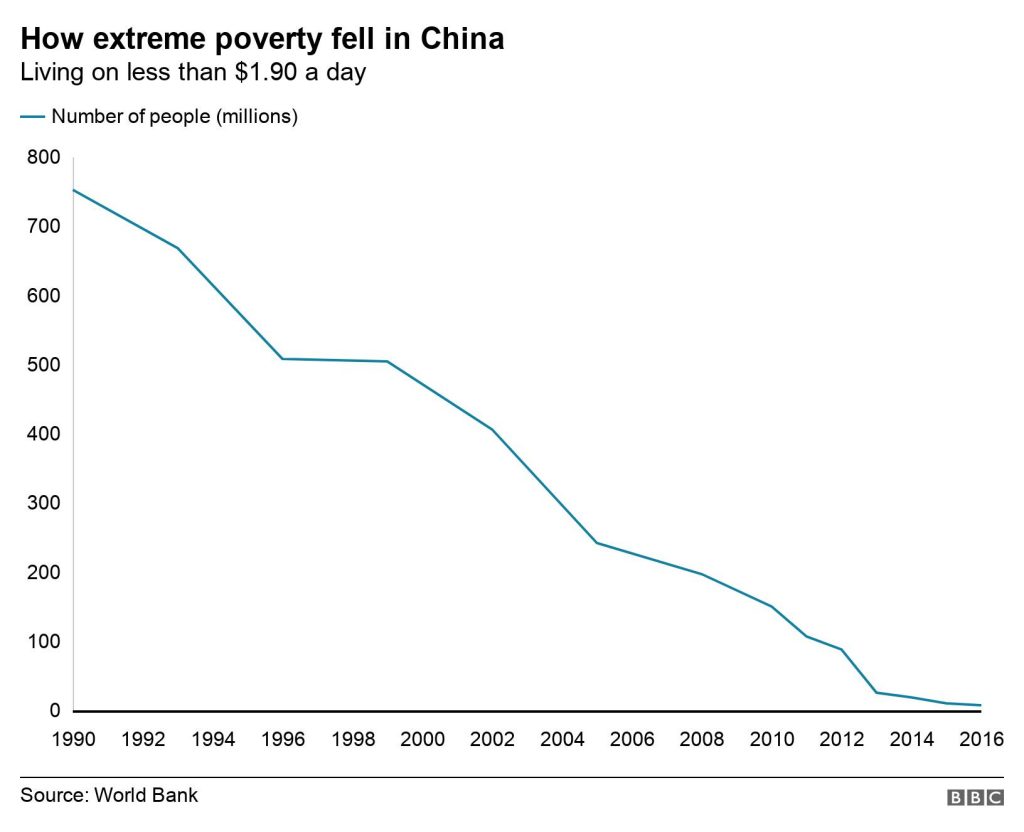
According to the World Bank, an income of less than $1.90 per day means that a person is statistically and officially poor by global standards. Xi Jinping's government, on the other hand, raises the bar to $2.30 per day, i.e. below this income, China's population is officially considered to be poor. Even so, the Chinese government has achieved the goal set in 2012 of lifting 100 million people out of the poverty line in the last decade.

.

As you can see from the BBC graph below, according to the World Bank the number of poor people in China, mostly rural, was over 750 million in 1990. In just 20 years, up to 2010, that figure fell to just over 100 million. And in the last decade, the number of poor people in China below the poverty line has fallen to just 5 million. In other words, in the last 30 years China's planned capitalism has lifted 745 million people out of extreme poverty.

Other countries such as Vietnam have also dramatically reduced their poor population, yet India still maintains levels of close to 20% of the population below the World Bank's threshold of $1.90 per day.

.

But of course, the consideration of extreme poverty must increase as the economy also grows, and by the standards of developed countries such as Spain, the extreme poverty line is severe poverty 11.83 euros per day or in some statistics at 40% of the average citizen's income. Therefore, in Spain we have 2.2 million people at risk of severe poverty (4.7% of the population), and what is even worse is that this figure is rising instead of falling as it is in China.

.

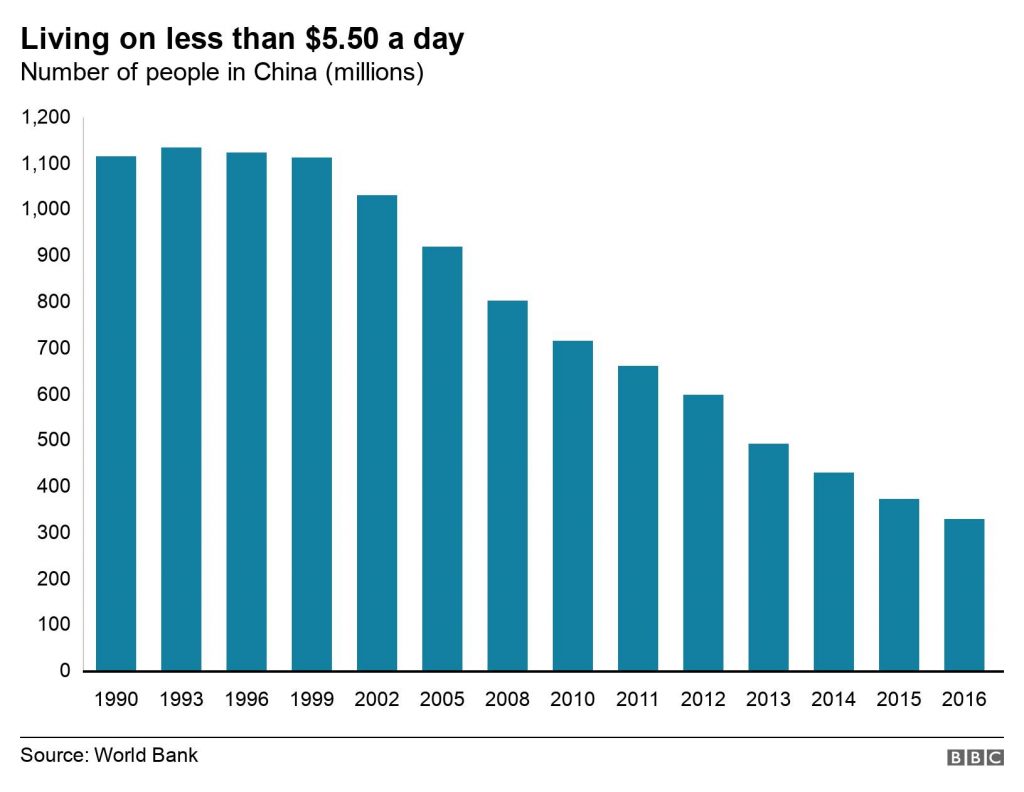
Some would argue, and rightly so, that the extreme poverty line in China today should not be set at $1.90 or $2.30, as its economy has grown enormously. Internationally, the World Bank sets $5.50 per day as the poverty line for upper-middle (not high) income countries. And in this category of countries we should already consider China as a whole, both in its urban and rural areas, if we want to be fair with the assessment of its poverty reduction. Well, in 17 years, from 1999 to 2016, according to the latest data published by the World Bank, poverty in terms of upper-middle income economies has also been reduced by almost 800 million people in China.

.

This can be clearly seen in the graph below, and projecting its economic growth over the last 5 years, there are probably no more than 150 million people in China today below this threshold, i.e. barely 10% of its total population. At these levels, China's income growth would already clearly exceed that of countries such as Brazil. Y the pandemic points the way because it is obviously further accelerating the comparative growth process between China and the rest of the emerging or already emerging countries.

Another thing is the economic inequality, China is invading the lists of billionaires at the same time as it lifts hundreds of millions of people from the poverty line. But this may be the necessary evil, the toll that growing economies must pay in order to lift millions upon millions of people out of severe poverty. Contrary to what many believe, the most realistic and efficient way to reduce poverty in the medium and long term is probably not through a utopian, more equitable distribution of existing wealth, but through greater wealth creation. In other words, powerful economic growth, even if it leads to greater economic inequality among the population.

.

If, in addition, the state, with extreme care and subtlety, combines social measures to help the most disadvantaged, while at the same time maintaining or even improving the conditions for the rich to continue expanding their fortunes within the domestic economy, we may be looking at solid and sustainable economic growth for decades to come. For inequality is necessarily bad only in the absence of economic growth, but need not be bad when more and more wealth is created in the aggregate.

.

Economies, like companies, get better or worse, but they hardly stay the same. And the same is true of economic policies, they equalise or unequalise, but hardly maintain the differences in wealth among their population. In short, there are four ways of dealing with economic differences in population through the application of economic and fiscal measures: equalising upwards, equalising downwards, inequalising upwards or inequalising downwards.

.

There is little point in reducing inequalities (equalising) if we thereby kill economic growth by raising taxes out of all proportion and demonising our rich until they leave for other countries with smarter governments that welcome them with open arms - and open taxes. It is preferable that our rich get richer and richer every day so that, along with them, our economy grows and our poor are lifted out of poverty, otherwise we will run out of rich people and become poorer across the board. In other words, upward unevenness is preferable to downward equalisation. Because equalising downwards through unsustainable public spending, involving tax extraction and confiscation, has historically been shown to undermine incentive, productivity and economic growth, plunging the poor who were intended to be kept afloat in the short term into misery in the medium and long term.

.

Finally, downward disparity This is what African dictatorships and other banana republics do, and therefore it is obviously of no use either. The ideal, of course, would be to be able to equalise upwards, But that is only a chimera that capitalism (and certainly not socialism) has never achieved, not even with China's planning and not even with American efficiency. In short, welcome the growing inequalities that lift millions of people out of poverty.

.

Source: BBC.com/news

The damned newspaper library of Minister Montero and Fernando Simón

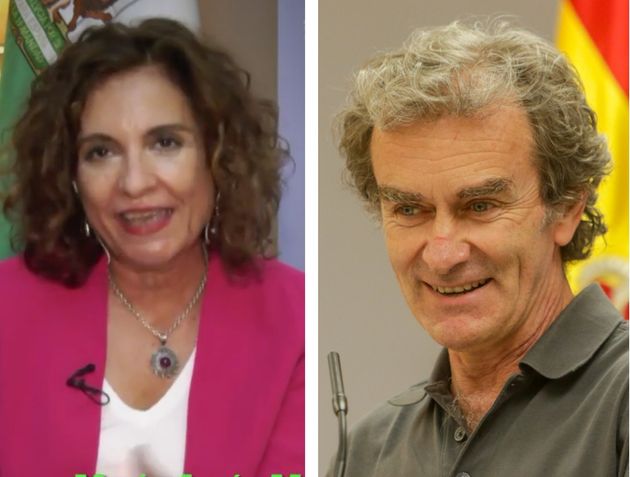
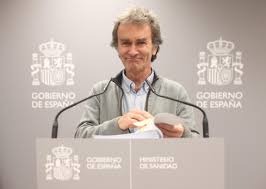
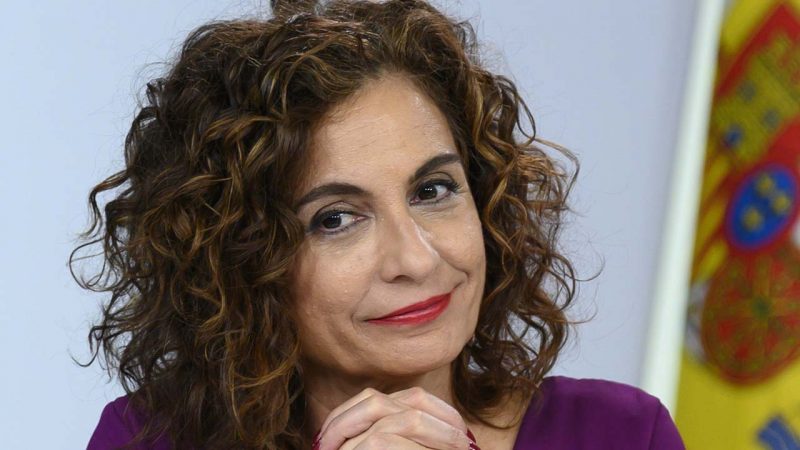
Some will say that the archive exposes the shame of everyone in this pandemic. But the reality is that it does not expose everyone equally, far from it. Today we think it is worth re-reading this article which we published 12 months ago, specifically on 5 March 2020. In it, you will see how some of us were already warning of the seriousness of what was coming, while our politicians continued with the mantra that the coronavirus was like normal flu but kills less. The most outrageous thing is that this disinformation did not only come from ignorant half-baked politicians, but from people like the very Minister of Finance and Government Spokesperson, Maria Jesús Montero. And with the aggravating factor that this lady was (and is) not only a double minister but also a doctor and surgeon, with a long history of hospitals under her direction such as the Virgen de Valme University Hospital or the Virgen del Rocío University Hospital. Or, for example, what was said at the time by the very popular and tireless Fernando Simón, a medical epidemiologist no less, who told us that masks did not protect us in any way and that we should not use them because people would make fun of us.

.

Given their medical training, we can hardly think that these reckless words of our leaders were the result of ignorance, but obviously of bad faith. As we ourselves have shown in this article, one did not need to be a doctor to see the pandemic coming at the beginning of 2020. Mere common sense and the information published by analysts and prestigious foreign epidemiologists was available to anyone who wanted to be informed beyond our TV news. It is worth re-reading this article from a year ago to recall the shameful statements made by the Spanish authorities. Because not all of us were living in the dark at the time, some of us were unequivocally warning of the seriousness of the situation and of the risk of not even having an economic recovery in the form of a U in Spain if we did not take immediate drastic measures. Rereading it a year later, with more than 100,000 The Spanish dead (68,000 according to official figures), is not to be sniffed at:


«The lies of the Spanish government and health authorities regarding the coronavirus.» (5 March 2020)

.

It is regrettable to see the differences in the handling of the emergency situation in the coronavirus pandemic between different countries around the world. But what is worrying is the attitude of the Spanish political and health authorities in the face of this crisis, as they strive time and again to distort the facts and data in order to minimise its stark reality. A mixture of cowardice and misunderstood paternalism that justifies, in the eyes of some, the absence of courageous decisions. The Spanish authorities' determination to deceive the public stands in sad contrast to the realistic and serious warnings of other governments and global health organisations.

.

The Minister Spokesperson of the Government, Maria Jesús Montero, has declared in different media, and without any blushes, that Covid-19 is nothing more than a “...a new and unacceptable project".“new flu, similar to normal flu and with an even lower mortality rate than normal flu”.” (for example in minute 10 of the following interview with him on RAC1 last week).

.

.

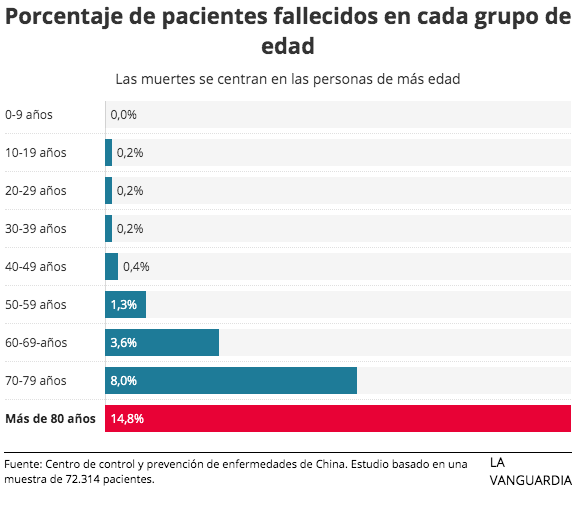
The unfortunate reality is that the lethality of this virus is much higher than that of seasonal flu. And any well-informed scientist, whose rigour is not contaminated by the political slogans of the government, will admit statistical figures of around 3 or 4 deaths per 100 infected. Some Spanish authorities use mortality figures for normal 2% flu, but for hospital admissions and not for those infected, thus inflating the mortality rate and making it incomparable with that of Covid-19. On the other hand, also maliciously, they proclaim that the mortality of the coronavirus is 0.7%, taking the death figures for those infected just at the beginning of the epidemic in Europe, which means that the sick who are going to die have not yet done so. To further embarrass the minister, here is the official comparison between the mortality rate of the common flu and the US CDC's Covid-19:

.

The most statistically reliable figures are found in China, where there are more and older cases of coronavirus. And those figures are now in the 3,75% mortality3012 deaths out of 80409 infected. Unfortunately, a fraction of those infected today will also die, while the number of new infections is already declining, so that this percentage is also tending to increase by about 0.04% per day, as it has done in the last few days. In other words, if the official figures in China are to be believed, mortality is indeed frighteningly close to 4%. And if we don't believe the official figures (I personally do) and think that the Chinese government is making up the mortality, then that's the end of the story. You can follow the daily evolution of the official figures in China at this page from Wikipedia, and the official figures for the rest of the world at this one.

.

However, some news which many people dismiss as being tremendist, infodemic or fake news, are in line with what is published in the majority of the world's media. international media with up-to-the-minute timelines of any new developments regarding the coronavirus,and spare no means or adjectives to keep the people of their respective countries on alert and on the lookout for health emergency. Because this state of alert and emergency does indeed punish the economy in the short term, but it saves lives. Thus, countries such as the US, where the spread of the virus is currently still proportionally lower than in Spain, are giving unequivocal instructions to their citizens to be prepared for imminent confinement o emergency situation This is because, mortality rate aside, what is clear is that this coronavirus is highly contagious, and its spread across the planet is unstoppable. Mortality rates aside, what is very clear is that this coronavirus is highly contagious, and its spread across the planet is unstoppable. That is why responsible governments are alerting and preparing their citizens for a massive infection. According to the calculations of Harvard Professor of Epidemiology Marc Lipsitch, Between 20 and 60% of the world's population will be infected by the coronavirus if we do not take drastic measures as China has done and/or an effective and viable drug does not emerge for everyone. And pending such a drug, our only option is to slow the pandemic. That means, even with optimistic mortality rates, millions and millions of deaths across the planet, at a brutal cost at all levels. What a contrast with the happy flowers statements of our ministers and health spokespersons who continue to talk about “new flu that kills less than normal flu”, right?

.

.

It is undeniable that a realistic warning about what is coming makes the population radically modify its usual activity, and with it consumption, productivity and therefore the economy plummets, as has happened in China. But courageous (albeit belated) measures, such as those taken and implemented with martial rigour by Xi Jinping, will save his country's economy in the medium and long term. Because an uncontrolled epidemic, with the mortality rate that this coronavirus entails, would have a far greater impact on the economy in the medium term than the short-term slump. Economically we could see a V-shaped economic downturn and recovery, but without bold measures by the already growth-anemic developed economies, we in the West will not even see a U-shaped recovery.

.

In Italy, the epidemic is just a few weeks ahead of us, and yesterday the decision was taken,The government's decision to close all schools and universities in the country, albeit belatedly, was a belated one. In Spain, on the other hand, despite recognise at least 3 infections in children school-age children, the closure of schools is not (yet) being considered. Not only that, but in one case it was the mother who insisted time and time again that her daughter be tested for the coronavirus, while the health authorities kept telling her to find a family member (as both parents had to stay at home because they were infected) to take her to school normally! What a botched job we are doing on such a serious issue in which we all have so much at stake! Because the fact that the vast majority of children and young people overcome the infection with mild or even asymptomatic symptoms does not in any way prevent these children and young people from infecting their parents, grandparents and teachers. These are all groups that will suffer serious consequences and whose mortality is very high, as we have seen above. Moreover, it is absurd to try to contain the epidemic by keeping infected parents at home and letting their children, who are also infected but many of them do not know it, move freely in the streets, buses and other environments with which they usually interact.

.

Another example: In Spain, the authorities have gone out of their way to emphasise that the existing infections were not from the EU (local infections) but imported, from Italy, China, etc. They insistently stressed that this was a very important detail, trying to convince the population that Spain was in a perfectly controlled situation since our infections were all imported, ignoring the fact that it is only a matter of time before there are, as there have been, community infections in Spain. However, when faced with infections whose origin is not imported, the Spanish authorities still describe them as of “unknown origin”, without yet recognising that they are already Community infections, i.e. local.
.

On the other hand, in the United Kingdom, despite having fewer people infected than in Spain today, there are already clearly warn The population should be made aware that community infections are an imminent reality and that the population needs to be aware of this in order to be better prepared.

.

Even in the American universities clearly warns that if students take advantage of spring break (similar to Easter holidays in Spain) to leave the country or visit areas with a high incidence of the virus, they will have problems to be readmitted back, unless they stay in the country for the rest of the year. two-week quarantine in a suitable location before returning to their rooms on campus. Just like here...

.

The situation is very serious, because unless a medication emerges within a few days that drastically reduces mortality and is feasible for mass administration, what is happening in Italy will only be the tip of the iceberg in the rest of Europe. And neither the health services (already overstretched in Italy) nor the logistics of essential supplies will be able to cope with a massive contagion. That is why it is vital to take courageous measures of blockade and isolation as China has done, even if it means a short-term economic collapse. However, the first decision the EU took was to take the option of closing intra-European borders off the table, thus paving the way for the free movement of Europeans and Covid-19 from Lisbon to Berlin. Yes, those same intra-European borders they did not hesitate to close instead, unilaterally suspending the agreement on Schengen, The refugees were arriving by the millions in the heart of Germany.

.

The paradox that China will now face is that it will have to continue to close its borders (to people, not goods) to prevent, once its domestic epidemic is under control, the virus from infecting them again, now coming from countries like the Europeans where the infection will be out of control due to late and cowardly political decisions. This is why we will see the recovery of the courageous Asian giant sooner than that of the old and cowardly Europe, which represents an extraordinary investment opportunity, as we have already advanced in “Realistic coronavirus figures and the opportunities of an unfortunate crisis“. China begins its path back to business. And it does so having acquired a priceless technological know-how to handle the next health crises, as we can read in this WeekInChina article.

.

In short, the handling of information and alerts to the public say a lot about each country. And unfortunately in Spain we have authorities who are more concerned with bread for today than with deaths and hunger for tomorrow. They focus the State's communication efforts on keeping the population in the dark, who consequently live without any foresight in the face of a health emergency, i.e. without stockpiling food and medicines or any family or personal contingency plan whatsoever. Even the Director of the Alerts and Emergencies Coordination Centre, Fernando Simon, has gone so far as to say that wearing a mask in the street is counterproductive because people would laugh at us or think we are infected, insisting over and over again that masks do not protect us from infection in any way.. And then admitting with a small mouth that if the population buys masks, health professionals will not have enough, showing that they are an efficient and necessary element of protection. Let us remember that in countries such as China they are compulsory masks for the entire population in risk areas and punish those who go out on the streets without them. Other governments, such as the French or German directly confiscate or prohibit the export of facemasks so that their health professionals can have them, without treating their citizens as imbeciles by telling them that they are no protection against infection and that they will make fools of themselves if they put one on.

.

It is true that some young and healthy readers may dismiss this article as being tremendist, but they should bear in mind that although they would overcome the infection with hardly any symptoms, they would probably fatally infect other less healthy and younger people in their family and professional environment, or simply strangers with whom they share, for example, a simple public transport. In the end, it is better to continue informing ourselves in international media and preparing ourselves for the worst, while we cross our fingers that we will soon have a medication available to everyone that will reduce the real mortality rate to the levels of a simple flu.

So much for what we wrote a year ago. Tremendous, isn't it?

The pandemic and tourism: What will happen to Spain?

Interesting reflections in this article from ValueWalk on how tourism-dependent economies are affected by this pandemic. Below we summarise and comment on the dark prospects that the author explains in this article.

.

Before the pandemic, the global tourism industry was a major contributor to the world economy, accounting for 10% of global GDP and more than 320 million jobs worldwide. But the pandemic has put at least 100 million jobs at risk, most of which are in micro, small and medium-sized tourism enterprises. That is 1 in 3 tourism-related jobs.

.

How have countries that are particularly dependent on tourism been affected by the pandemic?
These countries are likely to be affected by the pandemic for much longer than others that are not solely dependent on their tourist economy. The reason is simple and obvious. Contact-intensive services are part of the internal fabric of the tourism and travel sector, which unfortunately for tourism-dependent countries, had to be suspended due to the nature of the pandemic and will most likely continue until people feel safe to travel en masse again. There is no way to do tourism without personal, physical contact. And the virtual tourism that has emerged, via visits with professional guides who live-stream their tours via zoom and the like, is not and will not be a meaningful substitute or palliative for economic disaster.

.

In the first half of 2020, global travel and tourism fell by almost 80% and lost US$1.2 billion in revenue. The consequences for tourism-dependent countries, including several African countries, countries in the Caribbean, the Mediterranean and some Pacific Island nations, are severe, as their economies and GDP continue to shrink as the pandemic unfolds.

.

How do tourism-dependent countries plan to recover?
A number of tourism-dependent countries are trying to finance various policy measures to mitigate the effects of plummeting tourism revenues on households and businesses. Cash transfers, subsidies, tax breaks and loan guarantees have been part of these government policy measures. However, in countries such as Spain, which is used to receiving 84 million foreigners each year, such measures are clearly proving insufficient and ineffective.

.

Other tourism-dependent countries have opted for very specific approaches. The Seychelles, for example, benefited from an increase in tuna exports during the pandemic to compensate for tourism losses, while in Barbados the government is seeking to reduce social spending and reprioritise capital spending to create jobs in non-tourism sectors. Small economies, if their rulers are nimble and imaginative, can make decisions that have a substantial offsetting effect.

.

With the slow lifting of global travel restrictions, many tourism-dependent countries have also begun to reopen their borders. Some have drafted and approved very specific travel admission programmes that would admit tourists from low-risk countries with special quarantine requirements or allow admission on condition that tourists can provide proof of a negative COVID-19 test. However, others such as Spain cannot do so because their levels of contagion and ICU bed occupancy and daily deaths do not allow it.

.

What will happen to hidden tourist destinations?
While many tourism-dependent countries are implementing recovery strategies to boost travel and tourism, there are many tourist destinations, with somewhat more diversified economies due to their larger size such as Spain, that need tourism to survive the pandemic.

.

There are hidden parts of Europe where tourism is also key and represents between 10% and 15% of their GDP, for example Spain or Croatia. Or even more, such as in the Fiji Islands or others in the Asia-Pacific region.

.

Destinations such as Fiji for example are isolated tourist destinations that did not experience an influx of tourists on a regular basis even before the pandemic. However, now, given people's hesitancy to travel to popular holiday destinations, these destinations may be the perfect places for people to go now that countries are lifting travel restrictions.

.

What is the future for tourism-dependent countries like Spain?
It is very difficult to predict the future of the tourism industry and how tourism-dependent countries will fare during and after the pandemic. But slowly, with countries lifting travel restrictions and opening their borders, tourism-dependent countries may recover after the pandemic, but with so many people still hesitant about mass travel, such as flying, it is likely that global tourism will not return to pre-pandemic levels in the near future. And when it does return, the Hunger Games will decide which countries get the biggest slice of the sector's comeback, since tourism distribution need not return to the same countries - far from it. The key question is whether or not the economic damage caused in countries such as Spain will be reversible before the next generation is spoiled. And the macro data we explain in «We must plan for misery»The «tourism crisis" does not bode well for the optimism of our children. Our governments, present and future, will have much to say in the potential recovery and exploitation of tourism. But, as we warned in "The sinister future of our children in Spain»Parents must also make it easier for our children to make a living in less hostile economic environments.

We must plan for misery.

We must plan for the misery that is coming our way. And we must do what we can to alleviate it as early as 2021. It is unforgivable that the widespread impoverishment into which we are plunging in Southern Europe should catch us unawares, since the facts are right under our noses.

.

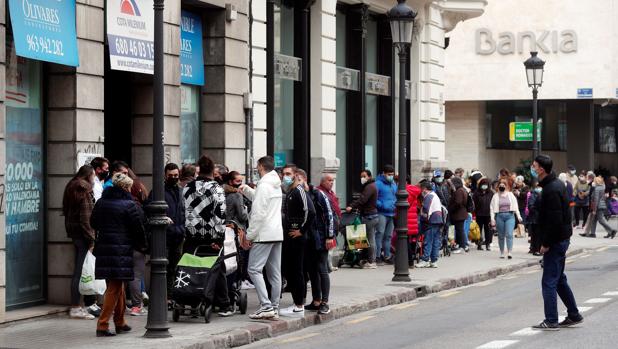
The indebtedness of Spanish households has increased not only in 2020 but also in the first quarter of 2021, and rising. At the same time, household disposable income has fallen very significantly. And it is significant because this decline in savings is occurring in the midst of rising unemployment and with the prospect of further increases, both of which are traditional drivers of increased savings and precaution in household spending. In other words, Spanish families are going bankrupt and, with no room for manoeuvre, they are drawing on any possible savings or debt to merely survive. The profits set aside by SMEs and the savings made by wage earners over years and years of sacrifices have vanished in just 4 quarters. And not only has their emergency lifeline disappeared, but the indebtedness they have been pushed into in order to survive has forged them into concrete feet.

.

Moreover, job destruction obviously goes hand in hand with the destruction of the business fabric. And therefore capital formation and business investment are neither there nor expected. The ERTEs provide a political cover-up for the employment scourge, but only temporarily, because when the dust of the demagogic measures dissipates, the harsh reality of our business fabric and labour market will slap us in the face unreservedly.

.

Nor will Papa State be able to do anything but mourn its resounding defeat. Expenditure and revenue projections were unrealistic even without COVID-19, as had been warning us the EU's Euro-bureaucrats. But the pandemic has shattered even the fanciful credulity of the government's staunchest groupies. The European funds are ridiculous and destined, to the surprise of any lucid mind, to digitise and green Spanish industry and companies, not to save them. In the end, these funds will remain in the hands of the usual people, far from the agonising real economy.

.

However, the game of Monopoly where the bank (ECB) continues to lend infinitely, it is unlikely to end in the default of any significant EU member. But we may well see a extraordinary fiscal adjustment imposed by the North of the EU (a few euphemisms suffice). And while this is happening, misery is permeating and spreading silently, like an oil stain, in what was once a welfare state.

.

The problems of the Spanish economy have increased tremendously and will continue to do so in the coming post-pandemic years, even if mass vaccination brings us back to normality. Because the normality of Southern Europe in general and Spain in particular is economic decline and fiscal exhaustion. Our population is unemployed, unproductive and its progressive ageing makes it even more extractive of a state that is exhausted. And fiscal abuse is the bread for today for the government of the day, but the hunger for tomorrow belongs to all Spaniards.

.

In this depressing scenario, we not only have to provide for our families, but we must also think about the future that awaits our children and the future families they will form. And the best thing for them will be to emigrate to countries whose economies are flourishing and where the wind of growth is blowing in their favour, and there are some. It is not easy to emigrate and get ahead, and that is why we must equip our children with the knowledge, tools and the strongest possible baggage to make their way in the world, as we explain in «The future of our children".«The sinister future of our children in Spain What can parents do?«.

.

Paying for an international and prestigious university education for our children will be our best inheritance as it will give them wings and teeth to fly and eat the world in growing and healthy economies. If, on the other hand, we bequeath them the equivalent of the cost of these international studies in bank balances or in bricks and mortar (see details of costs of all-inclusive University in the USA), we will be condemning them to a constant struggle in Spain to live in a minimally comfortable way, in an economically hostile environment and with a permanent icy headwind. And that extra 100,000 euros in the bank or half an apartment on the beach will not last long. I don't want that for my children. I want them to fly towards prosperous economies with the best preparation I can plan for them today.

What happened to GameStop - another New Normal?

The well-known Bloomberg editor Tracy Alloway explains in an article published this week what has happened in the markets with the price of the famous company GameStop and its chain of -obsolete?- physical videogame shops. Below we summarise Alloway's reflections and add some more from our point of view.

.

It seems inevitable that the democratisation or populisation brought about by technology will also reach the financial markets. But the impact of trading by small speculators through platforms such as Robinhood Markets is causing a real earthquake in which the strong hands of the markets are immersed without knowing or being able to do anything about it. Organised through various social networks, amateur investors/speculators have been able to make the share prices of meme stocks such as GameStop take off, while large hedge funds are suffering the consequences of having analysed these companies in more depth and betting against them.

.

Some fear that this war of money flows between small amateurs and big professionals, which generates infinite and further increases in the share prices of mediocre businesses, will collapse the system at some point. It may not go that far, but what is undeniable is that it takes away one of the basic premises of capital markets: the efficient allocation of capital.

.

  1. What happened to GameStop and how did it all start? The online broker RobinhoodMarkets, along with other similar platforms, have flooded the market with new amateurs. Many of them from their own homes, some of them unemployed, some of them studying and all with a lot of time on their hands because of the pandemic. It seems as if financial investment has become just another video game for this already gigantic niche. Tremendously crowded forums have sprung up, such as Reddit's WallStreetBets, whose slogan reads something like «Making money and having fun while doing it». These forums have made it their goal to exploit a financial system they have historically been unable to access. And the traditional market players, the establishment, are horrified at how they are managing to bend the system in their favour.
  2. How are they changing the way the market works? Traditionally Value investing has looked for undervalued companies to buy at a relatively cheap price in the expectation that it will go up. For the new amateur traders on such platforms, Value is not nearly as important. Some of the stocks these traders have their eye on are far from profitable or attractive to a traditional investor. But once the price starts to rise, the collective magnet is activated and the attraction of more and more interconnected traders on r/wallstreetbets begins. So far so good, since traditionally a company's share price can rise to a point where, relative to its earnings multiple, book value, etc., it is no longer attractive to investors. As a result, demand begins to be outstripped by supply and the share price moderates to more or less reasonable levels. But with the massive irruption of these new small speculators, prices can go far beyond what pseudo-fundamental or even technical analysis has historically tolerated.
  3. Why? Because flows dominate over professionals. The flows of money in and out are more important in this segment than the fundamentals themselves. And small traders have more capacity to detect and take advantage of the flows in and out of shares, with tools such as forums and the detection of the majority opinion of their colleagues in the purest social network style, than the professionals trying to properly delimit the value of these businesses. Paradoxically, professionals, at least in the stock segments targeted by these crowded platforms, are being relegated to the crumbs that retail investors used to have, and are sailing small boats at the mercy of the storms and big swells generated by the huge mass of amateur traders. The world upside down (finally?).
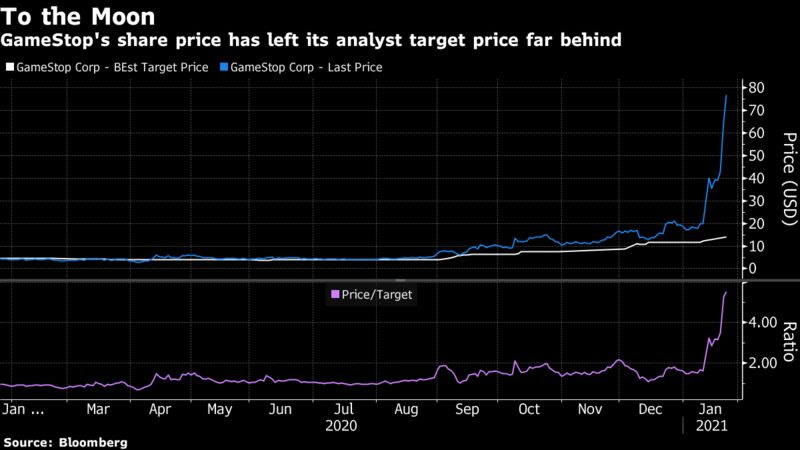
  4. Who were the professionals in the GameStop case? Short sellers, i.e. funds that borrow shares to sell them, hoping that their price will fall before they have to buy them back and return them to those who lent them to them for a small rental fee. These funds used to publicise their bearish bets and negative fundamental analysis on a company in order to convince the rest of the market that it is bad business to hold the stock and generate sales to drive the price down. But that strategy of professional investors going public with a short sale may now be history, because these days what this news generates is unbridled bullish interest from the unconditional mass of r/wallstreetbets. It is like a red alert that throws amateur traders into buying options on these stocks en masse, turning the traditional predators, the big funds and hedge funds, into prey. GameStop's share price has left its analyst target price far behind
  5. What is the strategy? The guys at r/wallstreetbets usually pick stocks that have weaknesses they can exploit. For example, some have taken to buying options on stocks to force their prices up. As many of you already know, options are contracts that give the holder the right to buy or sell the underlying stock at a certain price within a certain period of time. And new commission-free trading platforms, such as Robinhood, have made options trading much easier. The key idea is that buying options en masse forces market-makers to hedge their own exposures by buying shares of the underlying company. That dynamic can be enough to drive the price up, which generates more buy orders, feeding back more and more of the dynamic: The stock goes up, the short sellers give up and have to buy back the shares they need to return, and those forced purchases drive the price even higher.
  6. Can the small speculators really beat the big whales of Wall Street? What we should be looking at is not the amount of money retail speculators spend, but the amount of leverage inherent in those bets. Let's take an example:
    • Pol has a Robinhood account. He bought a call option strike $3,250 on Amazon on 14 August for $1,500. That option is crossed by a market-maker, let's say her name is Lola, who works at a large bank. But Lola does not want to take on the risk as Pol's counterparty; she wants to be merely a neutral facilitator. Her job is to facilitate trades in the market, not to bet on it, so she wants to hedge her position. She does this by buying Amazon shares, calculating what is called the delta of her position. The delta is how much the value of the option will change based on the price of the underlying stock. In this case she calculates that she must buy $66,100 worth of Amazon stock to maintain her neutral position. If Amazon's share price rises, she would have to pay for the option sold to Pol, but at least she would be compensated by the profit she would make on her Amazon shares.
    • A few days later, Amazon shares do indeed rise, and do so by 5%, so Lola needs to rebalance her books to maintain her neutral position. This time, because Lola's delta has increased, she will need to buy even more underlying shares. In fact, she will need to buy $230,000 worth of Amazon shares already. Et voilà! Pol's small bet has resulted in a purchase of $230,000 worth of Amazon shares.
    • By targeting broker exposure in a coordinated and massive way, retail traders are taking advantage of what is known as the «gamma squeeze». That is, as Amazon's share price approaches the strike price of the option, brokers and counterparties who want to remain neutral must buy more and more of the company's shares.
  7. What about hedge fund shorts? Gamma squeezes can be most effective when short squeezes of the company's shares are added. Traders at r/wallstreetbets have often identified companies with a lot of short interest and a small number of shares listed on the market. This further complicates matters when short sellers must buy back shares to close out their short positions. This dynamic also contributes to the rising price of outstanding shares as supply is scarce and demand, although forced, is more and more increasing. Hedge fund Melvin Capital announced on 25 January that it had accepted a $2.74 billion injection from competitors Citadel and Point72 Asset Management after its short positions generated a 30% loss for the year.
  8. Is this phenomenon a simple game? We might call it a simple gambling game were it not for the fact that these dynamics affect real companies, with real managers and real employees. Shares in GameStop, after all a retail software business, have soared exponentially this year. And the current price is such a cash injection that ideas have begun to emerge of what GameStop's management could do with all that capital raining down from the sky. Think of the strategic acquisitions, expansions and diversification of the business that are now within their reach. So these arbitrary flows also end up affecting the fundamentals of companies. AMC Entertainment Holdings, another meme stock whose main business is cinemas and theatres, avoided the bankruptcy to which the pandemic seemed to have condemned them at the end of January, by capitalising on the rise in its shares promoted mainly by retail traders. And in turn, some hedge funds may be selling some clearly bullish stocks to cover their losses, which will work against their returns.
  9. How long can this last? No one knows. It is difficult for the US regulator to fight comments on forums that generate such large movements because it is difficult to prove that such posts are part of an illegal orchestration to manipulate the market. In December the Massachusetts regulator made a formal complaint against Robinhood alleging that they had aggressively advertised their platform to attract novice investors and had not taken sufficient safeguards to protect them. Not very consistent, but that's all the regulator could do.

.

Big market squeezes tend to end abruptly and dramatically, and that will probably be GameStop's ultimate fate. But when that time comes, most fans of r/wallstreetbets will take their huge cash flows to their next target.

.

But we must not forget that amateur traders, most of them young people with or without university careers, who are causing these financial earthquakes are merely playing by the same rules of the game as the other players. The consequences of their flows are as morally reprehensible or irreproachable as the consequences of the flows of traditional strong hands. They have not invented anything, except that their strategic decisions do not stem from an investment committee or the Machiavellian complicity of several of them, but from investment trends or fashions that are transmitted through what we might call socio-economic networks, and whose execution is as atomised as it is massive and disciplined.

.

The big loser in this game is the efficient allocation of capital. Because although the rise in share prices can save companies from bankruptcy or provide businesses with money that, if well used, can make them take off in profits and improve their fundamentals, let us not forget that capital is being showered on those who do not deserve it. Companies that over the years have not been able to attract the capital of investors seeking value do not know how to generate it. And probably, the fact of providing them with capital that does not seek Value but rather to take advantage of inefficiencies in the system (not in the market), will not only perpetuate mediocre managers in their posts but will also give them, at least temporarily, more power.

https://twitter.com/ScotchStocks/status/1354630176806678529?s=20

An INefficient allocation of capital that comes on top of what we have been suffering since 2008, with state interventions to keep zombie companies and managers alive with free debt at negative rates, and against which it is very difficult to navigate. Therefore, although it is perhaps fairer that not only the strong hands take advantage of the failures of the system (don't miss the video-analysis by Tucker Carlson above), the market must increasingly handle more and more players who do not seek efficiency in the placement of their capital but other things. And that makes the market more inefficient and for longer, which is not necessarily as bad as it seems for those who navigate it with the search for value as their only compass.

Eurozone tested positive for Covid-19

Those of you who read us regularly will know that we have been saying for years that the Eurozone, as we know it, is neither viable nor sustainable. We warned this almost a decade ago (how time flies!), when the banking crisis was straining the seams of the Eurozone to the limit, and the dreaded Men in Black (MIB) of the Troika were scrutinising the public accounts of the Mediterranean countries of the south. The much-vaunted and politically correct concept of «More Europe» repeatedly hit the wall of the rich and productive North, which preferred a simple and profitable market union to a political, monetary and fiscal union.

.

Thus, the MIBs more or less discreetly shielded the Memorandums of Understanding (MoU) to avoid the free bar that we demanded from the South. Only in exchange for this and the stubbornness of the Eurobureaucrats to kick the can down the road and postpone the moment of truth, the Eurozone went ahead with all its incompatibilities and manifest unsustainability. The hope - in which nobody believed any more - was that with the help of the ECB's QE, and a few years of pseudo-bonanza, the South would, macroeconomically speaking, catch up with the North for once and for all. But the circle has remained unsquared for all these years.

.

The final blow to the economies of the South has come in the form of the SARS-CoV2 coronavirus pandemic, also known as Covid-19 disease. In this mother of all health crises, which is as bloody as it is short-lived, economies as large as Italy or Spain would need a shower of billions in debt (Coronabonds, Eurobonds or whatever you want to call them), which the northern Europeans are not prepared to finance jointly. Paradoxically, this time Merkel is not the standard-bearer of the NO to the free bar but the Netherlands, although it is also true that it is easy for the Germans to play the good cop with the bad Dutch cops. For whatever reason, the South (including France) is trying to take advantage of the final stretch of Merkel's political career to make some desperate concessions in spite of fierce Dutch opposition. The fact is that whatever comes after Merkel is likely to be much less inclined to make concessions to the South, remember the populism that Wolfgang Schaeuble achieved with his proposal to expel Greece from the System. A proposal that, on the other hand, made all the economic sense in the world.

.

Today, what the Netherlands and its circle of influence openly propose is a Europe as a simple common market (sound familiar?). And this idea of the EU coincides with the UK's idea of the EU, which has always been so vilified by Euro-bureaucrats. So this drift towards a «Less Europe» with which the North would feel comfortable could be the way forward, despite the opposition of the countries of the South, since we know that he who pays the piper calls the tune. But there is one small detail that complicates this idea of Europe: the Euro. A Common Market loses much of its meaning and simplicity if the monetary policy of all its members must necessarily be the same. In other words, having the same currency exchange rate, the same price of money (interest rates) and a single issuing bank (ECB), puts us back at the same starting point where we are right now. In other words, the South urgently needs trillions to survive, as well as a depreciation of the currency to regain competitiveness and hopes for growth, but the North is not willing to grant it at the expense of its economies. And this constant refusal is generating the rejection also of the European project by the countries of the South, since they know that the - insufficient - financial aid granted by the North will bring with it the relentless return of the dreaded IMFs, which entail the absolute loss of budgetary, fiscal and economic sovereignty in the countries of the South. The EU seems to be finally facing the final wall of the cul-de-sac along which it has been kicking the can down the road since 2011.

.

The glimmer of lucidity in the face of this permanent flight forward that the coronavirus has precipitated seems to be coming from France. Emmanuel Macron told none other than the Financial Times this week that the pandemic has brought the EU to a «moment of truth».». It is no coincidence that  Shahin Vallée, former advisor to the President of the European Council and strongman of the French Ministry of Finance, proposes to create what he calls «the coalition of the will» within the EU. In other words the EU to split into groups according to their intention to evolve towards «More» or «Less» Europe. Thus, countries that want more integration could keep their single currency and monetary policy, giving up sovereignty in exchange for a growing and irreversible fiscal and political union. But what is more curious is that those countries that want less integration, once freed from those who want «More» Europe, could also remain integrated. That is to say that the two incompatible parts would accommodate each other once they are freed from each other, resulting in a Europe not only with two speeds but with two different currency rates, two central banks and two different monetary policies. It would not be a Europe in perfect equilibrium, but it would be much more stable than the unsustainable powder keg in which Covid-19 leaves us.

.

All this could well be covered up under the same Europeanist sheep's clothing, of course. That is to say, using euphemisms that might even keep the less informed in European inopia (continue to call both currencies the Euro, continue to call both issuing banks the ECB, etc.). But there would be undeniable differences, such as, for example, the value of the euro in the southern countries, which could be 20 or 30% lower than the euro in the north. Of course, they would initially be quoted at par, intervened by the ECB, to avoid as far as possible the implementation of corralitos in order to prevent the flight of assets from the south, but they would necessarily drift apart over time. Post-covid19 rates would not diverge in the short or medium term, as everyone needs zero or negative rates at the moment. But in the medium term, Northern Europe could finally follow in the footsteps of the Fed. gradually increased the price of its strong Euro. Maybe we could even see a political and fiscal union beyond the mere common market in one of these - at least - two distinct zones, who knows, since the circle is much easier to square with truly converging economies and a club with fewer members and more common interests.

.

So, how should southern wealthy individuals position themselves in the face of such a post-pandemic scenario? Well, obviously they should avoid accumulating assets in the South or in the South, i.e. avoid having real estate anchored in the less wealthy EU countries (Spain, Italy, Greece, Portugal and even France). Instead, they could hold them in countries that are likely to be able to sell in Euros that are not affected by the depreciation against the Euro in the North. Or hold them directly outside the EU, for example real estate in the USA, buying them still with the only existing Euro and not with the future devalued Euro of the South. As for financial assets, obviously shares of companies from these southern countries should also be avoided in portfolios, and of course their public and private debt. Moreover, as we have said countless times before, and today more emphatically than ever, the more safety steps we can add between our money and the need to collect or confiscatory In the southern states, we will sleep better at night. We must be aware that in times of extreme situations, extreme solutions will be taken, which we would never have foreseen just 6 months ago.

.

What is undeniable is that even if this EU evolution takes more or less time to arrive and Euro-bureaucrats keep banging their heads against reality, this pandemic is going to leave the West's economic and political supremacy mortally wounded. Covid-19 will have a clear winner, if anyone is going to win in this pandemic, and that winner is none other than China. Not only because it has coped and preserved its economy in an exemplary manner during the epidemic, but also because the rest of the world will inevitably set back several years of economic growth. And that will radically accelerate the leadership of China and its very powerful economic orbit (Vietnam, Korea, Malaysia, Australia, Japan, Indonesia, etc., even India itself), making Asia the new centre of the world. It is true that many will say that the figures of contagions and deaths from the coronavirus in China are unreliable. But let's not kid ourselves, because the figures for many Western countries are not reliable either, and very few question them.

.

In these weeks and months of the pandemic, we have seen how each country has handled the health crisis in very different ways. The results are as diverse as the idiosyncrasies of the respective governments and citizens. And in the European Union, especially in the South, we find countries (read Spain and Italy) that are managing the health crisis in a more than dubious way. Once again we are seeing the differences between North and South within the EU, also in health policy management. The only thing that will probably remain of this European union after the pandemic will be the relative resilience of the northern economies, and the common market that has always been advocated by the most realistic.

.

Golden times for the awakened investor. We warned mid-March and also last day 1st April (by the way, the markets have risen close to 30% since the lows of that time). This crisis will change a lot of things in Europe, and at the same time it is uncovering huge opportunities. Imagine if we can take advantage of the restructuring of the Eurozone and the Euro, if we can invest in healthcare companies around the world and especially in China, or if we can take advantage of the pull of the stock markets and economies of what will be the new centre of the world. And all this with the wind at the back of every central bank on the planet. Unfortunately times are bad for the local investor with local assets.


How much will those who invest today earn?

For those of you for whom the trees of panic and volatility prevent you from seeing the forest of opportunities and returns that lie in the palm of your hands, let us explain Nick Maggiulli's simple, mathematical analysis of Ritholtz Wealth, which we fully endorse.

.

The crux of the matter is to shed light on asset purchases during times of panic. But first let us put the current crash in context.

.

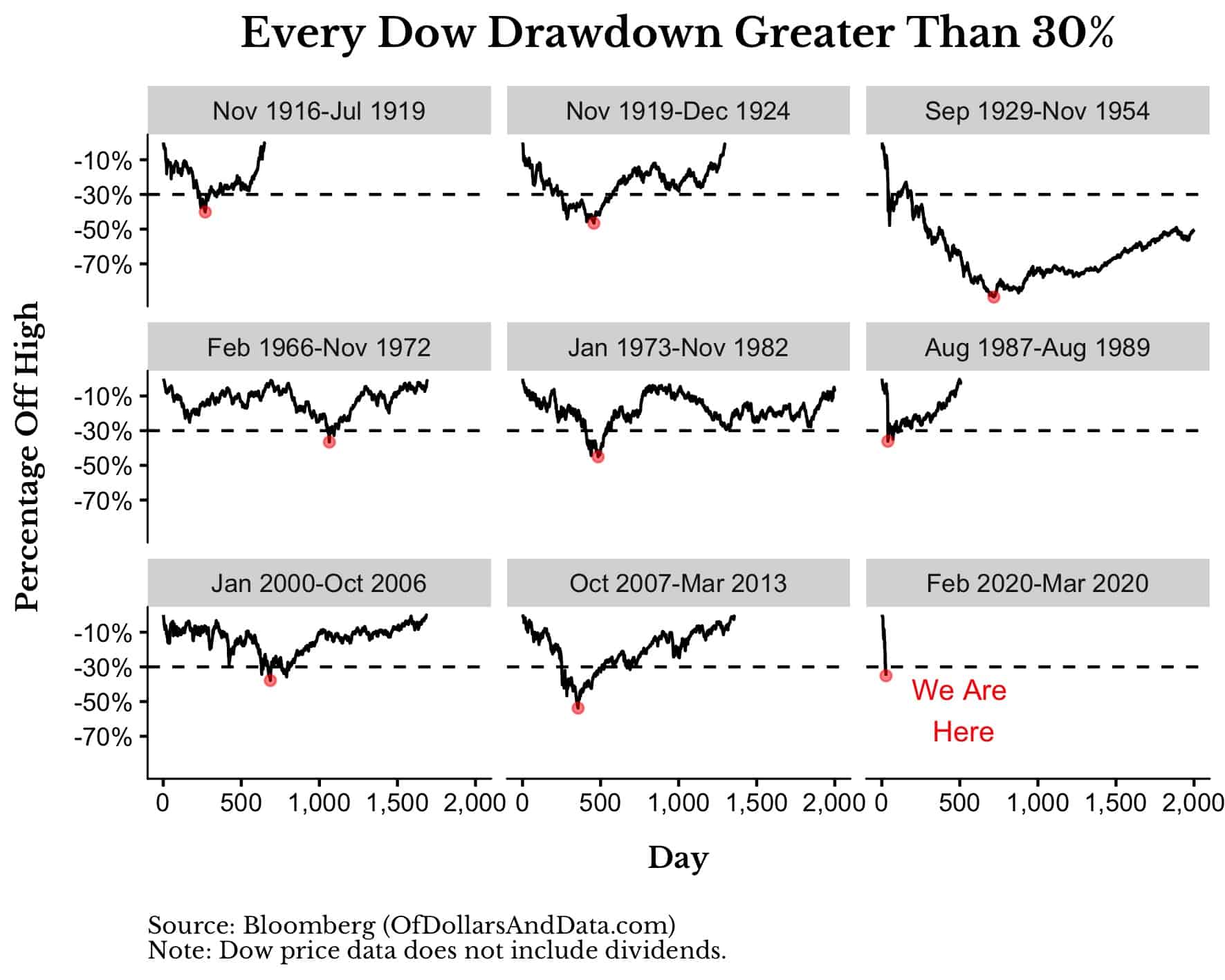
As of today, the low for the Dow Jones has occurred on 23 March 2020 and has been 35% from its highs, making it one of the worst months in the history of the US stock market.

.

If we analyse all the crashes above 30% since 1915, we see that this crash is one of the fastest and fastest we have ever had.

Moreover, while in the past we see the little red dot that signals the floor, at this moment we still do not know if we have already seen the low of last week or if it is still to come in this coronavirus crash.

.

Nevertheless, there is no doubt that these are golden times for investors buying equities now. Every euro or dollar we invest in today's markets will grow much more than those invested in previous months as soon as the markets recover. Because we all assume that sooner or later the markets will recover and humanity as a whole will eventually beat this virus as it has beaten other health crises before, right?

.

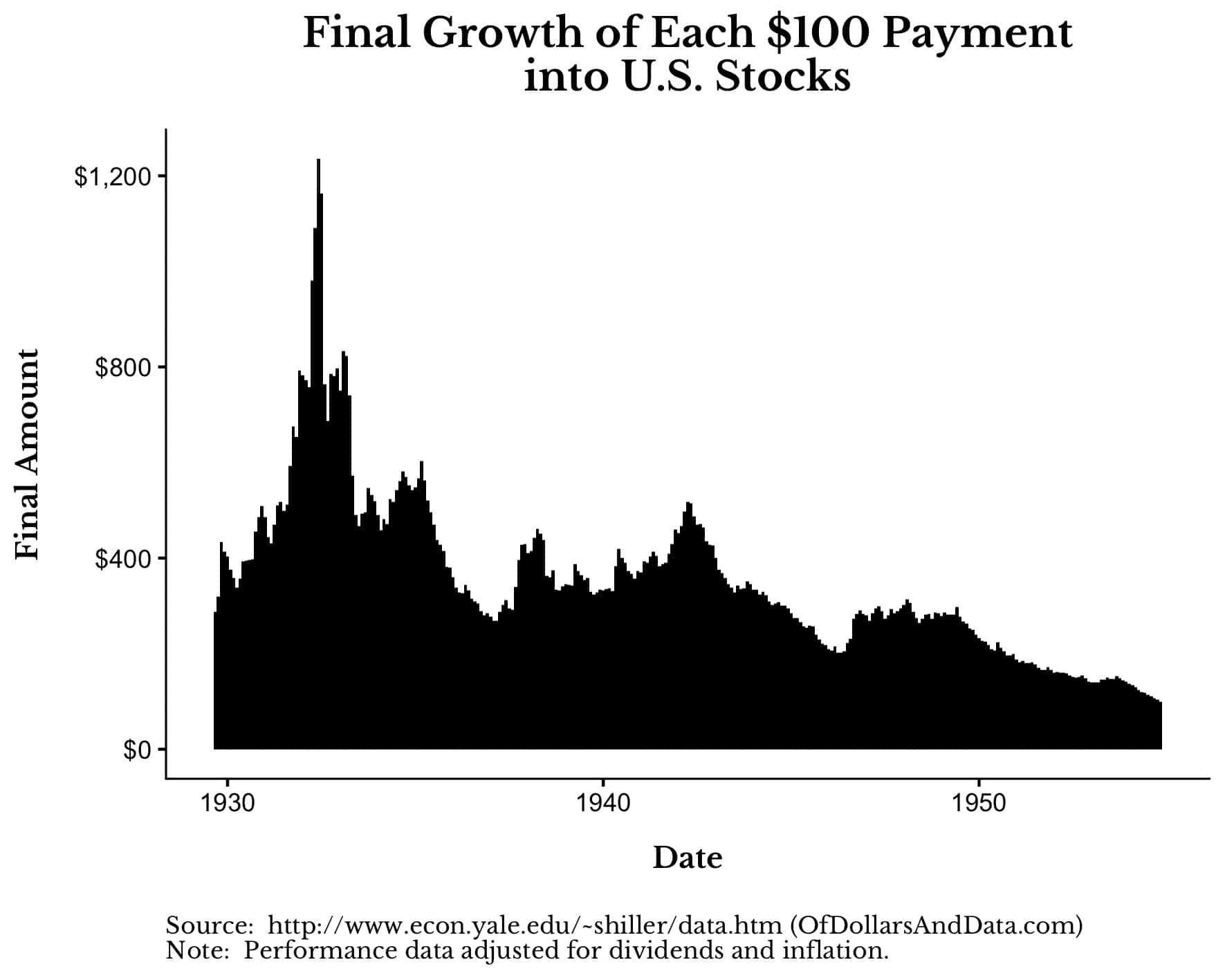
To demonstrate that every dollar invested today will yield much more than those invested before the crash, let us imagine that we decide to invest $100 every month in the US stock market from September 1929 to November 1954 (crash of 1929 and its subsequent long recovery).


.

If we had followed this strategy, this is what each $100 packet would have earned (including dividends and adjusted for inflation) until the recovery was completed in November 1954:

As you can see, the closer we bought to the low in the summer of 1932, the greater the long term benefit of that purchase. Each $100 invested at those lows grew $1200, which is three times as much as the $100 packs bought in 1930 ($400).

.

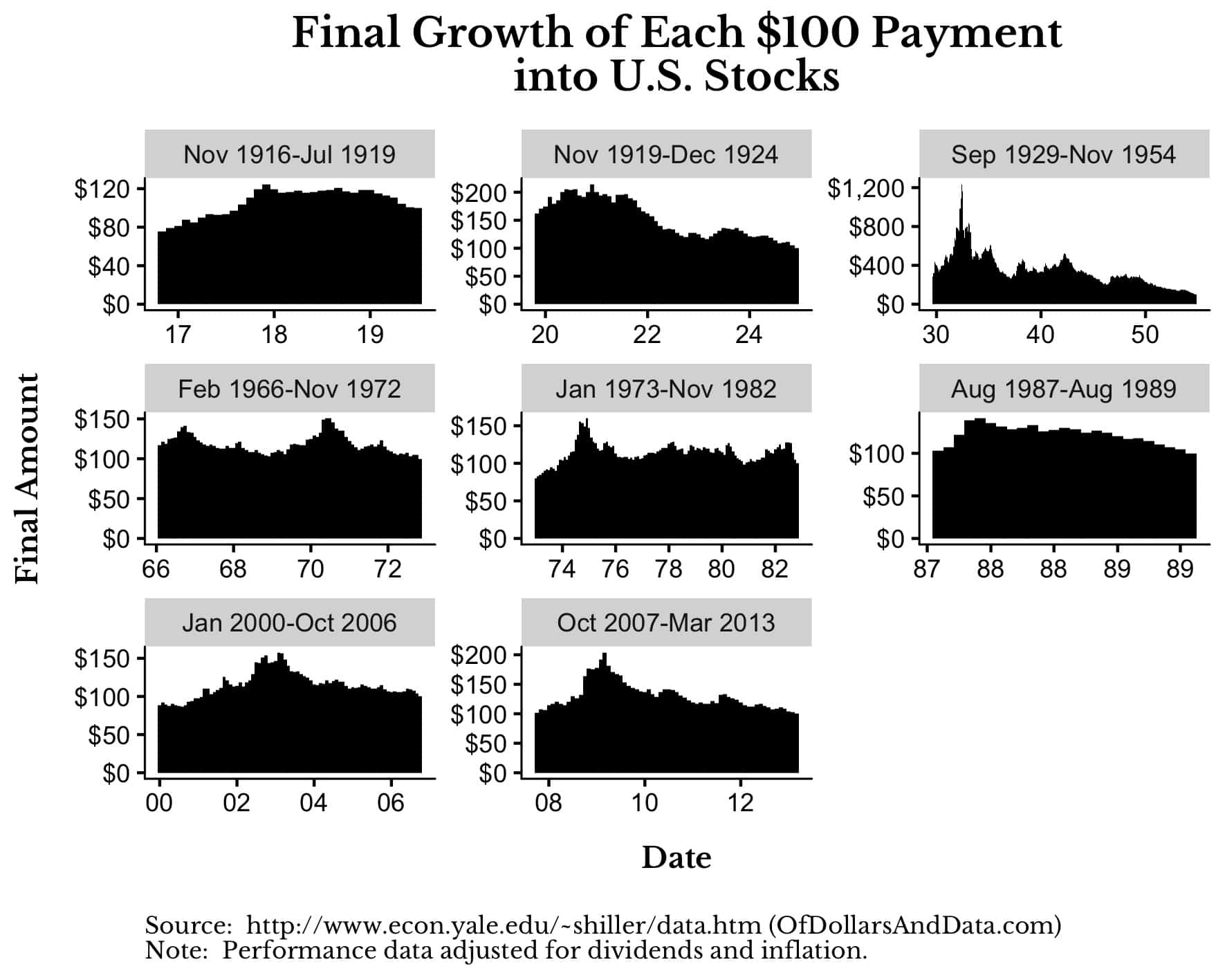
However, even if we look at the other falls above 30% shown in the first chart, we still see much higher profits if we buy during times of major panic and market declines:


This chart shows that buying near crashes (even if we don't hit their lows exactly) provides between 50 and 100% more profit compared to an investment at other times. That means that your $100 will grow $150 or $200 more (adjusted for inflation) when the market has recovered again.

.

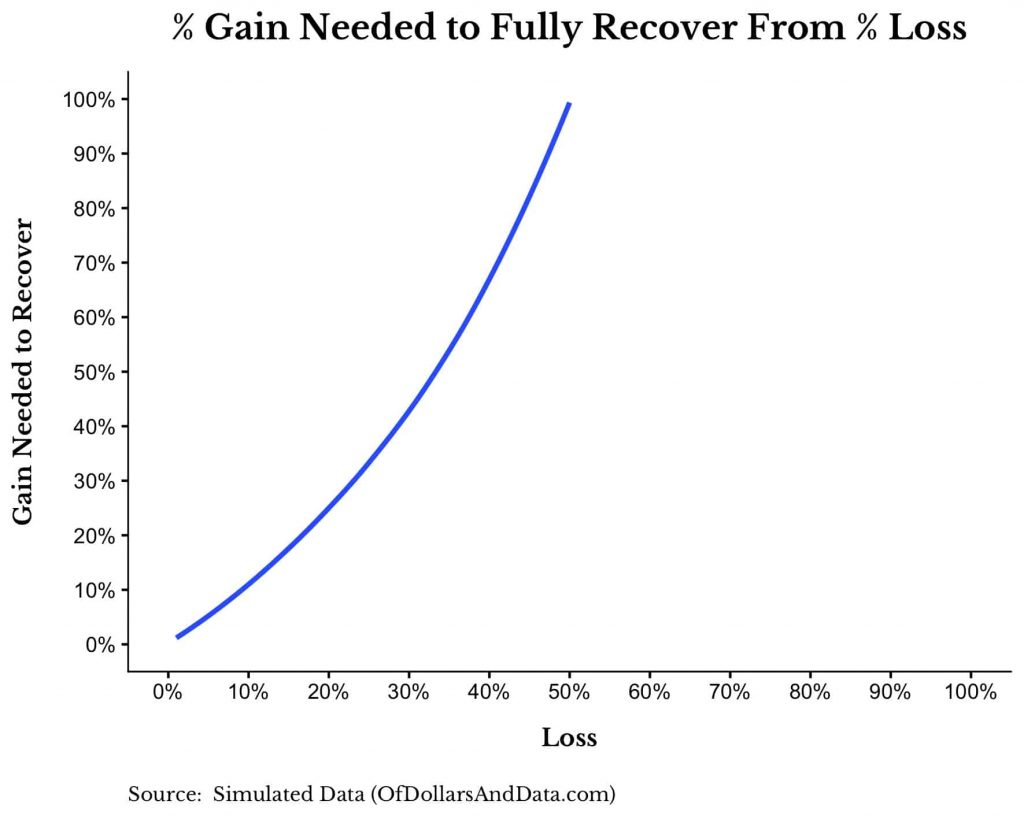
But where does such a spectacular increase come from? Well, besides being intuitive, its origin lies in simple mathematics: Every percentage loss requires a higher percentage gain to compensate for it. At this point in the film, it should not escape anyone's attention that a 10% fall requires an 11,11% rise to recover that loss. In the same way that a 20% loss requires a 25% rise and a 50% fall requires a 100% rise. You can see this exponential relationship very clearly in the graph below:


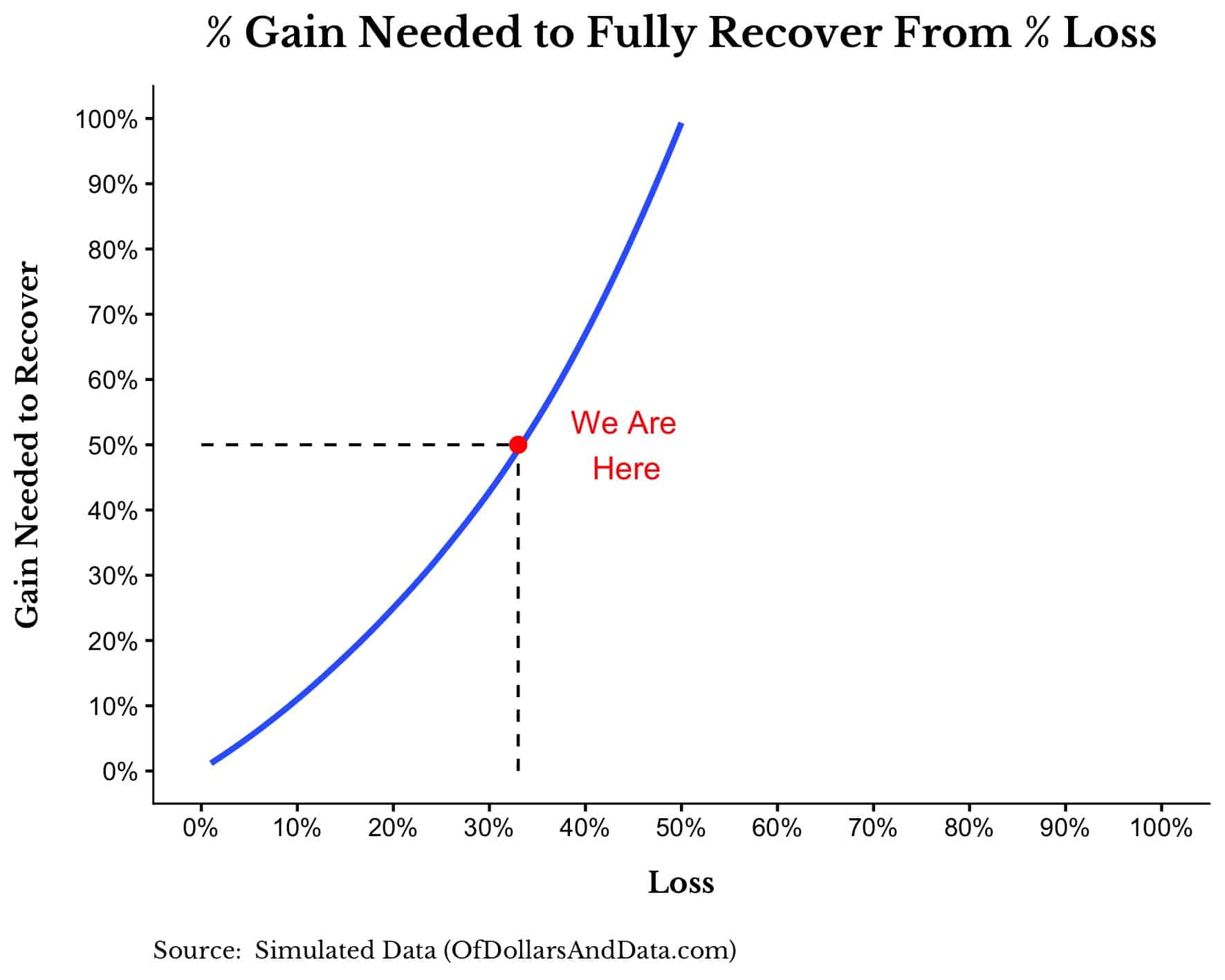
Let us now see what the chart would look like adapting it to the fall in the markets up to last week (-33%) and see the profit that would be needed to recover it:


If we do not see new lows, the recovery needed is 50%. And what a coincidence, for every $100 invested now they will generate $150 (a further 50%) when the recovery materialises.

.

But despite the obvious benefit of buying during the current panic, most investors are not doing so at all. Including those who have a lot of cash, either because they had it in other assets or because they sold during the crash in panic. And thank goodness they don't, because if they did, the crashes would no longer be crashes, and therefore the opportunities for good investors would vanish before they materialised. Excuses for not doing so can be diverse and very convincing for less good investors. Among them are «this time it's different» or «we don't know if it will fall further». As if a good investor is only one who is lucky enough to buy just on the day when the markets quote what will be the historic low of that crash. Remember that in graph 2 we talk about buying "as close as possible" to the low, without aiming to buy right on the bull's eye.

.

Let us now honestly answer the following question: How long do you think it will take for the markets to recover to the pre-pandemic highs? A month, a year, a decade? How long will it take for the indices to recover from that 33% decline? Answer yourselves.

.

Based on that answer, let us return again to the expected annual return in the future for our current investment. The equation is as follows:

Expected annual return = (1 + % Gain needed to recover)^(1/Number of years to recovery) - 1

But since we know that the percentage gain needed to recover is 50%, we can simplify it as follows:

Expected annual return = (1.5)^(1/Number of years to recovery) - 1

Therefore, if you think that the market will take time to recover:

  • 1 year, then your expected annual return = 50%
  • 2 years, then your expected annual return = 22%
  • 3 years, then your expected annual return = 14%
  • 4 years, then your expected annual return = 11%
  • 5 years, then your expected annual return = 8%

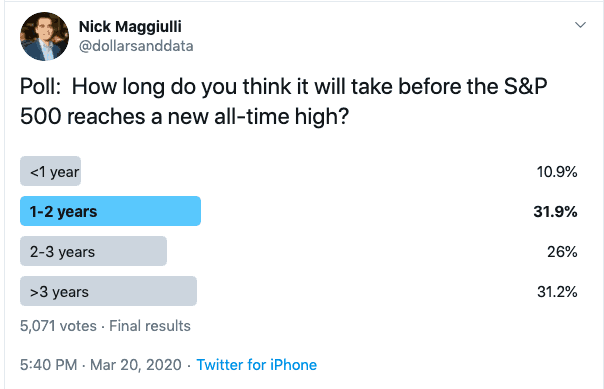
Even taking 5 years for a full recovery, the market would be offering you the same return as the US stock market has historically yielded. Nick Maggiulli asked this same question on twitter and found that two out of three of his poll participants believe that the recovery will come within 3 years.


That means that if the majority of respondents are correct, any investment made now, is going to yield between 14% and 50% annualised until the market recovers. Think about what this means. Investors who choose not to buy at this time are either giving up an annualised return in excess of 14% for the next 3 years, or they believe that the market will take more than 5 years to recover and despise annualised returns of less than 8%. In short, the only reasonable reason not to do so is if you already have all your money invested and have no more at the moment (time to sell grandma to invest more in the stock market, as he said...).

.

Of course, new black swans may occur on the planet, delaying the recovery of markets, as has been the case for decades in Japan, for example. But it seems unlikely, especially in efficient economies such as the US and growing economies such as China and the other Asian economic orbit. Moreover, note that throughout the article we are referring to the market, i.e. the indices. But imagine the figures that will be achieved by those who also have the possibility of investing in actively managed funds that significantly outperform the benchmark indices. In other words, those who invest in portfolios where the management team selects the companies with the greatest potential for recovery at this time (Healthcare sector in China, for example). And we will not tire of repeating that, although the vast majority of actively managed funds do not outperform their benchmarks, especially within the limited universe of funds marketed in Spain, there are world-renowned managers who have been doing so for decades. Unfortunately, however, they are not easily accessible to the average Spanish investor, as we explain in detail in «Why don't large international investors invest in the same funds as you?«.

.

As he once said Jim O'Shaughnesy, Many people confuse possibility with probability, and the two are almost opposites. Keep this in mind as you face new challenges that will come in these days.

.

One of the things that still surprises me is to see how simple mathematics can help us to clarify the thickets in which our own minds entangle us. Our fears and passions are our worst ally in the face of the crash caused by the covid19 virus. Objective figures are certainly a glimmer of sanity to handle Mr. Market's schizophrenia. And the numbers show us that, assuming the market (and even more so our well selected stocks by the world's best managers) will recover in the coming quarters or semesters, the returns we will get are very, very attractive. And therefore, any hypothetical new low in the stock markets would be nothing more than an additional buying opportunity and even higher profits. Fortunately for a minority, the majority do not see it this way and are still waiting to see the floor, like those who are permanently waiting to catch the next train, which will probably be an AVE train that does not stop at their particular station.

The lies of the Spanish government and health authorities about the coronavirus

It is regrettable to see the differences in the handling of the emergency situation in the coronavirus pandemic between different countries around the world. But what is worrying is the attitude of the Spanish political and health authorities in the face of this crisis, as they strive time and again to distort the facts and data in order to minimise its stark reality. A mixture of cowardice and misunderstood paternalism that justifies, in the eyes of some, the absence of courageous decisions. The Spanish authorities' determination to deceive the public stands in sad contrast to the realistic and serious warnings of other governments and global health organisations.

.

The Minister Spokesperson of the Government, Maria Jesús Montero, has declared in different media, and without any blushes, that Covid-19 is nothing more than a «...a new and unacceptable project".«new flu, similar to normal flu and with an even lower mortality rate than normal flu».» (for example in minute 10 of the following interview with him on RAC1 last week).

.

.

The unfortunate reality is that the lethality of this virus is much higher than that of seasonal flu. And any well-informed scientist, whose rigour is not contaminated by the government's political slogans, will admit statistical figures of around 3 or 4 deaths per 100 infected. Some Spanish authorities use mortality figures for normal 2% flu, but for hospital admissions and not for those infected, thus inflating the mortality rate and making it incomparable with that of Covid-19. On the other hand, also maliciously, they proclaim that the mortality of the coronavirus is 0.7%, taking the death figures for those infected just at the beginning of the epidemic in Europe, which means that the sick who are going to die have not yet done so. To further embarrass the minister, here is the official comparison between the mortality rate of the common flu and the US CDC's Covid-19:


.The most statistically reliable figures are found in China, where there are more and older cases of coronavirus. And those figures are now in the 3,75% mortality3012 deaths out of 80409 infected. Unfortunately, a fraction of those infected today will also die, while the number of new infections is already declining, so that this percentage is also tending to increase by about 0.04% per day, as it has done in the last few days. In other words, if the official figures in China are to be believed, mortality is indeed frighteningly close to 4%. And if we don't believe the official figures (I personally do) and think that the Chinese government is making up the mortality, then that's the end of the story. You can follow the daily evolution of the official figures in China at this page from Wikipedia, and the official figures for the rest of the world at this one.

.

However, some news which many people dismiss as being tremendist, infodemic or fake news, are in line with what is published in the majority of the world's media. international media with up-to-the-minute timelines of any new developments regarding the coronavirus,and spare no means or adjectives to keep the people of their respective countries on alert and on the lookout for health emergency. Because this state of alert and emergency does indeed punish the economy in the short term, but it saves lives. Thus, countries such as the US, where the spread of the virus is currently still proportionally lower than in Spain, are giving unequivocal instructions to their citizens to be prepared for imminent confinement o emergency situation This is because, mortality rate aside, what is clear is that this coronavirus is highly contagious, and its spread across the planet is unstoppable. Mortality rates aside, what is very clear is that this coronavirus is highly contagious, and its spread across the planet is unstoppable. That is why responsible governments are alerting and preparing their citizens for a massive infection. According to the calculations of Harvard Professor of Epidemiology Marc Lipsitch, Between 20 and 60% of the world's population will be infected by the coronavirus if we do not take drastic measures as China has done and/or an effective and viable drug does not emerge for everyone. And pending such a drug, our only option is to slow the pandemic. That means, even with optimistic mortality rates, millions and millions of deaths across the globe, at a brutal cost at all levels. What a contrast to the statements happy flowers of our ministers and health spokespersons who keep talking about «new flu that kills less than normal flu», right?

.

.

It is undeniable that a realistic warning about what is coming makes the population radically modify its usual activity, and with it consumption, productivity and therefore the economy plummets, as has happened in China. But courageous (albeit belated) measures, such as those taken and implemented with martial rigour by Xi Jinping, will save his country's economy in the medium and long term. Because an uncontrolled epidemic, with the mortality rate that this coronavirus entails, would have a far greater impact on the economy in the medium term than the short-term slump. Economically we could see a V-shaped economic downturn and recovery, but without bold measures by the already growth-anemic developed economies, we in the West will not even see a U-shaped recovery.

.

In Italy, the epidemic is just a few weeks ahead of us, and yesterday the decision was taken,The government's decision to close all schools and universities in the country, albeit belatedly, was a belated one. In Spain, on the other hand, despite recognise at least 3 infections in children school-age children, the closure of schools is not (yet) being considered. Not only that, but in one case it was the mother who insisted time and time again that her daughter be tested for the coronavirus, while the health authorities kept telling her to find a family member (as both parents had to stay at home because they were infected) to take her to school normally! What a botched job we are doing on such a serious issue in which we all have so much at stake! Because the fact that the vast majority of children and young people overcome the infection with mild or even asymptomatic symptoms does not in any way prevent these children and young people from infecting their parents, grandparents and teachers. These are all groups that will suffer serious consequences and whose mortality is very high, as we have seen above. Moreover, it is absurd to try to contain the epidemic by keeping infected parents at home and letting their children, who are also infected but many of them do not know it, move freely in the streets, buses and other environments with which they usually interact.

.

Another example: In Spain, the authorities have gone out of their way to emphasise that the existing infections were not from the EU (locally infected) but imported, from Italy, China, etc. They insistently stressed that this was a very important detail, trying to convince the population that Spain was in a perfectly controlled situation since our infections were all imported, ignoring the fact that it is only a matter of time before there are, as there have been, community infections in Spain. However, when faced with infections whose origin is not imported, the Spanish authorities still describe them as of «unknown origin», without yet recognising that they are already Community infections, i.e. local.
.

On the other hand, in the United Kingdom, despite having fewer people infected than in Spain today, there are already clearly warn The population should be made aware that community infections are an imminent reality and that the population needs to be aware of this in order to be better prepared.

.

Even in the American universities clearly warns that if students take advantage of spring break (similar to Easter holidays in Spain) to leave the country or visit areas with a high incidence of the virus, they will have problems to be readmitted back, unless they stay in the country for the rest of the year. two-week quarantine in a suitable location before returning to their rooms on campus. Just like here...

.

The situation is very serious, because unless a medication emerges within a few days that drastically reduces mortality and is feasible for mass administration, what is happening in Italy will only be the tip of the iceberg in the rest of Europe. And neither the health services (already overstretched in Italy) nor the logistics of essential supplies will be able to cope with a massive contagion. That is why it is vital to take courageous measures of blockade and isolation as China has done, even if it means a short-term economic collapse. However, the first decision the EU took was to take the option of closing intra-European borders off the table, thus paving the way for the free movement of Europeans and Covid-19 from Lisbon to Berlin. Yes, those same intra-European borders they did not hesitate to close instead, unilaterally suspending the agreement on Schengen, The refugees were arriving by the millions in the heart of Germany.

.

The paradox that China will now face is that it will have to continue to close its borders (to people, not goods) to prevent, once its domestic epidemic has been controlled, the virus from infecting them again, now coming from countries like the Europeans where the infection will be out of control due to late and cowardly political decisions. This is why we will see the recovery of the courageous Asian giant sooner than that of the old and cowardly Europe, which represents an extraordinary investment opportunity, as we already advanced in «Realistic coronavirus figures and the opportunities of an unfortunate crisis«. China begins its path back to business. And it does so having acquired a priceless technological know-how to handle the next health crises, as we can read in this WeekInChina article.

.

In short, the handling of information and alerts to the public say a lot about each country. And unfortunately in Spain we have authorities who are more concerned with bread for today than with deaths and hunger for tomorrow. They focus the State's communication efforts on keeping the population in the dark, who consequently live without any foresight in the face of a health emergency, i.e. without stockpiling food and medicines or any family or personal contingency plan whatsoever. Even the Director of the Alerts and Emergencies Coordination Centre, Fernando Simon, has gone so far as to say that wearing a mask in the street is counterproductive because people would laugh at us or believe that we are infected, insisting time and again that masks do not protect us from infection in any way. And then admitting with a small mouth that if the population buys masks, health professionals will not have enough, proving that they are an efficient and necessary element of protection. Let us remember that in countries like China they are compulsory masks for the entire population in risk areas and punish those who go out on the streets without them. Other governments, such as the French or German directly confiscate or prohibit the export of facemasks so that their health professionals can have them, without treating their citizens as imbeciles by telling them that they are no protection against infection and that they will make fools of themselves if they put one on.

.

It is true that some young and healthy readers may dismiss this article as being tremendist, but they should bear in mind that although they would overcome the infection with hardly any symptoms, they would probably fatally infect other less healthy and younger people in their family and professional environment, or simply strangers with whom they share, for example, a simple public transport. In the end, it is better to continue informing ourselves in international media and preparing ourselves for the worst, while we cross our fingers that we will soon have a medication available to everyone that will reduce the real mortality rate to the levels of a simple flu.


Shall we help you search?

Cluster Family Office

We care about transparency both in management and in our own way of working. Leading wealth management and family offices company

Do you need help in capital and wealth management?

How can I avoid the negative effects that my fortune may have on my children?

How and when should I talk to my children about family wealth, and what relationship should they have with money throughout their adolescence?

How can I measure the real risks of my investments and protect my assets adequately?

Do I have sufficient liquidity and stable income to cover my needs on a permanent basis?