
We look after your interests

(+34) 93 626 47 75

Torres Sarrià, Carrer de Can Ràbia, 3-5, 4ª Planta BCN 08017

(+34) 91 794 19 82

Pº de la Castellana, 93 2nd floor MADRID 28046

Category: Estrategia

Investing in Medallion and Renaissance. The secrets of the world's best managers.

Most investors know little or nothing about the inner workings of what is considered the best investment fund in the world, due to its stratospheric performance over more than 30 years, the Medallion Fund. We have therefore decided to write this article unveiling the information we have gathered and the ins and outs we learned when we visited its management, Renaissance Technologies, a couple of years ago. Despite the length of the article, we believe it will be very interesting for readers to learn about the background, inner workings, curiosities and eccentricities of this great group of scientists, who have been recognised as the best managers in the world for their ability to beat the market for decades.

.
The first piece of bad news is that since 1993, Medallion has only managed money for its just over 300 employees and, of course, the owners of the management company. The good news is that Medallion's fund manager Renaissance, has 3 funds open to some institutional clients. But the second piece of bad news is that to invest in these institutional funds you have to have a minimum of $5 million, and also pass the due diligence that the fund manager performs on new investors. Yes, you read that correctly, to access Renaissance's institutional funds it is not enough to have a minimum investment of 5 million dollars, but the managers reserve their right of admission. But do not be discouraged, read on because At the end of the article we will explain how an investor with a minimum of 125,000 euros/dollars can access these funds. 

.

According to Bloomberg, the size of the Medallion, which is the fund set aside for «...", has been reduced to the size of the Medallion.«friends & family».» The current owner's fund size is approximately $11 billion, which together with the other funds that Renaissance manages for an elite group of institutional clients, make up the $62 billion under management in total (figures as of January 2019).

.

We will now explain the origins and evolution of the world's best fund manager, and at the end of the article we will tell you about our personal visit to the Renaissance Technologies facilities, after passing both their due diligence and ours and thus becoming institutional clients of their funds.

.

The origin and evolution of Medallion and Renaissance performance:

On the north shore of the luxurious Long Island, just a couple of hours' drive from Manhattan, lies the area popularly known as the Renaissance Riviera. Not for nothing are the biggest billionaires in the area scientists working for Renaissance Technologies in neighbouring East Setauket. This elite group created in 1988 what has been the biggest money-making machine in the financial world, the Medallion Fund. A quantitative fund that has far exceeded the returns of other legendary managers such as Ray Dalio or George Soros. And what is even more spectacular is that it has done so in less time and from a smaller size.

.

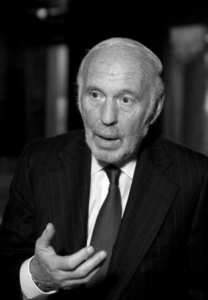
This fund almost never loses money. Its worst 5-year performance has been -0.5%. According to Andrew Lo, professor of finance at MIT and chairman of AlphaSimplex, another quantitative fund manager, «Renaissance is the financial and commercial version of the Manhattan Project«. Andrew Lo praises Jim Simons, the mathematician who founded Renaissance in 1982, for bringing so many scientists and intelligence together in a single enterprise. «They are the pinnacle of quantitative investing. No one is even close to their level.». Very few companies generate so much fascination, buzz and speculation. Everyone has heard of Renaissance and the mythical Medallion but hardly anyone knows what goes on in there. Apart from Simons, a somewhat more public figure who retired in 2009 with a personal fortune estimated at more than $16 billion, little is known about the rest of its small group of founding scientists, whose wealth exceeds the GDP of several countries.

.

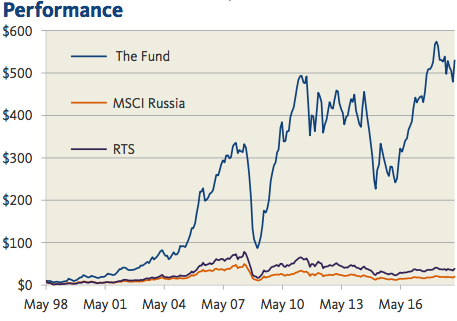
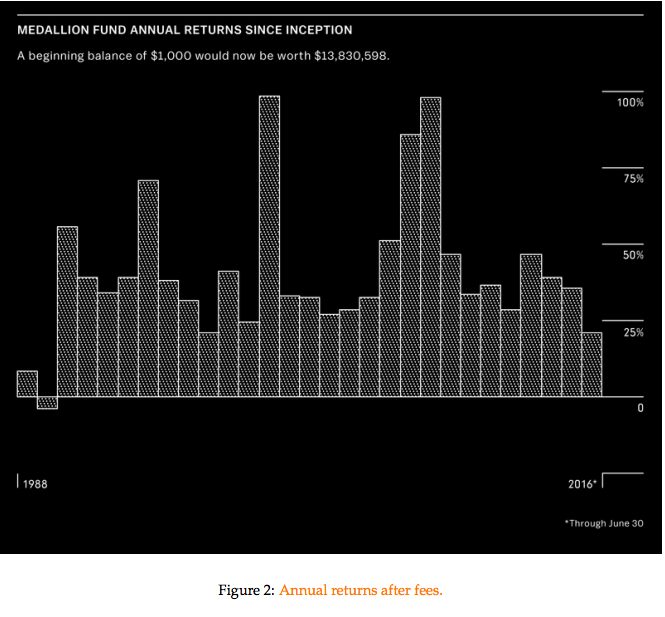
For those who are wondering whether such astronomical returns (see graph below) and such sustained returns over time are really possible, it is worth commenting here on the words of Simons, in his lecture last week at the Massachusetts Institute of Technology (MIT), when he was asked for the umpteenth time in his career whether he had ever been compared to the fraudster Madoff: «Of course, with our results and after what happened with Madoff, shortly after that the SEC (US regulator) looked at us and investigated us thoroughly. Of course they didn't find anything.». But this team of scientists who have been beating the markets for more than 30 years, with a fund closed exclusively to them, and 3 others with entry barriers of USD 5 million, really care little about the sceptics.

.
Renaissance is unique among hedge funds, institutional funds and closed-end funds. Its partners and managers are as cool as they are eccentric. Of the more than 300 employees, 90 are doctors (Ph.D) in disciplines such as mathematics and physics. Peter Brown, who co-heads the firm, used to sleep on a folding bed in his office. His counterpart, Robert Mercer, rarely speaks. And the identical twins, Stephen and Vincent Della Pietra, PhDs specialising in string theory, often argue loudly with each other. The rest of the staff can't be called typical office workers either. There is too much talent for vulgarity.

.

For the outsiders, the mystery is how Medallion has been able to win so close to the top of the table. an annual 80% before commissions, The fund, by the way, takes almost half of the return, although in reality almost all of it stays at home as it is a fund exclusively for members and employees. And the most surprising thing is that despite three decades of experience, they have not been able to copy them enough to come close to their results. The reasons are to be found in the power of its computational capacity, because the computers in their bunker basements are among the most advanced on the planet. Their talented employees have more and better data in which to find patterns and models that can be exploited. And they also fine-tune the costs of their transactions, of which there are many, while taking into account the consequences that their own trading generates in the markets.

.

But it should not be forgotten that the origins of most of its founders come from IBM back in the 1980s. There they used statistical analysis for the first linguistic challenges faced by mathematicians and computer scientists. Jim Simons, mathematical genius, professor at MIT and Harvard, winner of the Oswald Veblen Prize in Geometry and co-creator of the Chern-Simons Theory, was also a code breaker for the Institute for Defence Analyses (IDA).IDA) of the USA. (the current location of the Renaissance headquarters may not be coincidental, given that East Setauket was the area known as Culper Spy Ring, The birthplace of espionage, which enabled Goerge Washington to confront British troops with prior knowledge of their secret plans at the end of the 18th century). The aim of quantitative analysis is similar: to build models that find hidden signals in the «noise» of the markets.. Often they are just whispers, but some are able to predict how the price of a share, a bond or a barrel of oil will make a profitable move, however imperceptible it may be. The problem is complex. Prices depend on fundamentals and flows and the often irrational behaviour of the actors who are buying and selling. Despite (or because of) the fact that Simons lost his job at IDA after publicly denouncing the Vietnam War in a New York Times article, the cryptographic connections he researched helped him create Renaissance, and a few years later Medallion. On his way out, he sought out and surrounded himself with cryptographers and mathematicians such as Elwyn Berlekamp and Leonard Baum, former colleagues at IDA, Stony Brook and professors Henry Laufer and James Ax, for his initial project: Statistical price prediction.

.

The beginnings were bittersweet, and trend following and conversion to the mean caused them problems. Gradually they built models and more models. The initial results were mixed: +8.8% in 1988 and -4.1% in 1989. But in 1990, after explicitly focusing on short-term trading, Medallion achieved a profit of +56% net of commissions. The scientists went on to develop an internal programming language for their models. Today, Medallion uses dozens of «strategies» that run together as one. The computer code they use includes several million lines of code, which is soon to be said. Several teams are responsible for specific areas of research, but in practice everyone can work on everything. Every week there is a meeting where new ideas are tested and discussed to extreme limits by almost a hundred PhDs and other gifted minds.

.

In the early 1990s, spectacular yields became the norm at Renaissance: 39.4%; 34%; 39.1%. And customers began to flock to Medallion. The fund manager never bothered with marketing, in fact today its website still looks like a relic from 20 years ago. In 1993 Renaissance stopped accepting new customers. Fees were multiplied from 5% management + 20% success fee to 5% + 44%. Brutal, but even so, their net returns still stood out far above the rest. Not only that, but also In 2005, they had already expelled from the fund all former investors who were neither partners nor employees, leaving Medallion exclusively for them, and creating for the outsiders the first of the 3 institutional funds of which we will give details later: RIEF, RIDA and RIDGE.

.

Scientific background applied to markets:

The success encouraged Simons to hire more and more brilliant scientists. The next batch of gifted people to join the Renaissance family was a team of mathematicians from IBM's research centre in Yorktown Heights, NY, who were struggling at the time to get machines to recognise, emit and translate human speech. Let's just say that the parents of Siri, Alexa and Google Translate. At first mathematicians tried to rely on linguists to codify grammar, but they soon realised that the problems they faced were much better solved by mathematical probabilities than by language experts.. Mercer for example disappeared for months to type conjugations of French verbs into a computer. Processing his data allowed him to write an algorithm that found the most plausible translation for each sentence: «Le chien est battu par Jean» translated as «John does beat the dog», which was a dramatic improvement on the literal translation that systems without such algorithms were running up against. With every linguist they fired and mathematician they signed up, the system took a step forward. A similar thing happened with speech recognition: «Given an auditory signal x, the speaker probably said y«. «Recognition and translation are the intersection between mathematics and programming,» said Ernie Chan, who worked in the 1990s in IBM's research department and today manages QTS Capital Management.

.
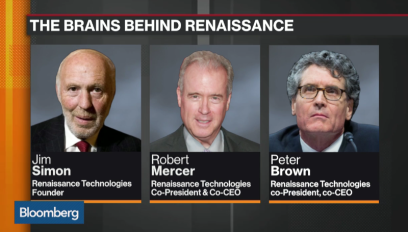
Mercer and Brown then made a bold proposition to IBM: «Let us build a computer model to manage a part of your pension fund».». At the time IBM was managing a $28 billion fund for its employees. IBM rejected the proposal, thinking what would language programmers know about the investment world? But Mercer and Brown were already determined to apply their knowledge to making money in the financial markets. IBM was also at a low ebb, and it was easy for Simon, Mercer and Brown to recruit talent at the time. Renaissance was created by mathematicians who learned to program, not the other way around. They learned how to build large systems where many people were working at the same time. That was another competitive advantage of Renaissance.

.

Talented additions came and went, the Della Pietra twins (String Theory), Lalit Bahlt (responsible for human speech recognition algorithms), Mukund Padmanabhan (digital signal processing specialist). Almost all of them had worked together at IBM. They soon realised that tackling the market was much more demanding than the advances required at IBM. Either your algorithm was better than the rest - which were starting to flood the markets - and you made money, or it was worse and you went broke. High pressure was tremendously productive. Renaissance spent a lot of resources collecting, sorting and cleaning data, and making it accessible to its researchers. «If you have an idea, you want to test it quickly. And if you have to get the data you want to use right first, it slows the process down enormously,» said Patterson, another code breaker who worked for British intelligence and was part of Renaissance until 2001. But intellectual challenges are not the only incentives for this group of data-hungry brains. They also enjoy something more intangible: The feeling of a family of top-level scientists and the complicity and satisfaction that this brings them. Simons was like the benevolent father figure who added emotional intelligence to a group as diverse as they were geeky.

.

When the IBM scientists joined Renaissance, Medallion was already earning more than 30% net of commissions. And almost a third of that came from futures trading. In those early days, the inefficiencies of the market were more visible and exploitable than they are today. For example, one of their scientists noticed that there was a 15-minute gap between the close of options and futures, which allowed them to create a specific system to exploit that for a time. The market was full of aberrations, and the scientists investigated each one to death. The sum of all of them generated very large amounts of money for them. In the beginning it was millions, but after a few years it was in the billions. But as the financial system became more sophisticated with the proliferation of other quantitative funds, inefficiencies became scarce.

.

When Mercer and Brown came to Renaissance, they started working separately, but soon realised that they were more powerful working together. They fed off each other: Brown was the optimist and Mercer the sceptic. «Peter is very creative with a lot of ideas, and Bob says, I think we need to go deeper on this one,» Petterson said. They took over the group working on listed stocks, which were losing money. It took no less than 4 years to make the system work.. But Jim Simons was very patient. The investment paid off, and even Today, listed equity managers, through their derivatives and leverage (let's not forget that inefficiencies today are much more subtle) still generate the lion's share of Medallion's profit.

.

Simons explained in an interview in Institutional Investor back in 2000 that a winning [quantitative] system must be highly layered. «With every new idea you have to determine: Is it really new or is it somehow implicit in something we've already done? Once that's determined, the team has to figure out how much it should weigh in the mix.» He explained that signals can cool off at any given moment, but that vigilance must be maintained because they can emerge again at any time, or even withdrawing that vigilance can have an impact on the performance of the whole. The trade can be in any asset class and last for fractions of seconds or many months. In a lecture Brown gave in 2013 he explained an example that they shared with outside investors at the time, and was therefore public: By studying the weather in financial centres around the globe they found that local markets have a subtle tendency to rise more on sunny days than on cloudy ones. «It turned out that if it is cloudy in Paris, the French stock market is less likely to rise that day than if the sun shines during the opening hours of its market».» he said. It was not a big money maker, as that only happened slightly above the 50% of the time. But with the right tools and system in place, they are exploitable signals, along with many others. Brown continued: «The point is that there can no longer be obvious and powerful signals, because they would have been exploited by others as soon as they were incipient. What we do is look for huge amounts of signals, and for that we have 90 PhDs in mathematics and physics, who just have to sit there every day to distinguish them from the noise of the markets. We have over 10,000 processors (year 2013) down there who are constantly gutting very diverse data in search of those signals». Nowadays the methods of profiting from the market are as secret as they are difficult to imagine. A couple of years ago information was leaked that they were planning to use GPS (atomic) clocks to synchronise buy and sell orders in different markets, through nearby servers that manage to take massive positions without their purchases altering the market price and before even the HFT (High Frequency Trading) funds have time to react. We cannot even imagine what they will (or do) with quantum computers.

.

In addition to language specialists, Astrophysicists have been especially successful throughout history in deciphering systems. Such scientists shine above the rest when it comes to finding patterns in a sea of data. noisy. String theorists have also been particularly successful in filtering data. And the Della Pietra brothers, who along with others of their team at IBM were involved in the listed equity area at Renaissance, were among the first to shine in their field. These identical twins, now 58 years old, have never been apart from each other. Both attended an advanced honours programme at Columbia at the age of 16, graduated from Princeton with a degree in physics and received their PhDs from Harvard in 1986. They always sat next to each other, recalls his former professor of abstract algebra at Princeton. «Their conversations were full of argumentation. They were passionate mathematical discussions, and they were always correcting their professors». The fact that they are identical twins seems to take them to another dimension. «They are almost telepathic,» says Ernie Chan. At Renaissance, the Della Pietra's have always had adjoining offices with a large window for constant communication. «They are very creative and competitive with each other,» adds Patterson, to whom they reported directly for a few years.

.

The IBM team focused on constantly improving system efficiency and performance. As the Renaissance models were essentially short term, focused on fine-tuning transaction costs and how their own movements affected markets, both very difficult problems to solve, according to other fund managers. quants. They also ensured that trades and profits were in line with the system, since a bad price or any other crack could spoil the whole outcome of that particular operation.

.

Medallion reserved exclusively for members and employees:

The amount of money invested by an employee in Medallion depends on his or her overall contribution to the company. And collaboration with the environment is seen as key to having a bigger slice of the pie. Employees are allowed to buy a limited number of shares in the fund. In addition, a quarter of their salary is invested directly in the fund for at least 4 years. They all pay, of course, the tremendous 5% mgmt fee + 44% performance fee. Simons made it clear from the start that the size of the fund matters, and that too much money hurts performance. Renaissance currently limits the size of Medallion to 10-12 billion, which is double what it was a decade ago. It is therefore not uncommon for partners and employees to disinvest large sums of money to maintain a manageable fund size. Profits are also usually distributed on a semi-annual basis.

.

Thanks to Medallion, Simons, who still owns the company's 50%, amasses a fortune of 16 billion, according to the Bloomberg Billionaires Index. The other Renaissance heavyweights such as Laufer, Mercer and Brown have unquantified fortunes publicly, but have probably amassed many hundreds of millions each. But in a way, money, like the family atmosphere among the partners, keeps them together, with the exception of a few scientists who, already wealthy, have preferred to devote their intellect entirely to research or philanthropy. In general, few employees and partners leave Renaissance over the years. Why should they? The intellectual challenges are as attractive as they are constant, the colleagues are top-notch and the salaries are astronomical.. As all the employees have become wealthy, their lifestyles have changed. Trains to Manhattan have given way to private helicopters. Scientists have traded in their Hondas for Porsches, and expensive hobbies have become the norm. Simons' cousin Robert Lourie, who heads the futures research team, built stables and a riding arena for his daughter. State-of-the-art yachts are also the order of the day, and spending on company trips for team building activities is unmentionable. Simons, a heavy smoker, even took out a fire insurance policy with his favourite restaurant to allow him to continue smoking his beloved Merit after dinner. You will understand better now why the coast where the management company is located is known as the Renaissance Riviera.

.

However, the money has, of course, also brought them some displeasure. In 2001 they hired a Russian scientist, Alexander Belopolsky. Patterson was reluctant to hire him because Belopolsky had previously worked on Wall Street, where he had jumped from one job to another. His fears were well-founded. In 2003 Alexander and another Russian, Pavel Volfbeyn, announced that they were leaving to work at another hedge fund, Millennium Partners, where they would be working on a new project. had negotiated multi-million dollar bonuses in exchange for trying to copy Renaissance's know-how.. Of course, both the Russian scientists and Millennium were sued in court by Renaissance, and the matter was subsequently settled by a financial settlement of which no details are known.

.

However, not all Russians were unhappy at the company. Around that time, another scientist named Alexey Kononenko, who came out of the former USSR and received his PhD from Penn State in 1997, was promoted and moved up the Renaissance organisational chart with a bang, raising some eyebrows among the more senior staff. Kononenko was seen having dinner at Simons' house, and that was a sure sign that the Russian had a gift that made him more special than the rest of the company's gifted brains. Time proved him right, and Medallion achieved returns in excess of 40% per annum net after that dinner.

.

Building on the crash of 2007 and 2008, what is the secret of Renaissance?

When competitors or former investors are asked how Renaissance can continue to achieve such impressive results, the answer is unanimous: They run and evolve more than the rest.. Even so, they have not been without their scares. According to sources close to the fund manager, in August 2007 the mortgage market crashed, wiping out many hedge funds along the way, which literally disappeared from the map, including the 30 billion giant managed by Goldman Sachs. The disasters of so many trapped investors and leveraged quantitative and non-quantitative hedge funds flooded the markets with sell orders, making the situation much worse. Medallion suffered a loss of almost a billion in a matter of days, almost 20% of its size at the time.. This, which had never happened before in the fund's almost 30-year history, gave the team of scientists food for thought. They even considered whether they should reduce risk to ensure the fund's survival by selling off some positions. Fortunately, the scientists put their hearts aside and focused on their brains, letting the systems do their job. In the last four months of the year, they not only recovered their losses but closed the year with a brutal profit of +85.9% net. But it doesn't stop there. In 2008, the year of the stock market crash, profits were even higher, close to 100% net. The Renaissance partners reaffirmed their principles: «Don't mess with the models». And they also learned a lesson: the damage that large third-party bankruptcies can cause to the market must also be calculated.

.

Quantitative managers often say that there is no system that is effective forever. The variables are infinite and the markets as changeable and diverse as the human race and its globalisation. So one wonders how much longer Renaissance will be able to deliver these superior returns. The reality is that almost a decade after Simons' official retirement, the money-making machine is still running, and the old ex-IBM team is still between 50 and 65 years old.

.

The visit of Cluster Family Office to the Renaissance facilities:

We will now tell you our impressions of the visit we made a couple of years ago to the Renaissance bunker in Long Island (images below from google maps). We will start by saying that, once they passed their due diligence to be accepted as institutional investors, we had to insist that we were allowed to visit their headquarters., The majority of those selected are only shown their Manhattan offices, which are more «than the Manhattan offices".«commercial»but also spectacular. About 40 people work in Manhattan on a regular basis, but the offices are large enough to house the more than 300 employees who work at renaissance. Why is that? Well, because in Manhattan they have a backup and servers equivalent to the equipment they use in the bunker, and from time to time they practice a drill as if it had been rendered inoperative, moving all personnel for a day or two to Manhattan., in order to ensure that they continue to work perfectly in the event of an emergency in the bunker. That's how geeky and rigorous they are.

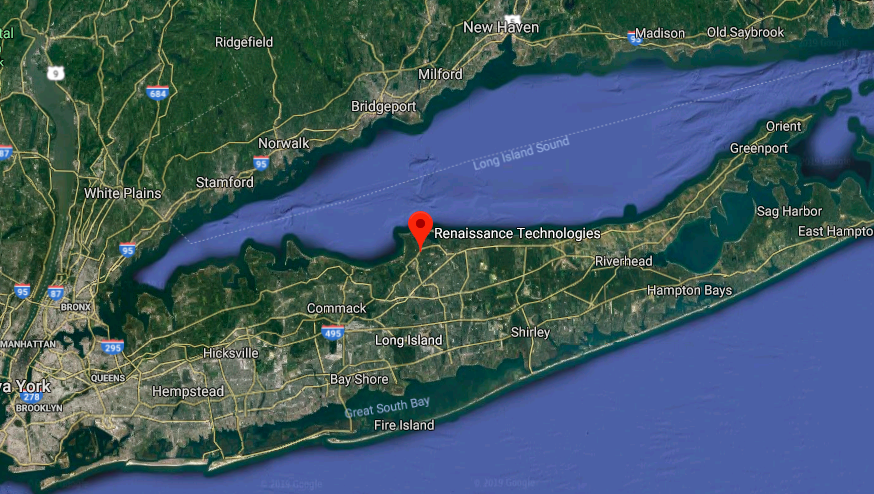
 

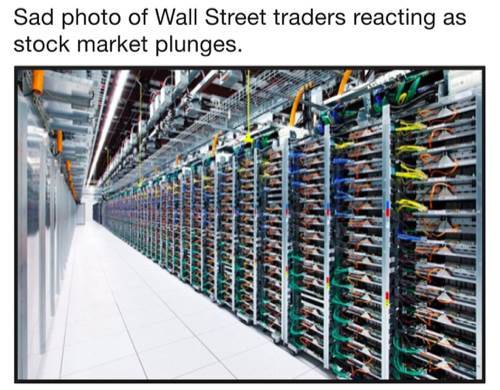
Why do we call the Renaissance headquarters on Long Island a bunker, if it appears to be a building (or several), large, yes, but just like any other? Well, because in addition to the access control on the road and the fact that it is surrounded by a lush forest that naturally conceals the facilities, inside there are a multitude of access controls, depending on the degree of restriction desired for each part of the building. Some doors were crossed when our companions swiped a simple magnetic strip through the reader, but others, closer to the heart of the company, required additional codes and even their fingerprints.. In addition to its two-storey height and its whimsical shape, which is slightly reminiscent of the Pentagon building, the main block also has two underground levels which house, among other secrets, the computer room. They agreed to show us around for a few minutes. It was a huge, white-walled, perfectly cooled space with a double-height ceiling. In the centre of the room, half a dozen 2-metre-high columns were lined with processors lined up on either side, forming long corridors between each column. The length of each column was impressive - we estimated at a rough guess that they must be between 50 and 60 metres long., The processors, as they allowed us to walk down those aisles from one end to the other. Obviously the figure of more than 10,000 processors that Brown talked about in 2013 was no exaggeration. Inside that room was another smaller room, to which we did not have access, which must have contained other mainframe computers. Interestingly, all the cooling machinery was outside that large room, so that even the air-conditioning maintenance technicians didn't have to enter the computer room at all. We had never seen anything like this before, and probably very few private companies have such a computer arsenal. We immediately understood what other big names in quantitative management were talking about when they said that «...the new system is a new way of doing business.«No one is at Renaissance's level in terms of data processing and analysis, not even close.»

.

During the visit to the rest of their facilities we could see that indeed all the individual offices are identical in size and decoration, following the guidelines of the partners. We did not see a single closed office door, everyone works with their door open to facilitate interaction and the exchange of ideas., as Simons states in an interview. They explained some of their internal processes, such as the challenges that rapporteurs of new proposals to be incorporated into the system have to overcome. Any new idea must overcome a huge number of Ph.Ds (PhDs in physics, mathematics, etc.) trying to smash it mercilessly. Y the proposal of the rapporteur(s) will only progress if it overcomes the criticism and convinces the eminent. The next step is to test the proposal with models for a period of time. If it continues to work, it is tested with operations and real money in small amounts for another period of time. And if finally all the results are positive and there is no affectation or interference with the rest of the systems, it is implemented. The process can take months or even years, It is not fully implemented until it is empirically well proven and tested. It was impressive to see the challenges, where these new proposals are debated to death. There was a large screen presiding over a huge oval table with about forty seats, and around it a second ring of chairs for a total audience of more than a hundred. Imagine that room full of Ph.Ds arguing vehemently and trying to find the cracks in any new proposal. Truly, nothing that does not certainly improve the existing system will make it through that first theoretical filter and subsequent practical implementations.

.

The comments and behaviour of the managers we met that day confirmed to us that indeed the motivation for scientists to stay at Renaissance is not primarily money - once they have become rich enough, what keeps them there is the attraction of an intellectually challenging environment and being surrounded by the best. And what better place than here, they said. They also told us that the intellectual challenge of working surrounded by 90 Ph.Ds of the scientific elite not only serves to retain the talent already working at Renaissance, but also to attract eminent people who are bored in their university research positions. These profiles, tired of no professor or university colleague daring to contradict them on anything, fit perfectly in the fun that an environment such as Renaissance offers them, where they can the challenges they constantly subject each other to are at a level they could never find in any university in the world.. The concentration of talent, not to mention the impressive semester cheques, acts as a real intellectual magnet to retain and attract the most prodigious minds. 

.

Funds open to institutional investors: Renaissance Institutional Funds

In addition to the legendary Medallion, which is reserved exclusively for members and employees, as mentioned above, the fund manager has 3 funds open to institutional investors with a minimum of 5 million to invest and who have passed the fund manager's internal due diligence: Renaissance Institutional Intitutional Equity Fund (RIEF), Renaissance Institutional Diversified Alpha Fund (RIDA) and Renaissance Institutional Diversified Global Equities Fund (RIDGE). They explained to us how they discriminate the management of Medallion compared to that of the RIEF fund, the oldest of the 3 funds that are still open to institutional investors (you can see its track record since 2005 in the table below). They readily admit that their «best ideas» are applied to the Medallion, and that their «second best ideas» are used in RIEF.. The other two institutional funds, RIDA and RIDGE, are different animals. The latter two are seen as tests or platforms where other (apparently more conservative) ideas are applied, they are perfect laboratories for their research, although for many other fund managers they would be their own funds. flagships or flagships, without a doubt. After analysing the 3 funds, from Cluster Family Office We decided to invest for the moment only in RIEF, which we could define as the most similar quantitative fund of the three to Medallion, essentially focused on equities from all over the world and long-biased. In the graph below you can see its performance since its launch in 2005, when -as we have already said- all external investors were definitively expelled from Medallion.

In our long career in wealth management, we have visited many, many asset managers around the world. We have seen them in all shapes, sizes and colours, but the visit to Renaissance a couple of years ago was the most special. It was like visiting the Mecca of quantitative management. That feeling of seeing how the best in the world work in their field. Having said that, we have to confess that quantitative funds are not our cup of tea, The majority of us feel much more comfortable investing in good value managers who focus on finding shares in good companies at attractive prices. Quantitative managers are still black boxes that, when they stop making money (as is the case with the vast majority), there is nothing to hold on to. However, we must surrender to the evidence of the Number Ones, who have not stopped earning money to date and far above the others.. That is why the RIEF combination in portfolios of more than 10 million together with the other leading international Value managers is, in our opinion, the best option.. We are convinced that this is the perfect mix for the coming years in equities: a percentage of the best Value managers and a percentage of the best quantitative fund on the planet. The proportions to suit the consumer, or rather adjusted to the needs and circumstances of each individual.

.

The good news for junior investors, as we mentioned at the beginning of this article, is that can access funds of funds that slice these combinations starting at 125,000 euros/dollars., although logically paying an additional commission, as we explain in «Funds that make inaccessible funds accessible«. Medallion will certainly remain reserved exclusively for Renaissance partners and employees forever. But investing in the substitute RIEF The minimum amount of 5 million and the due diligence carried out by Renaissance itself to decide whether or not to grant access to the aspiring institutional investor are insurmountable barriers for the vast majority. This is why being able to enter through the back door via a fund of funds is an extraordinary opportunity. The only one.

.

Disclaimer: This article does not represent an investment recommendation for the products mentioned. The funds referred to in the article are not registered for marketing in Spain and are only suitable for qualified investors, with minimums ranging from €125,000 to €5,000,000.
 

Where would Mark Mobius invest a million dollars today?

Today we are going to refer to an article published by Bloomberg where a panel of 5 experts give their opinion on which assets they think are the best to invest in at the moment. One of these experts is Mark Mobius, founder of Mobius Capital Partners and former executive chairman of Templeton. His recommendations have particularly caught our attention because they coincide with our strategy, which we have been implementing for some time now. Cluster Family Office. We will therefore summarise and comment on Mark Mobius' arguments and proposals to Bloomberg readers, to which we fully subscribe.

.

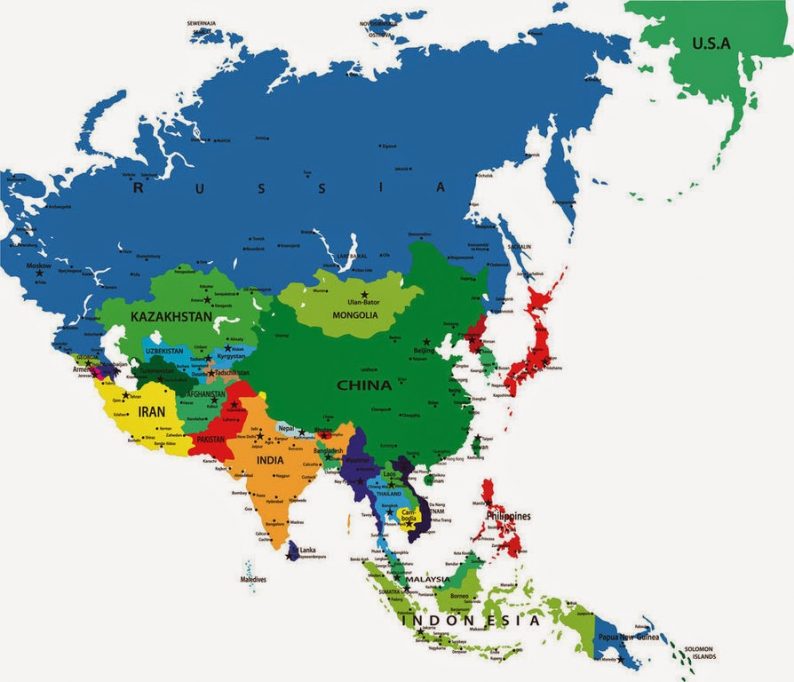
In the late 1980s, emerging economies accounted for only 51Tbp3T of the global market, but now they account for more than 401Tbp3T and rising. In those years investors could not invest in more than half a dozen stock exchanges, yet now we have more than 70 markets open to growing foreign investment. This now allows for enormous diversification, and points the way forward: Now is the time to invest in certain economies emerging - or already emerging where tremendous economic recovery and growth is taking place.

.

For example, Brazil's stock market has risen 40% from its lows. And it still has a long way to go, as every sector is set to benefit from the reform being implemented by the new Bolsonaro government (political-ethical discrepancies aside). The country's entire political environment is being radically changed as a result of the relentless pursuit of corruption that is taking place. Take Petrobras, one of the largest oil companies, which is changing its entire organisational structure from top to bottom to make sure that no more corruption cases take place in order to be in tune with the new government. All the companies have been getting their act together on corporate governance issues, along the lines of stamping out corruption so that the state does not take a fatal look at them. This is very positive for international investors, since with more rigour and order, the Brazilian consumer sector will benefit and will do particularly well in the coming years.

.

Political data has even aligned with technical analysis, as many markets have drawn a double bottom long trend. In terms of fundamentals, the most defining data for the investor, we still see attractively low price to earnings and book values in many of the emerging economies, which let's not forget are the economies that are riding the wind of economic growth and demographics in their favour. Russia's P/Es are only in the multiple of x5, that is even below Pakistan's valuations. If we add to that the advances in corporate governance that Putin is implementing, the Russian stock market is very, very cheap indeed.

.

Moving on to the fundamentals, we like India's domestic consumption oriented companies, whose economy is already practically growing at 8% per annum. India's software sector is very large (like everything else there) and we like the medium-sized companies that are embracing new technologies to, for example, start/increase their online sales. India's byzantine distribution system is being modernised radically by technology, tax reforms and the elimination of taxation between the different regions of this sub-continent. This will be vital and will greatly boost the movement of goods and trade. Despite the intrinsic difficulties that still exist in India, Amazon and Walmart are getting local businesses into their game.

.

It is true that there is still a lot of bad credit hurting the books of the big banks in India. And the government is going to bail them out and recapitalise them properly, which will have an impact on the value of the currency. But this weakening of the Rupee will be short-lived. Let's not forget that the central bank, despite its stormy relations with the BJP, has historically been effective in stabilising the currency. Mobius says he would put a 30%, of the $1 million referred to in the article, in India.


And what about China. Its potential is enormous, both for Cantonese companies listed in Hong Kong and A-shares listed in Shanghai. And its market economy, perfectly planned by the Jinping government, is an oasis of prosperity for Western investors in the growth desert of Western developed markets. It is also more than interesting to look for companies that are particular winners in a trade war with the US that has more political than real economic overtones. One of the clear winners to look out for, although we were already looking at it on the merits of its own growing economy, is Vietnam, which is welcoming southern Chinese companies to relocate or simply expand. In fact, and as a significant anecdote, the failed summit between Trump and North Korean President Jong Un was held in Vietnam because the US government wanted to show Jong Un the Vietnamese model as an example for North Korea to follow. The model evolution, from an iron communist economy like Vietnam's, to a growing and prosperous market economy, without loss of government control. And all this praised by the US president, live to see.

.

And the same is true for the rest of Southeast Asia, where everything is still to be done and the middle class has a tremendous future ahead of it. Mexico is also benefiting from its recent agreement with the USA and Canada. World trade is like a big balloon: if you push on one side, it inflates on the other.

.

In short, Mobius is fully in line with our positioning in Russia, Vietnam, China, India and Brazil. And this positioning is materialised through the management companies of local institutional funds who know the political, legal, accounting and economic characteristics of their respective countries inside out. The result is in the form of alphas spectacular and consistent. And fortunately options are beginning to emerge fund of funds so that smaller investors (with a minimum of $125,000) can access these large institutional funds. emerging who do not even have retail classes.

.

The reasoning, then, is clear: traditional markets belonging to developed economies must be abandoned because they have and will have the wind against them for at least a generation. Their economic growth is and will be anaemic, and their ageing and unproductive demographics are and will be an insurmountable drag on their companies' future share prices. It is true that some Western companies are desperately and painstakingly turning to Asia in their search for revenue. But it should not escape anyone's notice that it is far more productive to invest directly in Asian companies that concentrate all their turnover and growth in domestic economies with overwhelming GDP growth and demographics.


Funds that make inaccessible funds accessible

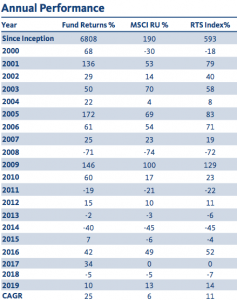
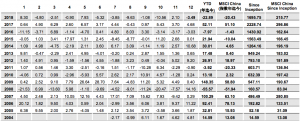
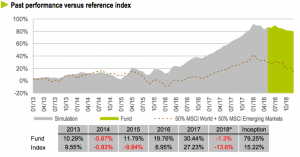
¿Os imagináis poder invertir en los mejores fondos institucionales del planeta, donde invierten las manos fuertes del mundo financiero, con tan solo 125.000 euros? Nos referimos a poder invertir en fondos y hedge funds con barreras de entrada de 500.000, un millón o cinco millones de inversión mínima. Fondos que, a pesar de seguir abiertos (de momento), tienen mínimos prohibitivos para carteras que no alcancen al menos los 10 millones, si desean una diversificación adecuada de gestores y zonas geográficas. Fondos que por la brillantez de sus rendimientos históricos están a años luz respecto al catálogo de fondos que vende la banca española, como explicamos ya en «Fondos y Hedge Funds institucionales, la liga en la que no pueden jugar los inversores retail». Estamos hablando de gestores de la talla de Branis, Jiang o Simons del mítico Medallion, que han demostrado durante décadas que están por encima de los demás, consiguiendo alphas descomunales como las que podemos ver en las siguientes tablas.

<

Pues bien, algunos fondos de fondos agrupan en sus carteras gestores de grandes fondos y hedge funds institucionales y «trocean» esos mínimos de inversión prohibitivos en tickets de tan sólo 125.000, como decíamos al principio del artículo. Lógicamente, esta facilitación para que puedan acceder inversores menores requiere un análisis exhaustivo y una selección previa de fondos que no es gratis. Todos estos fondos de fondos cobran una comisión adicional a las que de por sí ya tienen los fondos subyacentes. Es decir, que se estará pagando comisión sobre comisión. Pero si la cartera de fondos subyacentes es lo suficientemente potente en rendimientos netos, y las comisiones del fondo de fondos son moderadas, el resultado será el de fondos de fondos que seguirán superando a sus respectivos índices de referencia de manera muy jugosa.

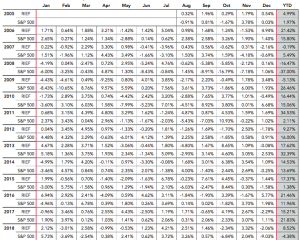
En el gráfico de arriba podréis ver el rendimiento que ha obtenido uno de estos fondos de fondos, domiciliado en Luxemburgo, en cuyo interior se concentran los 3 gestores arriba mencionados y media docena más de primeras espadas de la gestión Value de fondos institucionales. Como veréis, el fondo se compara con un índice compuesto por 50% MSCI World y 50% MSCI EM, lo cual le pone el listón muy alto, ya que si os fijáis en la mayoría de índices de referencia que utilizan los fondos, suelen ser del tipo AR (absolute return) u otras definiciones menos comprensibles. Estas nomenclaturas de la mayoría de índices o benchmarks «capan» los rendimientos del índice en cuestión respecto al índice bursátil del respectivo país con el objetivo de que el fondo lo supere visualmente de manera más holgada. Esto suele producir falsos alphas, que resultan engañosos para los inversores, ya que en muchos casos esos fondos tampoco superan a sus puros índices de referencia o lo hacen de manera muy mediocre, lo cual no justifica sus costes de gestión activa. En cambio, en este fondo de fondos la comparación es a pelo con el MSCI World y Emergente, lo cual es muy de agradecer y dice mucho de la potencia de los fondos subyacentes, puesto que los vienen superando ampliamente.

.

Como podréis apreciar, a pesar de que el fondo fue lanzado en Mayo 2018 y la mayoría del rendimiento es una simulación del comportamiento de todos esos fondos subyacentes en los últimos cinco años,  ya en rendimientos reales de 2018 está más que amortizando sus comisiones sobre comisiones.

.

¿Cuál es la mala noticia? Pues que la mayoría de estos fondos de fondos, al igual que ocurre con los fondos institucionales subyacentes, tampoco se comercializan en España. Y por tanto, hoy por hoy, la única forma de acceder a ellos es abrir una cuenta en un banco luxemburgués que acepte clientes menores (tarea más difícil de lo que parece sin la referencia adecuada) y suscribirlo desde allí con un mínimo de 125.000 euros.

.

Comparad los rendimientos de las tablas con los de cualquier fondo de inversión pasiva y veréis como, a pesar de la mediocridad generalizada de la gestión activa, algunos gestores se ganan sobradamente sus comisiones. Lo difícil es encontrarlos, pero aún es más difícil poder acceder a ellos con importes menores. Aunque como siempre solemos decir, haberlos haylos, como ya explicamos en el blog de Cobas.

.

Disclaimer: This article does not represent an investment recommendation for the products mentioned. The funds referred to in the article are not registered for marketing in Spain and are only suitable for qualified investors, with minimums ranging from €125,000 to €5,000,000.

Warren Buffett, conceptos para marcar a fuego en el inversor. Capítulo 2: Inversión.

Después del Capítulo 1: Endeudamiento, vamos con la segunda entrega de los razonamientos, frases y conclusiones del genio Warren Buffett, extraídos de las múltiples Cartas a los Accionistas que ha publicado Berkshire Hathaway a lo largo de décadas, conferencias, coloquios universitarios, entrevistas en múltiples medios de comunicación, ensayos personales o comentarios realizados en la Comisión de Investigación sobre la Crisis Financiera.

.

En este Capítulo 2 trataremos la visión de Buffet del concepto de inversión y la forma en que cada persona aborda esta práctica tan determinante en la vida:

.

Invertir bien no está vinculado a un alto coeficiente intelectual. Con una inteligencia normal se puede invertir de manera excelente. Sólo hace falta carácter para controlar los impulsos irracionales que arruinan a otros inversores inteligentísimos. Para evitar dichos impulsos, es conveniente reflexionar mucho sobre las inversiones. Y para hacerlo, la mejor forma es estar sólo en una habitación y pensar. Si eso no funciona, créeme que nada más lo hará.

.

Cuando fui adolescente pasé 8 años haciendo gráficos para ganar dinero en bolsa (chartista). Entonces álguien me dijo que nada de aquello era necesario, que bastaba con comprar algo por debajo de su valor. Conocer de primera mano el chartismo te hace pisar más firme cuando lo abandonas definitivamente para buscar el valor fundamental en tus inversiones.

.

Invertir con poco dinero mejora las expectativas de rendimientos, contrariamente a lo que muchos piensan. Con poco dinero y pocas oportunidades para invertirlo, solemos elegir mucho mejor. Sin embargo la mayoría de gente atribuye sus fracasos a la escasez de millones y no a sus malas decisiones (desde nuestra visión como Multi-Family Office podemos asegurar que eso es totalmente cierto, cuanto mayor es el patrimonio de un nuevo Cliente que llega a nosotros, paradójicamente más ineficiente suele ser la gestión del mismo).

.

Quiero ser propietario de activos que sean productivos. Parece una obviedad, pero es asombrosa la cantidad de gente que está de acuerdo con esta frase y sin embargo invierten su dinero en activos no productivos, a la espera de que alguien pague más por ellos en el futuro, y esa es la esencia de la especulación.

.

La especulación no es inmoral, ni ilegal, ni engorda, ni es pecado. Pero es jugar a algo totalmente distinto de invertir en algo que te va a producir ingresos con el tiempo. A partir del momento en el que compro algo, sea una granja o cualquier empresa, me olvido de su cotización y me centro en lo que produce cada año, y si esa producción es satisfactoria o no en relación con lo que he pagado.

.

No creo que si el presidente de la FED me dijera al oído las decisiones que fuera a tomar en el futuro cambiara mi opinión sobre mis negocios adquiridos. Simplemente los voy a tener durante muchos años mientras dichos negocios funcionen. Si de verdad entiendes de negocios, probablemente no deberías tener más de 6. Si puedes identificar 6 buenos negocios no necesitas mayor diversificación, porque las probabilidades de que se tuerzan más de uno o dos son realmente bajas si los conoces y analizas correctamente. Si en cambio inviertes en un séptimo y un octavo, en lugar de poner más dinero en tu primero y segundo, vas a cometer un error. Casi nadie se ha hecho rico gracias a su séptima mejor idea.

.

La concentración debe ser directamente proporcional al conocimiento de los activos en los que inviertes. En cambio, para la población en general, sin interés ni dedicación al análisis de los negocios, y por tanto desconociéndolos, la diversificación es la clave de su éxito. Lo mismo puede decirse a los inversores en fondos de inversión. Si no se dedican al análisis y selección de los fondos de inversión activa -o contratan a álguien que lo haga por ellos-, que les permita seleccionar un puñado de fondos que consigan superar a los Mercados, lo mejor que pueden hacer es invertir en fondos de inversión pasiva, que al menos les asegurarán no hacerlo peor que el Mercado. Es cierto que la selección de empresas de Berkshire Hathaway ha obtenido una rentabilidad superior, pero invertir en las empresas de EE.UU. en su conjunto (fondos de gestión pasiva o ETFs) no ha sido hasta hoy una mala inversión, y eso es algo que puede hacer cualquiera si tiene suficiente paciencia.

.

La paciencia es otra de las claves para el inversor. De hecho el Mercado es un sistema que distribuye dinero de los impacientes hacia los pacientes. Y es la obsesión por el precio de las cosas y no por su valor la que genera la fatal impaciencia. Intento comprar un dólar por 60 centavos. Y si veo posibilidades de conseguirlo no me importa cuanto tiempo deba esperar. Pero si veo hoy algo atractivo, no dejaré pasar la oportunidad a la espera de que más adelante pueda aparecer algo aún más atractivo.

.

Si van por la carretera y ven un puente que soporta un máximo de 4,000, no intenten cruzarlo con un camión de 3,950. Vayan por otra carretera y crucen por un puente que soporte 7,000. Ese es el mismo márgen de seguridad que deben mantener cuando realizan una inversión. No deben comprar un negocio que vale 100 por 95, sino buscar uno que valga 100 pero que puedan comprar por 60.

.

Quizá os pueda interesar el artículo publicado en el blog de COBAS: «Gestión activa, gestión pasiva«

Warren Buffett, conceptos para marcar a fuego en el inversor. Capítulo 1: Endeudamiento.

Buffett ha sido y será uno de los genios del mundo de la inversión durante generaciones. Un personaje que, al igual que otros insignes como Einstein, Gandhi o Adam Smith, dejan una huella intelectual que hace avanzar y evolucionar a quienes se interesan por beber de sus conocimientos. Por ello, merece la pena que dediquemos algunos artículos a recordar algunas de sus citas y reflexiones más interesantes que ha hecho públicas a lo largo de su larga vida. Los razonamientos, frases y conclusiones que incluiremos en esta sere de artículos están extraídos de las múltiples Cartas a los Accionistas que ha publicado Berkshire Hathaway a lo largo de décadas, conferencias, coloquios universitarios, entrevistas en múltiples medios de comunicación, ensayos personales o comentarios realizados en la Comisión de Investigación sobre la Crisis Financiera.

.

En este Capítulo 1 trataremos algunos pensamientos relacionados con el endeudamiento que resultarán deliciosos para cualquier inversor:

.

Esencialmente existen dos tipos de endeudamiento, el público o del Estado, y el privado  o de la población (nos centraremos en el endeudamiento privado, ya que de todos es sabido que el público suele utilizarse de manera nefasta y abusiva hasta niveles de endeudamiento tan descomunales como los actuales en los Estados desarrollados). Dentro del endeudamiento privado también es imprescindible distinguir dos tipos: El endeudamiento para el consumo y el endeudamiento de inversión/ahorro.

.

El endeudamiento para el consumo es algo malo, ya que tan sólo drena potencial de inversión y reduce las posibilidades de ganar dinero en el futuro. Ejemplos de deuda para el consumo sería un crédito para comprarse un coche, para hacer unas buenas vacaciones o las mismísimas tarjetas de crédito. Mientras que el endeudamiento de ahorro o inversión tiene un componente más positivo, ya que permiten cambiar fracciones de capital a lo largo del tiempo por otros activos que, teóricamente, deberían apreciarse durante ese mismo periodo de tiempo. El ejemplo más comunmente conocido es el de una hipoteca, en la que cambiamos dinero, que devolveremos fraccionadamente, por la adquisición de ladrillos que en principio van a mantener o superar el valor del dinero invertido en el tiempo. Otros endeudamientos para inversión son por ejemplo las líneas de crédito que permiten ampliar un negocio, bien comprando otras empresas o expandiéndose con nuevas instalaciones, maquinaria, personal, etc. Todo ello con la intención de que ese capital que se amortizará en el tiempo se transforme en otros activos que mantengan o superen su valor inicial.

.

Sin embargo (o con él), las recomendaciones para evitar endeudarse de manera importante son diáfanas: Si eres inteligente no necesitas crédito, y si no lo eres no deberías utilizarlo. El endeudamiento es la única manera de arruinar a una persona inteligente. Si estás libre de deuda evitas meterte en problemas cuando las cosas no salen como habías planeado, cosa que ocurre en la mayoría de ocasiones.

.

Comprar una empresa utilizando gran cantidad de endeudamiento, o asumiendo una gran deuda existente en esa empresa, generalmente da un resultado negativo. Es como conducir con un puñal en el volante apuntando a tu corazón. Más te vale ser un excelente conductor y ser extremadamente prudente, lo cual te evitará muchos accidentes, pero cuando tengas uno será mortal. Ese es el efecto perverso del endeudamiento, que contrarresta los muchos beneficios que te puede conllevar si todo sale sorprendentemente bien. Es como el alcohol, una copa es satisfactoria, pero 10 copas traen muchos problemas y te pueden arruinar la vida fácilmente.

.

El endeudamiento, además, es adictivo. Cuando las cosas salen bien uno cree ser el más listo de la clase, y sus amigos, vecinos y entorno parecen confirmarlo con su admiración y aplausos. Cuando eso ocurre, nuestra naturaleza humana nos impide parar y bajarnos del tren. Lo mismo ocurre cuando Mr. Market sube y sube sin parar, los codiciosos inversores sólo ven su meritoria capacidad para ganar dinero en bolsa. No importa el precio de las empresas que está comprando, sólo los beneficios que consigue día tras día. Hasta que alguna cosa se tuerce. En ese momento el puñal del volante atraviesa, rápida e irremediablemente, el corazón del eufórico conductor endeudado.

¿Merece la pena invertir en un plan de pensiones a cambio de los beneficios fiscales?

La respuesta es NO, a no ser que se tenga la rarísima virtud de escoger uno de los escasísimos planes de pensiones que superan a su índice de referencia a 10 años. Y aún así, 10 años son muy pocos si tenemos en cuenta que la vida inversora suele ser muy larga cuando hablamos de pensiones para la vejez. Pero la pregunta secundaria que debemos hacernos es: ¿Qué probabilidades realistas tenemos de invertir en un plan de pensiones que no nos condene a la mediocridad? Ahí es cuando la respuesta empieza a resultar más incómoda si queremos ser objetivos y sinceros. Y es que el porcentaje de fondos de inversión que no superan a sus respectivos índices de referencia es muy bajo, digamos que entre el 1% y el 12%, dependiendo de la fuente, el plazo y los sectores en los que nos fijemos. Pero si miramos la rentabilidad de los planes de pensiones respecto a sus índices, el porcentaje de los fondos que justifican su comisión es aún menor.

.

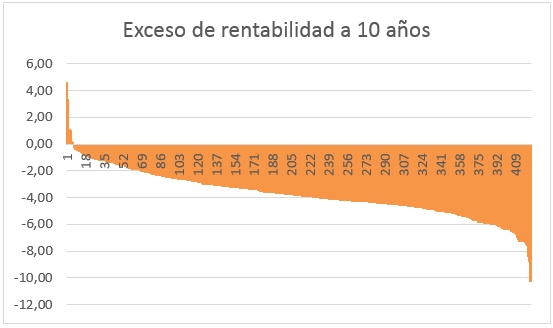
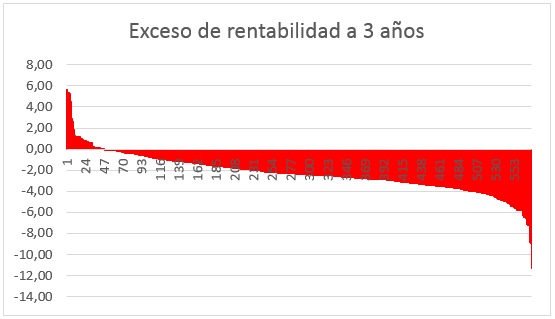
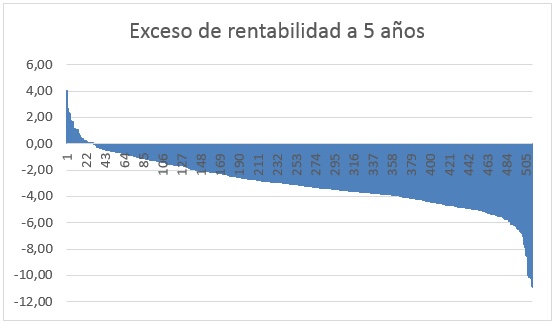
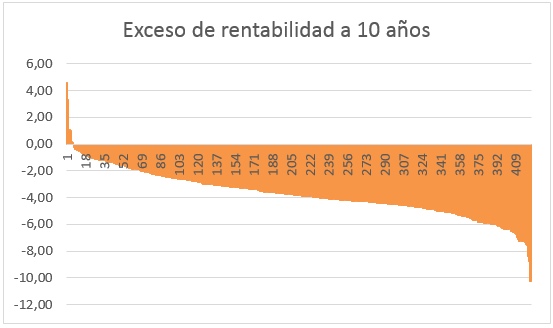
Veamos los gráficos del último informe que ha elaborado Morningstar de los planes de pensiones que superan en rentabilidad a sus respectivosa a tres, cinco y diez años. Demoledor:


Lógicamente, a mayor plazo más se minimiza el efecto Montecarlo del que ya hablamos hace una década. Fijaos que si nos centramos en el periodo de 10 años, lo cual no es ningún disparate ni mucho menos si estamos hablando de planes de pensiones que se supone que no vamos a utilizar hasta la edad de jubilación, el porcentaje de fondos que superan a su índice es inferior al 1%! Pero es que para la jubilación a muchos les faltan más de 20 o 30 años, con lo que el porcentaje de probabilidades de superar al índice a través de un plan de pensiones se acerca peligrosa e indignantemente a cero.

.

¿Cuál es la conclusión a la que debemos llegar con este bofetón de cifras? Pues que si en el universo de fondos invertibles desde España ya es difícil encontrar un fondo de inversión «normal» que supere a largo plazo a su índice, encontrar un plan de pensiones que lo consiga a más de 10 años vista es casi misión imposible para la mayoría de mortales. ¿Y cómo consiguen los bancos y demás vendedores de pescado colocar tantos miles de millones en planes de pensiones si éstos son tan mediocres? Pues para eso están las baterías de cocina de regalo, las smart tv, los porcentajes de dinero de regalo ingresados en cuenta y… las bonificaciones fiscales. Sí, esas mismas bonificaciones que muchos defienden como la panacea para ahorrar impuestos mientras preparamos nuestro retiro.

.

El problema de base es que quienes defienden que es fiscalmente más interesante invertir en un plan de pensiones que en un fondo de inversión al uso, a pesar del hachazo en renta cuando llega el momento de la verdad, no tienen en cuenta que el nivel de mediocridad en la gestión de los planes de pensiones es sustancialmente mayor que el de los fondos de inversión en general. Por tanto, el principal motivo para huír de los planes de pensiones NO es que pagaremos en renta el día de mañana los impuestos que ahorramos hoy en las exenciones de las aportaciones (podríamos discutir si compensa o no tal bonificación fiscal), sino que los equipos que gestionan planes de pensiones consiguen resultados aún peores que el promedio de fondos de inversión al uso que se comercializan en España.

.

Por todo ello, si un inversor es capaz de encontrar fondos cuyos gestores superen a su índice de referencia a largo plazo de manera consistente (haberlos haylos y os remitimos a este artículo que publicamos en COBAS hace unos meses), jamás debe sacrificar esa joya por un plan de pensiones cuya gestión sea peor, por muchos beneficios fiscales o regalos que le hagan sus comercializadores. Bonificaciones fiscales y regalos de dinero o en especies que, por muy tentadoras que sean, no dejan de ser un pan para hoy que nos condena a la mediocridad en rendimientos durante el resto de nuestra vida inversora. Otro tema es cómo conseguir poder invertir en fondos que superan consistentemente a sus índices y que pertenecen a ese universo del 90% de fondos que NO son invertibles desde España. Pero eso ya lo hemos explicado repetidamente en artículos como «The advantages of investing from Luxembourg«.

Tipos del norte. Tipos del sur.

Europa año dos mil veintipico. Después del trauma que supuso la negociación in extremis del Brexit, la UE tuvo que afrontar el siguiente elefante blanco en su habitación: La inflación. Aunque crecía tímidamente, era ya un tema que los tipos del norte no querían ignorar por más tiempo. La demografía y el crecimiento económico anémico, lastrado por la ingente deuda en toda Europa, había permitido aplazar la gran decisión a pesar de que en los EE.UU. ya habían normalizado el precio de sus dólares y el resto de su política monetaria.

.

Las comparaciones entre la economía norteamericana y el babel europeo eran odiosas. Y los tipos del norte, germánicos y escandinavos, con sus economías fuertes y saneadas no podían ni querían soportar el riesgo de una inflación descontrolada. Sus empresas multinacionales habían soportado admirablemente un Euro caro (que no fuerte), pero con la devaluación de la moneda única potenciada por unos tipos negativos, la inflación amenazaba ya muy seriamente la decisión del BCE de mantener la represión financiera bajo cero.

.

Los tipos del sur, los mediterráneos, en cambio seguían necesitando que la inflación se les comiera un endeudamiento impagable. Rezaban para que un aumento generalizado de precios y sueldos, aunque acompañada de pérdida de poder adquisitivo, hiciera más pagadero un papel mojado que sólo el BCE les estaba comprando desde hacía ya una década. Pero los tipos del sur seguían sangrando déficit en sus presupuestos. Debían más y más, año tras año. Y ni sus gobernantes populistas ni sus niveles de productividad eran capaces de conseguir el equilibrio presupuestario necesario para detener la hemorragia.

.

Sin crecimiento económico consistente que incrementase los ingresos de los Estados del sur, y sin una inflación persistente que devaluase la deuda impagable, la única opción que quedaba para evitar el default masivo de los tipos del sur era el austericidio, pero esa vía se había demostrado también inútil para salvar a los griegos. La lata chutada desde hacía años, por fin topaba contra el muro que los tipos del norte y los del sur tenían ya frente a sus narices.

.

Los tipos del norte y los tipos del sur tenían idiosincrasia, productividad, datos económicos y necesidades opuestas. Pero paradójicamente unos tipos tan distintos tenían unos tipos iguales: Los tipos de interés. La cobardía y la obstinación de los euroburócratas de los últimos 25 años les había condenado a compartir moneda y tipos de interés a tipos muy distintos. Quizá había llegado el momento de que los tipos del norte y los del sur se adaptasen a sus respectivas economías.

.

Pero que nadie se equivoque llegado el momento de los tipos distintos: Aunque le sigamos llamando euro, si su precio es distinto para los tipos del norte y para los tipos del sur, cotizarán distinto y la moneda única será, de facto, historia. Y algunas pistas de ello no faltaron para los más suspicaces en todos estos años.

.

La pregunta del millón es si la separación de tipos norte y sur es inevitable o hay alguna opción más. Hace un par de años bautizamos como «The Big Write-down» y «Wtrite-down selectivo de deuda» la única forma de conseguir que los tipos del norte y los del sur siguieran compartiendo tipos, al menos durante algunas décadas más. Quizá en pocos años la UE esté ya muy cerca de tener que tomar la decisión final: Tipos distintos norte y sur, o bien write-downs selectivos del único acreedor que puede permitirselo, el BCE.

.

Hasta hoy la UE no ha hecho lo correcto sino lo necesario para aplazar el desastre, veremos a partir de ahora qué camino deciden tomar los tipos poderosos. Porque como bien dice Jonathan Tepper en este tuit, la decisión no la votaran los tipos del sur sino que la tomarán los tipos del norte cuando no tengan más remedio.

.

La segunda pregunta del millón es si los inversores están preparados, no sólo para evitar los efectos negativos de cualquiera de los dos caminos que la UE va a tomar, sino para aprovecharse de ellos.

Seguro Unit Link con valor de rescate diferido y su exclusión del Impuesto de Patrimonio.

Recientemente la aseguradora luxemburguesa Lombard International Assurance ha publicado this article en Fundspeople en el que explica que la Dirección General de Tributos española ha respondido favorablemente hace unos meses a las consultas vinculantes (V3070-17V2516-17) en las que se planteaba la posibilidad de evitar el Impuesto de Patrimonio para las pólizas unit linked sin derecho de rescate durante un periodo determinado de tiempo. Obviamente esta novedad es tremendamente importante para aquellas personas que residen en comunidades autónomas que no están bonificando, o dejen de bonificar en el futuro, dicho Impuesto de Patrimonio.

.

En las citadas consultas vinculantes la D. G de Tributos confirma que durante el tiempo en el que el tomador del seguro establezca voluntariamente su renuncia explícita a rescatar su dinero, ese importe no tributará en su cálculo del Impuesto de Patrimonio. Es decir, que se acabó lo de tributar inevitable e indefinidamente por un dinero que ya ha tributado en el pasado y del cual no se va a hacer uso y disfrute en el presente.

.

El seguro de ahorro Unit Linked luxemburgués es además un vehículo de inversión versátil y económico como ninguno, ya que permite incluír en la cartera cualquier fondo del mundo, esté o no registrado para su comercialización en España. Este hecho por sí sólo ya justifica la creación del vehículo, como hemos explicado en «Fondos de Inversión: Aún hay clases«, pero si le añadimos además el ahorro que supone en el impuesto de patrimonio durante los años en los que no se vaya a hacer uso de ese dinero, y la seguridad jurídica y bancaria de Luxemburgo, la conveniencia de tener un Unit Linked personal/familiar se convierte en necesidad para aquellos que dispongan de al menos 250.000 euros. La D. G. de Tributos lo podría decir más alto, pero no más claro.

Fondos de Inversión: Aún hay clases…

A pesar de los esfuerzos regulatorios de la normativa MiFID II, los inversores retail, es decir los inversores de a pie que tratan de defender sus ahorros ante la voracidad del sector bancario y financiero, siguen estando condenados a la mediocridad de sus inversiones. La nueva normativa va a servir esencialmente para dos cosas: La primera es para dificultar aún más la labor de los asesores financieros independientes, manteniendo anémico su crecimiento y beneficiando así a los grandes players del sector, o sea los bancos; y la segunda para, además, blindar a estos grandes players ante posibles demandas por parte los sufridos inversores. Lo único bueno que puede aportar la normativa será la transparencia en los costes que se cobren a los clientes, aunque conociendo a la banca y la endémica connivencia del regulador, hecha la ley hecha la trampa.

.

El caso es que el inversor retail, bien sea de banca comercial o incluso el de banca privada, sigue condenado a invertir su dinero en fondos de inversión de inferior calidad que los inversores cualificados o institucionales. Quizá esto aún sorprenda a muchos inversores, pero la realidad es que el universo de gestores y fondos de inversión no se limita ni mucho menos a los fondos UCITS o AIFMD que están registrados en España para su comercialización a través de las entidades financieras y plataformas. Es más, el porcentaje de fondos registrados en la CNMV, y que por tanto son invertibles teóricamente por cualquier inversor de banca comercial o privada en España, es de tan sólo aprox. 10.000 fondos de inversión, el 10% del total de los más de 100.000 fondos existentes en el mundo. Y decimos que son invertibles «teóricamente» porque en la práctica las entidades financieras españolas ni tan siquiera ofrecen ese 10% fondos a sus clientes, sino que venden un catálogo de fondos de tres o cuatro mil fondos a lo sumo. ¿Por qué? Pues obviamente porque sólo venden los fondos con los que tienen cerrados sus acuerdos comerciales. ¿Va a cambier eso con la nueva normativa y las llamadas clases limpias? Se tendrá que ver. Pero en cualquier caso, que una parte del beneficio de las entidades venga por los mandatos de gestión (u otras vías imaginativas…) y deje de venir por las comisiones que cobran de los fondos, tan sólo aumentará potencialmente las opciones del inversor de a pie español hasta como máximo ese 10% de fondos existentes en todo el mundo que están registrados en España para su comercialización. Es decir, que en el mejor de los casos los inversores seguirán sin poder acceder a aprox. un 90% de los fondos que hay en el mundo mundial.

.

La culpa no sólo es de las entidades financieras que limitan su catálogo de ventas, ya que la CNMV es también restrictiva a la hora de autorizar los productos que se pueden comercializar, y sobre todo porque penaliza fiscalmente aquellos fondos que no comercializa la banca española y han pasado previamente el filtro regulatorio español:

.

Proteccionismo + Arbitrariedad = Perjuicio para el inversor.

.

¿Y cómo hacen los inversores cualificados o institucionales para tener acceso al 100% de fondos existentes, difiriendo la fiscalidad de las plusvalías igual que si invirtieran en sólo el 10% de fondos registrados en España? Pues mayoritariamente a través de sus propios vehículos de inversión extranjeros depositados en bancos internacionales. Los hay para todos los gustos pero lamentablemente no para todos los bolsillos… o casi. Veamos. Por ejemplo hay inversores que disponen de SICAVs o SIFs luxemburguesas cuyos costes anuales rondan los 100.000 euros, lo cual hace inviables estos vehículos si el inversor no dispone de al menos 8 o 10 millones de euros. Pero también existen vehículos de inversión como los seguros de ahorro luxemburgueses, también llamados Unit Linked, cuyos moderados costes hacen de ellos unos vehículos perfectamente viables para carteras de tan sólo 250-300 mil euros. Estos son sin duda los vehículos hoy en día más baratos que permitirán a los inversores pequeños (>250k eur) acceder al 100% fondos de inversión del mundo difiriendo su tributación como en cualquier fondo comercializado por el banco de la esquina. Podéis leer más sobre ellos en «The advantages of investing from Luxembourg»

.

Pero desgraciadamente las dificultades para los inversores de a pie no se resuelven totalmente con la creación de un seguro de ahorro luxemburgués. La mayoría de los mejores fondos de inversión del planeta están destinados a clientes cualificados e institucionales, y las inversiones mínimas aceptadas por estos gestores son prohibitivas para el ahorrador pequeño y medio. En muchos casos los mínimos ascienden a $500,000, $1,000,000 o incluso más. Y si tenemos en cuenta una razonable diversificación de la cartera, en la práctica nos podemos encontrar que disponemos de un vehículo de inversión accesible para un patrimonio pequeño como es el Unit Linked, pero dentro del cual no podemos meter los mejores fondos del planeta porque sus mínimos de inversión se escapan de nuestro alcance. Llegados a este punto, los inversores no institucionales o no cualificados que tengan un Unit linked, pueden optar por invertir sólo en fondos que dispongan de clases retail -pagando lógicamente mayores comisiones- o bien utilizar los cada vez más numerosos fondos de fondos institucionales que, a cambio de una comisión sobre comisión, permiten el acceso a una cartera diversificada de fondos con mínimos prohibitivos a partir de sólo 125.000 eur. Ni que decir tiene que esos fondos de fondos institucionales tampoco pertenecen al 10% de fondos accesibles para el inversor retail sin vehículo propio de inversión.

.

La pregunta del millón es si merece la pena pagar esa comisión sobre comisión de los fondos de fondos institucionales. Y la respuesta es que lógicamente dependerá del importe de esa comisión adicional y de la calidad de los fondos institucionales que tengan en cartera (como ya explicamos en nuestro artículo en el blog de COBAS: Gestión pasiva, gestión activa). Como ocurre en cualquier fondo, también en los fondos de fondos institucionales los hay malos, mediocres y brillantes.

.

En cualquier caso, disponer de un vehículo de inversión personal como un Unit Linked luxemburgués, dentro del cual podemos invertir en el 100% de fondos del mundo, difiriendo transparentemente la tributación, es vital para conseguir que el dinero del inversor pequeño y medio sea gestionado por los mejores gestores del planeta, al igual que gestionan el dinero de los más ricos y poderosos. Porque la lista de las primeras espadas mundiales de la gestión no se acaba con Paramés, McLennan, Guzmán, Mobius, Martín, Lanternier, Kirrage, etc. El mundo es muy grande y en ese 90% de fondos inaccesibles hay lógicamente una parte importantísima de gestores estrella que, desgraciadamente, jamás gestionarán el dinero del los inversores de banca comercial y privada españoles.


Louis Vincent Gave: ¿Y ahora qué?

A continuación os adjuntamos la newsletter que ha enviado esta semana Louis V. Gavel, del prestigioso equipo de research de Gavekal, en la que habla del efecto de los ETFs y la traslación del centro del mundo desde los países tradicionalmente desarrollados hacia los emergentes. Para muestra un botón traducido:

.

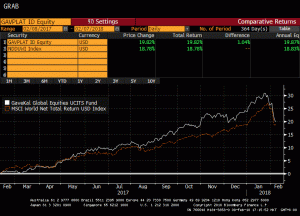
«Otro claro síntoma de que el entorno del mundo de la inversión ha cambiado es que los resultados inferiores de los mercados emergentes, que prevalecieron entre 2011 y 2016 (cuando cayó el petróleo, el USD subió y los yields se mantuvieron bajos), hoy claramente ya son historia. Estamos viviendo ahora en un mundo donde el rendimiento de los bonos tenderá a subir, el USD tenderá a bajar, y los precios del petróleo podrían mostrar presiones alcistas. En un mundo así, la exposición a los mercados emergentes una vez más resulta una recompensa. De hecho, un rasgo interesante de las recientes caídas es ver cómo la volatilidad de los mercados de renta variable norteamericano ha sido realmente mucho mayor que la de la mayoría de mercados emergentes. Incluso después de la caída de esta semana, los mercados asiáticos están significativamente mejorando los rendimientos de la renta variable global.»

.

Resulta curioso ver como poco a poco el centro del planeta inversor se desplaza desde los EE.UU. y Europa hacia Asia, y con ello, la volatilidad emprende el camino contrario. O sea que mientras el desarrollo llega a los emergentes, la volatilidad viaja hacia los países donde el desarrollo está lastrado por el sobreendeudamiento. Y lo lamentable es que para la mayoría de asesores y gestores de banca privada, las propuestas de inversión hacia países donde hay crecimiento económico y demográfico con una volatilidad en descenso (países emergentes), son de mayor «riesgo» que los tradicionales fondos europeos y americanos, donde la anemia y la volatilidad se apoderan de sus crecimientos. Seguramente la dificultad de encontrar buenos fondos emergentes comercializables en España sin disponer de un vehículo de inversión adecuado (donde quepa cualquier fondo, hedge fund o private equity del mundo mundial difiriendo su tributación como si se tratase de cualquier fondo que te vende el banco de la esquina) ayuda a que se sigan rellenando las carteras con los fondos de siempre. Pero la realidad es tozuda y el centro del mundo se desplaza inexorablemente hacia Asia, donde hay gestores impresionantes que consiguen alphas espectaculares.

.

A continuación la newsletter de Louis-Vincent Gave completa, que prácticamente no tiene desperdicio:

In Agatha Christie’s Murder on the Orient Express, the victim is stabbed by twelve different individuals.


The same is often true of bull markets; when they die, one finds many a finger-print on the murder weapon.


With that in mind, one could pin the death of the bond bull market on accelerating inflation, or on the globally synchronized global growth surge, or on the lack of investments in new capacity over the past decade (see A Brave New New World, attached), or even on the demographic shift unfolding in the Western World (see The Savings Glut’s Long Life and Slow Death), or simply on the realization that fiscal policies all around the world are bound to stay inordinately loose for far too long (see US Budget Deficits, attached)… But whichever reason one wants to hang one’s hat on, the bond bear market is likely here to stay. After all, if bonds can’t even rally by a few basis points as equity markets meltdown, then we must have a structural bond bear market on our hands.

 And at the risk of stating the obvious, this structural bond bear market is now clearly a headwind for equities.


It also marks a profound shift in the investment environment.


In a piece written close to the market top (see A Once in a Generation Shift – attached), we highlighted that OECD bonds had been the perfect counterweight to equity positions for decades. However, it wasn’t always so. In periods when inflation picks up, OECD bonds do not protect portfolios against downside risk. Instead, they add to the downside risk. We also showed that one way to know whether we were in an ‘inflationary’ environment or a ‘deflationary’ environment was to look at the relative performance of long dated US Treasuries to Gold as both had asset classes tend to ‘trend’ over long periods of time. And when the ratio ‘gold to bonds’ moves ABOVE its 4 year moving average, that is typically a confirmation that we are moving into an inflationary environment. As the chart below highlights, following this week’s rise in yields, such a move has now just occurred:


So if OECD bonds are no longer a sound hedge for equity risk, what is an investor looking to reduce the overall volatility of his portfolio, to do?


In the 1970s, and again in the 1987 crash, one of the best hedges (aside from gold), were German (and Swiss) bunds. Back then, the DM was slowly but surely establishing itself as Europe’s trading and reserve currency; a genuine alternative to a US$ weighed down by too many years of US ‘guns and butter’ policies. Take 1987 as an example: US interest rates rose until they broke the back of the (then) roaring equity bull market. But as equities cracked and the fed slashed rates, investors sought out the safe haven of the inflation-fighting Bundesbank. So much so that, by the end of 1987, for an investor looking back at January 1986, German bunds had actually outperformed not only US Treasuries (that wasn’t even close), but global equities as well:


So, as Yogi Berra once said, is it ‘deja-vu all over again’? After all, in the US today, we not only have guns and butter; we should also soon have bridges, and tunnels, and hip replacements and student loan write-offs etc… (see The US Budget Deficits, attached).  At the same time, we have China making a concerted push to turn the RMB into Asia’s DeutscheMark, a currency that will increasingly fund Asia’s trade and Asia’s capital spending. And sure enough, just as global equities (World MSCI in the chart below) and US Treasuries (TLT US in the chart below)  have started to roll over, Chinese bonds (represented below by the Gavekal China Fixed Income UCITS fun) have held their own. In fact, like German bunds in the fall of 1987, the Gavekal China Fixed Income UCITS fund has returned over 14% in US$ terms which handily beats the flat return of long dated US Treasuries, and could approach the return of global equities should global equities repeat the past week in the near future!


Another clear sign that the investment environment has changed is that the underperformance of emerging markets, which prevailed between 2011 and 2016 (as oil fell, the US$ rose and bond yields stayed low) is now clearly over. We are now living in a world where bond yields will trend higher, the US$ is trending lower, and oil prices could show upside pressures. In such a world, exposure to emerging markets once again becomes rewarding. In fact, one of the interesting feature of the current pullback is how volatility on US equities has actually been much worse than that of most emerging markets. Even after this week’s pullback, Asian markets are significantly outperforming global equities. For example, our Asian Value UCITS fund (which focuses on developing Asia) is up +31.12% over the past 12 months, while our Asian Opportunities (which includes Japan, Australia and Asian bonds) is up +23.61% over the past 12 months. This compares favorably to the +19.4% gain in the World MSCI for the past year.


Still, the question at hand is whether we are now confronting a correction? The start of a crash? Or the unfolding of a genuine bear market?

  1. ARGUMENTS FOR A CORRECTION:
  • We were due: record RSI indicators, record stretch without a 5% correction, first year without a down month etc…
  • As mentioned above, the investment environment is changing. Deflation should no longer be a concern. Central banks will no longer be as supportive of asset prices. The US$ is done rising. Oil is done adding liquidity to the system. Interest rates are moving higher… Any one of these forces would be a lot for the market to digest. But all together, they may be like Diderot’s proverbial apricot, or Monty Python’s wafer-thin mint: a little too much to chew on.
  • However, fundamentally, interest rates remain low, global growth is solid and so investors are likely to keep chasing returns?


It’s not a crash, it’s a correction”

  1. ARGUMENTS FOR A CRASH

Old card-sharks will always say that “if you sit down at a poker table and after 30 minutes, you have not figured out who the fish is, then you are the fish”.

Of course, in recent years, there have been no fish. Everyone won as all asset prices rose: equities, bonds, corporate bonds, real estate… It was just a question of relative performance with equities doing best of all. Still, as the equity bull market matured, it also evolved. Widening its reach and grasping the savings of an ever wider percentage of the population. So much so that, to a large extent, the bull market of recent years could be described as the ETF bull market. Indeed, according to data from research firm ETFGI, the ETF industry’s assets under management (AUM) stood at $4.569 trillion in November 2017, compared to $3.396 trillion at the end of 2016. Assets under management of ETFs have grown by more than a trillion dollars in less than a year. Over 2016, in comparison, ETF assets grew by a relatively paltry $522 billion. Still, over the past two years, more than US$1.5 trillion of assets have flooded into ETFs. To put things in perspective, in 2017, the US mutual fund industry recorded a growth in assets of US$91bn. In short, last year, the growth of AUM in the ETF industry was basically ten times that of the mutual fund industry.

Now I manage money for a living. In fact, I took over the management of the Gavekal Global Equities Strategies almost exactly one year ago… and while the past three weeks have been tough (our overweight energy positioning did us no favors), we are still ahead of the World MSCI for the past 12 months (net of all fees):

The reason I highlight this is that I am sometimes called upon by our sales team to go pitch the fund. And invariably, a question that always comes up amongst smarter investors is who are your other investors?”. And the reason smart potential investors ask this question is obvious enough: they don’t care much for owning a fund with ‘Nervous Nellie’ investors who will panic at the first sign of trouble, hereby forcing the management of the fund (i.e.: my team and I) into liquidating assets at the trough of a cycle, when we should instead be focusing on picking up bargains.

The premise behind the (often-asked) question is that owning assets with a bunch of ‘weak hands’ is not an attractive long-term proposition.

This obvious enough common-sense brings me back to the massive inflows into ETFs that we witnessed in the past two years. Are the ETF inflows “sticky money” that will stay invested through the market’s turmoils? Apparently, we witnessed US$30bn in ETF outflows last week (the first outflows in quite a while) and that was enough to create the dislocation we witnessed. What would happen to markets if those outflows reached 10% of the increase of the past two years, or US$150bn? What if the ETF outflows over the coming weeks reached 20%, or US$300bn? Who will take the other side of such large, incremental, marginal, trades?

To be clear: we have no way to know how sticky the ETF money will prove to be; if only because the inflows we have witnessed in the past two years are simply unprecedented. Meanwhile, the past few years have been so steady on financial markets that we have no real data to model how stable the ETF industry’s AUM could prove to be in periods of stress. The only thing we know for sure is that the ETF industry is today a much larger beast than it was in 2008. And it is by and large an untested, and unknowable beast.  And then, we also know that:

  1. Historically, in periods of market stress, money tends to stay into mutual funds because mutual funds often charge upfront fees (the sunk cost fallacy), or because investors trust the managers they chose more than they trust themselves to navigate the market’s choppy waters (the expert fallacy), or because they have done a fair amount of due diligence and thus want to validate their hard work (the sunk cost fallacy, again…) etc… Meanwhile, the whole point of ETFs is that they cost next to nothing to trade, that they do not require large amounts of due diligence, nor a relationship with a manager, etc… Thus, if we assume that the reason some of the ETF investors like ETFs is that they are easy to get into, and just as importantly easy to get out of, then should we not worry that some of the investors who chose ETF for the ‘easy liquidity’ will likely wish to exercise that very ‘easy liquidity’ now that the markets have started to head south?
  2. Aside from higher liquidity, the other main reason investors like ETFs is the (perceived) low fees. And this is where the potential for disappointment could set in because of the difference in how ETFs and mutual funds trade. Let me use my own fund as an example. If tomorrow, an investor (Nellie Nervous), decides that she doesn’t like the look of markets and no longer wants exposure to a global equity strategy, Nellie puts in her redemption form (before the agreed cut-off time) for, let’s say, US$500k. I am then notified that by closing time tomorrow, US$500k will be leaving the fund. It is then up to me to decide whether I wish to reduce holdings across my 40 names proportionately, sell some of my exposure in US oil producers (in order to reduce the pain from my overweight energy stance), reduce some of my cash buffer etc… But whatever decision I have taken, by the next closing day, the money leaves the fund , Nellie Nervous receives her cash, which she can then deposit in short term UST, bitcoins, modern art, gold bars, etc…

Meanwhile, if Nellie owned US$500k of the QQQ (or SPX, or EWJ etc…), and decided to sell her ETF, what actually happens is that she places her sell-order with a broker, who (through the exchange) then turns to one of the “market-making” firms for that ETF. Assuming that, at this precise time, no-one is coming in to buy Nellie’s ETF (hereby allowing for the shares to simply move from one investor’s hands into another), then the market-maker (maybe Deutsche Bank, or Credit Suisse, or Morgan Stanley etc…) will give the exchange the price at which the market maker feels comfortable that it can unwind the position in the Nasdaq 100, or S&P 500, or MSCI Japan etc… And as we saw during the flash crash of May 2010, when markets unravel quickly, it can be hard for market-makers to keep up. At such times, the market-makers may well quote prices with greater and great discounts to NAV; which is how, back in May 2010, we saw a number of ETFs lose up to a third of their value, and sometimes more, while their underlying benchmarks were down just a few percent.

That was then. When the ETF market was much smaller, quainter, and less the plaything of the retail investment public than it is today. And so, with retail investors now in a full-on love affair with ETFs, let us imagine that, like a bad first husband coming out of prison, all of a sudden a liquidity squeeze like the 1987 crash or the 1998 LTCM meltdown re-appears. Not the start of a recession (a la 2001), nor a massive banking crisis (a la 2008), for neither looks likely today. But simply a good old fashioned liquidity squeeze, as investors realize that the investment portfolios they have constructed are now inadequate for the world in which we are moving (see A Once in a Generation Shift). With that, less us imagine US$150bn (or 10% of the past two year’s rise in AUM) of outflows from ETFs (To be clear: this is pure speculation, for who is to know what the retail investors will decide to do tomorrow? For all we know, he/she may decide that the recent 10% dip is a terrific buying opportunity and buy more ETFs!). If this were to occur, then the questions that will rapidly appear will be:

  • Will the market-makers have the balance sheets to take on these transactions? If so, then
  • Will the market-makers have the appetite to take on these transactions? And if so, then
  • At what cost to the investment public, and profits to themselves (through higher spreads and discounts to NAVs) will the market markers decide to take on these transactions? If History is any indication, most likely a fairly large one. After all, what put the gold in “Goldman Sachs” and the more in “Morgan Stanley” has historically been the ability of investment banks to provide liquidity, at a high cost, to clients in the middle of a crisis. And if so, then
  • Will the general investment public conclude that both the ‘liquidity’ and ‘low fees’ attributes of ETFs turned out to be “bull market mirages”? And if so then
  • Will that realization encourage yet more ETF selling, bringing us back to square one, above? Wash, rinse, repeat…

In other words, was May 6th 2010 the dress-rehearsal for what could soon happen in the ETF world?

Back then, a number of investors found out the hard way that the ETF’s low fees hardly made up for the massive discounts to NAV that they suffered in the midst of a panic. With the experience of May 2010 in our rear-view mirror, and with a broader market sell-off now in the front and center of any investors’ concerns, will investors once again be forced to confront the question of what is the point of saving 0.2% per annum in management fees if, when one wishes to sell in a panic, one ends up selling one’s ETF at a 20% or more discount to NAV? Are ETF investors who think they can liquidate in a downturn going to have proven themselves to be “penny wise and pound foolish”? Will they be the fish to the card-shark investment banks?    

  1. ARGUMENTS FOR SOMETHING WORSE?

In the Spring of 2008, the global economy was humming along. In fact, for those of us sitting in Asia, it was hard not to feel very enthusiastic about the future: the Asian Crisis was falling off of our ten year rear-view mirror, China was delivering the greatest rise in purchasing power, over the greatest number of people in one generation, ever recorded in the history of Mankind (that’s humankind for our Canadian friends). India looked set to join the global economy. Indonesia and Malaysia were developing fast, partly thanks to rising commodity prices, and partly thanks to attractive demographic profile. Even Brazil, of whom it was once said that “it is the next emerging market, and always will be’, was thriving.

Things were good. And then things turned bad very quickly.

Things were bad because the financial regulators, especially in the US but also to some extent in Europe, fell asleep on the job. They allowed banks to expand their leverage from the time-tested 10x, up to 40x and beyond. They rubber-stamped the creation of financial products that made little sense, (such as CDOs squared, PIK loans etc…) except that they allowed yield starved investors to gorge themselves – but without realizing the risks they were taking as they did.

Could History repeat itself?

Probably not, if only because banks are nowhere near as levered as they were in 2008.

Still, one nagging concern is that, for the past five years, investors of all size and stripes (even small retail investors) came into the market day-in/day-out to sell volatility (daily volume on VIX options has risen from 23k in 2006 to 3m today!). This constant selling of volatility was just another way to ‘reach for yield’. And needless to say, the consequent downward pressure on volatility was very bullish for risk assets.


Projecting ourselves forward however, we can probably assume that the number of investors rushing to sell volatility forward will now be constrained to a smaller group of traders who actually understand what they are doing? Logically, this should mean that volatility should settle back closer to its long term mean of roughly 17%. If so, then that would mean that we would now confront an environment of higher interest rates and higher volatility… And if we have higher interest rates and higher volatility baked into the cake, doesn’t that almost guarantee lower PEs?


Following up on the above idea, we have seen in recent years, especially in the US, a rapid growth in quant funds, CTAs and risk parity strategies (witness the steady rise in SPX options trading). However, a number of these strategies were, in essence, levered longs on bonds and equities simultaneously, on the premise that bonds and equities are negatively correlated. However, as we surmised in our most recently Monthly, what happens if bonds and equities stop being negatively correlated? Well, obviously we now know the answer: the risk-parity, quants and algo traders have to start deleveraging their balance sheets aggressively in a market where the marginal buyer has, all of a sudden, disappeared. And the reason the marginal buyer has disappeared is that in recent years’ (as the picture below makes clear), the marginal buyer has started to look very different from the marginal buyer of past bull markets:


Which brings us back to the “yield-chasers” mentioned above. In my careers, every bear market has started with the ‘yield-chasing’ investors getting burnt. It is almost as if “the bear” enters a room and decides ‘First, I will eat the yield chasers. They are the easy preys. Then, if I am still hungry, I will eat the momentum guys. And if I am still hungry after that, I will have the value investors for desert’.


The fact that the yield chasers just got destroyed doesn’t mean that, de facto, the momentum and value guys are next. Maybe the bear has had its fill, and goes back to sleep (after all, it is hibernating season)? But still, when the yield chasers get eaten, we momentum and value guys have to realize that we are potentially next on the menu…


And all this brings me to perhaps the single most important reason to be cautious given recent developments: namely the fact that this is now the second crisis in a decade where US regulators have shown themselves to the world to be completely hapless.


After all, if the current sell-off really is the direct consequence in the implosion in the XIV.US, and other such products, then the first question we should ask ourselves is why these products even existed in the first place? I mean, what economic interest was served by allowing retail investors to pile their hard-earned cash into a product that, through its very conception, had an extremely high probability of being worth zero at least once, if not twice, a decade?


Are we back to where we were ten years ago, when all of a sudden, we all had to figure out what a CDO-squared was and how they could implode the global financial system?


It is it just that, this time around, it’s just a different bunch of letter but the core principle stays the same: let’s create products that allow the average punter to reach for extra yield, even at the cost of getting blown up once a decade! The ultimate “eat like a bird and sh.t like a cow” trade?


Honestly: why would US regulators even allow things like 3x levered Brazil ETFs, or worse yet, inverted VIX ETFs who, by design, are destined to go to zero in a time of market stress? What economic benefit is there to have such products offered to the general public? Or more appropriately, what point is there to have a financial regulator is the regulator allows for things like a reverse VIX ETF, or futures on Bitcoins?


Unfortunately however, if the past is any indication, regulators will respond to this latest market hic-cup by telling money managers how they can pay for research, or by clamping down further on offshore tax havens, or by dictating firm’s compensation policies… More regulations, of things that had nothing to do with the crisis in the first place! Thus, if the end result of all this is more lawsuits (one can bet one’s bottom dollar that a number of the investors wiped out in the Volageddon will not take their losses lying down), more regulations, higher interest rates and higher volatility… then it is hard to walk away from the past week with a strong “risk on” mentality?


Or at the very least, a strong “buy the dip” mentality. For there are still risks that offer attractive returns across a number of equity markets around the world. It may however, be very different markets, and different segments of the markets, from those who have done so well for investors over the past five years.

As always, please do not hesitate to reach out if you have any comments or questions.  

Yours truly,

Louis-Vincent Gave

PS: PLEASE NOTE THAT THE ABOVE REPRESENTS MY PERSONAL VIEWS AND IS IN NO WAY AN OFFER TO BUY/SELL ANY SECURITIES.

Shall we help you search?

Cluster Family Office

We care about transparency both in management and in our own way of working. Leading wealth management and family offices company

Do you need help in capital and wealth management?

How can I avoid the negative effects that my fortune may have on my children?

How and when should I talk to my children about family wealth, and what relationship should they have with money throughout their adolescence?

How can I measure the real risks of my investments and protect my assets adequately?

Do I have sufficient liquidity and stable income to cover my needs on a permanent basis?