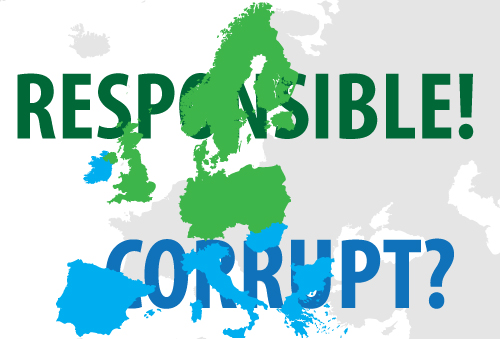
Europe, the year two thousand and twenty-something. Following the trauma of the last-minute Brexit negotiations, the EU had to tackle the next elephant in the room: inflation. Although it was rising only slightly, it was already an issue that the northerners could no longer afford to ignore. Demographics and anaemic economic growth, weighed down by massive debt across Europe, had allowed the big decision to be put off, even though the US had already normalised the value of the dollar and the rest of its monetary policy.
.
Comparisons between the US economy and the European ‘Babel’ were odious. And the northern nations – the Germanic and Scandinavian countries – with their strong and sound economies, could not and would not bear the risk of runaway inflation. Their multinational companies had coped admirably with an expensive (though not strong) euro, but with the devaluation of the single currency fuelled by negative interest rates, inflation was now posing a very serious threat to the ECB’s decision to maintain the financial repression below zero.
.
The southerners, the Mediterranean types, on the other hand, still needed inflation to eat away at their unpayable debt. They prayed that a general rise in prices and wages – even if accompanied by a loss of purchasing power – would make it more feasible to pay off the worthless paper that only the ECB had been buying from them for a decade now. But the southerners continued to bleed deficits from their budgets. They owed more and more, year after year. And neither their populist leaders nor their productivity levels were capable of achieving the budgetary balance needed to stem the haemorrhage.
.
Without consistent economic growth to boost the southern states’ revenues, and without persistent inflation to devalue their unpayable debt, the only option left to prevent a massive default by the southern states was ‘austericide’, but that approach had also proved futile in saving the Greeks. The can that had been kicked down the road for years had finally hit the wall that the northerners and southerners now had right under their noses.
.
The people of the north and the people of the south had contrasting characteristics, levels of productivity, economic data and needs. Yet, paradoxically, such different groups shared one thing in common: interest rates. The cowardice and obstinacy of the Eurocrats over the last 25 years had condemned them to sharing a single currency and interest rates set at very different levels. Perhaps the time had come for the northern and southern countries to adapt their interest rates to their respective economies.
.
But let no one be under any illusion when the time comes for different exchange rates: even if we continue to call it the euro, if its price differs between the northern and southern countries, it will trade at different rates and the single currency will, in effect, be a thing of the past. And a few clues as a result there was no shortage of for the most sceptical among us over all these years.
.
The million-dollar question is whether the divide between the north and south is inevitable, or whether there are other options. A couple of years ago, we dubbed it «The Big Write-down» and «Selective debt write-down»the only way to ensure that the north and the south continued to share interest rates, at least for a few more decades. Perhaps in a few years’ time, the EU will be very close to having to make the final decision: different interest rates for the north and the south, or selective write-downs by the only creditor that can afford to do so, the ECB.
.
To date, the EU has not done what is right, but rather what is necessary to postpone disaster; we shall see from now on which path those in power decide to take. Because, as he rightly says, Jonathan Tepper in this tweet, The decision won’t be voted on by the lot in the south; instead, it will be taken by the lot in the north when they have no other choice.
.
The second big question is whether investors are prepared not only to avoid the negative effects of whichever path the EU ends up taking, but also to capitalise on them.