

We look after your interests

(+34) 93 626 47 75

Torres Sarrià, Carrer de Can Ràbia, 3-5, 4ª Planta BCN 08017

(+34) 91 794 19 82

Pº de la Castellana, 93 2nd floor MADRID 28046

Category: gestion financiera

Why does every investor need an EAFI or a Family Office?

Perhaps for those of us who are professionally engaged in it, the answer may seem obvious. Especially for those of us who have suffered for decades in our own flesh the miseries and shortcomings of private banking. It is no coincidence that, in addition to being advisors, we were, are and will continue to be essentially investors, and as such, our interests are still, unfortunately, at the antipodes of those of the banks and their misnamed advice. Having said that, let us now analyse the transcendental decisions that every investor should take to advise on the correct management of their assets.

To begin with, the ordinary investor should analyse his or her asset situation and determine whether, in addition to purely financial advice, he or she also needs tax, legal, commercial, corporate or real estate advice. In other words, they may need to put their companies/businesses in order, their real estate investments or divestments, the administration of these properties, inheritance and family matters, their investments in the stock market and in unlisted companies, the generation of the necessary income for their family or projects, optimising the taxation of all of this, etc. (more…)
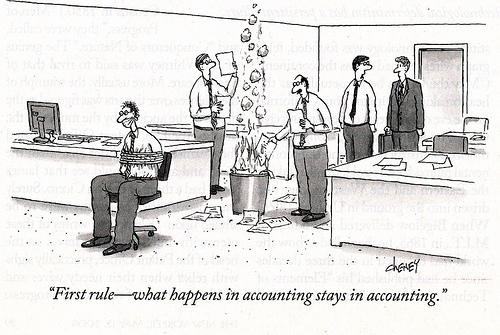
It's not for not collecting, it's for not accounting.

With central banks and their QE, the debt situation in the developed world has reached a surrealistic level worthy of study. Not only because of the unprecedented size of the balance sheets of the FED, ECB, BoE, BoJ, SNB, etc., but above all because of the manipulation of accounts, which has become a macabre and dangerous norm.

Thus, the manifest insolvency of the southern states of the Eurozone is the gigantic elephant in the room of the Troika (now renamed «the 3 institutions»: EU, ECB and IMF) that all these creditors ignore without the slightest blush. The most surreal case is that of Greece, which with Syriza at the head of its government is causing panic among its European partners. And this panic is not caused by the Greek state's inability to repay its massive debt - they have known that for years - but by the new government's willingness to publicly and openly acknowledge its insolvency.. Why? Simply because recognising that Greece will never be able to pay means having to write off losses on its creditors' balance sheets. And that really panics them, since neither the European banks nor the indebtedness and budget deficits of the other Eurozone countries are in such a state that they can count not a single euro of additional losses at the moment. (more…)

The CNMV shields itself against a foreseeable collapse in fixed income.

According to this communiqué issued by the CNMV last Friday, investment funds registered in Spain for marketing will have to publish a series of warnings in addition to those set out in the current regulation. Special emphasis is placed on fixed-income funds and funds that establish a return objective, whether guaranteed or not, and structured funds. These warnings must be included in the prospectus of the funds, as well as in the DFI (Key Investor Information) and in the IPP (Periodic Public Information). In other words, no one, neither investors nor judges, can say that the CNMV is in any way responsible for the losses that any investor may incur in fixed income in the near future. The fact is that they have already seen the lion's ears when the CNMV has had to defend itself in recent years for having acted with slovenliness, incompetence and/or negligence in the pitiful issue of preferential securities. (more…)

The side effects of Central Banks are already here.

various-central-banks

It was to be expected that central bank intervention would not be innocuous. We warned a little more than a year ago and its effects are already blowing up in some people's faces. If to this massive intervention never seen before we add a couple of other ingredients (Madonna, Madonna, just a couple...) such as OPEC's plot to push down the price of oil, the conflict in Ukraine or the radicalisation of the alleged Islamic State in the Middle East (which affects even Paris itself), the amplification of the side effects of central bank intervention can and will be uncontrollable.

Today we are already witnessing brutal price movements, which do not correspond at all to a healthy financial system, nor to corrections or adjustments of excesses, but rather to the delusions of a system that has been in place for years. frankeinsteinian capable of anything. Let us look at some very significant examples in recent weeks which, however, have paradoxically had rather localised devastating effects until today: (more…)

2015 could well be an annus horribilis for the traditional investor.

Before listing some of the risks we will face this year, let us define what we mean by «traditional investors». This term covers the vast majority of retail investors and even many institutional investors. These are the investors who put their money into traditional fixed-income and equity products typically marketed by banks. In other words, bonds and listed shares, as well as investment funds of all kinds that invest in these same assets, paying hefty commissions to the distributors (banks) to place them with their clients. Assets that performed well years ago, when the financial system was not overwhelmed by debt and the actions of central banks.

We must not lose sight of the fact that the conditions are ripe for most investors to have a disastrous year: (more…)

Have you won the lottery jackpot? The first 5 decisions you need to make.

Most lucky lottery winners end up losing their entire fortune within a few years. This is a quasi-universal law that affects the vast majority of lottery winners, as bad decisions start as early as the first minute after the draw. Let's see how bad decisions can be avoided in the first days or weeks after being chosen by the goddess Fortune. We will summarise them in 5 essential decisions and present them to you in the usual chronological order in which they should be taken.

The first The golden rule would be maximum discretion. The fewer people who know that we have won the jackpot or any other lottery, euromillions, etc., the better, much better. Not only for security reasons, but also to avoid, as far as possible, becoming a tempting lure for fraudsters, tricksters and unscrupulous and unscrupulous investment hunters. And bankers should also be included in this bag, as they will immediately be on the lookout for their prey as soon as they smell the blood of the nouveau riche and its irresistible liquidity. However, some bankers will have to be told, since the winning tenth or tenths must be deposited in a bank for collection and the corresponding 20% withholding, in other words, the first tax bite from the State. But be careful, (more…)

Generating income in a scenario of expensive bonds and rising rates.

Generating income when rates can only go up, and doing so in an environment of recession or anaemic growth, is at best a pipe dream. The fact is that there comes a point at which trying to scrape a tenth of a yield by adding risk (and we are not talking about mere volatility but the dreaded insolvency) is not only reckless but also increasingly difficult to achieve. A few examples to illustrate this point: The Spanish 10-year sovereign bond, with government indebtedness of 100% of GDP and its persistent public deficit of -7%, offers an incredible yield of 1.96% per annum. Or the high yield corporate debt of companies in the developed world, as over-indebted as the countries, with yields that are less and less «high» and which will be mercilessly crushed by the rise in interest rates. And what can we say about Greece itself, the paradigm of insolvency and the impossible rescue by states also in need of a bailout, offering a ridiculous 7.79% for 10 years. In other words, the investor receives 7.79 per annum in exchange for Greece being able to pay back its euros intact in 2024... Insane. The sovereign debt that many investors have in their portfolios (ignoring the fact that there is life beyond traditional listed fixed income), which has risen as much as the Spanish risk premium has fallen in the last two years, reminds me a lot of the turkey sentiment before Christmas... (more…)

Is there life beyond Bestinver?

Most of you will already be aware of the scandal surrounding Francisco García Paramés’ departure from the investment management firm Bestinver. Let’s just say that the Entrecanales family, owners of the fund management firm, and through their brand-new director Luis Rivera, have provided the perfect example of how to ruin Spain’s best fund management firm and a manager who is a European benchmark in the world of value investing in one fell swoop. Furthermore, it is not only personal relationships that have led Paramés to set up his own future fund management company, but also his two right-hand men: Álvaro Guzmán and Fernando Bernad, who they have just announced who will remain at Bestinver only until the end of the year to ensure a smooth transition. After all, it would be a real shame not to know how to look after, cherish and retain the «European Warren Buffett» in your company, working alongside him and his team for as long as necessary. (more…)

The 'tailored fund' scam

Esta es la última moda en las técnicas de abuso comisionista de la banca, y parece que llegó hace unos meses para quedarse entre los inversores más cándidos. Los fondos perfilados en definitiva son fondos de fondos cuyo criterio de selección es mantener una combinación de aproximadamente media docena de fondos que en su conjunto se adecuen al perfil inversor tipo: Agresivo, moderado, dinámico, conservador, etc. O sea, que en lugar de que el asesor de la entidad bancaria de turno recomiende a sus Clientes tener en cartera 4, 6 u 8 fondos determinados, sustituyendo unos por otros cuando lo considere necesario, le va a proponer comprar sólo uno, el perfilado. Y serán los gestores de éste quienes compran y vendan los que quieran en cada momento, sin que el inversor ni se entere. (more…)

Fixed Income 2.0

La renta fija tradicional, en forma de bonos emitidos por Estados y empresas, está pasando por momentos muy complicados. El abuso de endeudamiento por parte de los países desarrollados -y cada vez más también los emergentes-, junto con la fabricación de dinero por parte de los bancos centrales a niveles jamás vistos, hace que la renta fija sea cada vez menos fiable en general. Si fabricamos dinero de la nada sin anclarlo a nada, la deuda se convierte en meros dígitos cuya solvencia queda cada vez más en entredicho, ya que los ingresos y la capacidad de generar flujos de dinero para devolverla quedan cada vez más ridículos respecto a la cantidad debida. Y eso ocurre tanto a las empresas como a los Estados de los llamados países desarollados.

Si además añadimos a ello una política sostenida durante años de tipos de interés a prácticamente cero, y unas facilidades de recompra de activos por parte de bancos centrales demenciales, tenemos como resultado que la deuda más solvente (sic) como la alemana o la estadounidense está en tipos negativos. Y como consecuencia, el resto de deuda de países paradójicamente hiperendeudados, también goza de unas primas de riesgo mínimas, es decir que pagan extraordinariamente poco por recibir dinero prestado. (more…)

Shall we help you search?

Cluster Family Office

We care about transparency both in management and in our own way of working. Leading wealth management and family offices company

Do you need help in capital and wealth management?

How can I avoid the negative effects that my fortune may have on my children?

How and when should I talk to my children about family wealth, and what relationship should they have with money throughout their adolescence?

How can I measure the real risks of my investments and protect my assets adequately?

Do I have sufficient liquidity and stable income to cover my needs on a permanent basis?