
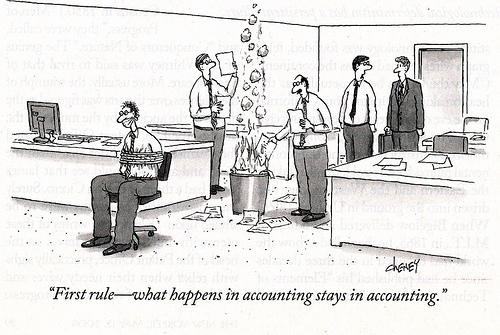
 With central banks and their QE, the debt situation in the developed world has reached a surrealistic level worthy of study. Not only because of the unprecedented size of the balance sheets of the FED, ECB, BoE, BoJ, SNB, etc., but above all because of the manipulation of accounts, which has become a macabre and dangerous norm.
Thus, the manifest insolvency of the southern states of the Eurozone is the gigantic elephant in the room of the Troika (now renamed «the 3 institutions»: EU, ECB and IMF) that all these creditors ignore without the slightest blush. The most surreal case is that of Greece, which with Syriza at the head of its government is causing panic among its European partners. And this panic is not caused by the Greek state's inability to repay its massive debt - they have known that for years - but by the new government's willingness to publicly and openly acknowledge its insolvency.. Why? Simply because recognising that Greece will never be able to pay means having to write off losses on its creditors' balance sheets. And that really panics them, since neither the European banks nor the indebtedness and budget deficits of the other Eurozone countries are in such a state that they can count not a single euro of additional losses at the moment.
The balance of the accounting make-up of Portugal, Spain, Italy and even France is so fragile that the last thing the European economic authorities are prepared to do is to account for even the smallest loss on the monstrous debt that flows from one balance sheet to another in the Eurozone. To be able to kick the umpteenth debt snowball into gear means that no one must default, not even a small debt restructuring. Interest rates will be accommodated down to zero, maturities will be extended to infinity, austerity policies will be relaxed, unspeakable concessions will be agreed, etc, etc, etc. All in exchange for the debtor (in this case Greece), however insolvent it may be, continuing to officially admit the total debt owed. This will allow the creditors to continue to record these dizzying figures on their balance sheets as virtually «collectible» in the infinite future, and not as losses that would have to be provisioned for in accounting and fatally.
The negotiations between the brand new Greek finance minister Varoufakis, Germany's Schäuble and Eurogroup president Dijsselbloem - both staunch supporters of financial Calvinism until today - must be most surreal. I imagine the Dutchman and the German offering all sorts of advantages in exchange for Varoufakis continuing to recognise an absurd and unpayable debt. And I also imagine the Greek weighing up all the options open to him, which are not few, to decide the future not only of his compatriots but also, to a large extent, of the Eurozone as we know it.
Let us not forget that in addition to European promises of rate cuts and maturity extensions to continue to recognise the larger portion of the existing debt, Greece has tempting proposals for liquidity from China (good strategists if ever there was one) and above all Russia, which would score a goal in the corner (another) for the EU and indirectly for the USA. Russia needs to veto European sanctions in some less bloody way than the Ukrainian war, and the East has money to spare, and setting foot in the EU is a very tempting candy. Let's not forget that a Greece bailed out by the Chinese/Russians would be much more solvent and therefore «unremovable» from the Eurozone against its will. On the other hand, the Westerners in the Eurozone have more problems than money. And the accounting make-up is beginning to unravel in the southeast like an ice cream on the shores of Mykonos in August.
Whatever the outcome, any approximation to a recognition of the reality of the financial matrix we live in is welcome. The accounts of banks and developed countries must return to a picture closer to financial reality, however painful that may be. Tsypras, Varoufakis or any other politician worth his salt must once and for all say loud and clear that the king has long since been walking naked among the balance sheets of European banks and states. And that we in the south will never be able to pay back what we owe to those in the north, nor what we owe each other in exchange for tricky reciprocal bailouts. Surrealism in its purest form.
It is against this backdrop, and the possibility that unpayable debt restructurings may soon be on the cards, that investors who need to generate income must contend. Woe betide those who must continue to rely on fixed income sold to them by the nice banker on the corner... As always, regulators prepare, institutional investors and banks are starting to let go of ballast (fixed income) before the storm hits, and are placing bonds with their hands full among poor retail investors. But in imaginative and attractive ways, such as structured products, income distribution, guaranteed return targets (sic), etc, etc, etc, etc, etc, etc, etc....
You may be interested in re-reading the article entitled «Generating income in a scenario of expensive bonds and rising rates«; or this one «2015 could be the annus horribilis for the traditional investor«. Not knowing about alternatives is no longer an excuse for throwing one's wealth on the debt roulette table.