I am pleased to inform you that as of this week, we are publishing articles periodically in the prestigious GurusBlog. There we will be able to reach an audience that until now did not know us, and therefore our work of disseminating our way of seeing wealth management will have a wider reach. We will not always publish all the articles there and here in duplicate, but some posts will be published only in one of the sites. However, we will always try to publish short notes referring to our articles published in GurusBlog. I hope you enjoy it and here is the first one: «Who moved my Value? The compass of the New Normal«

 The ECB has denied that it opposed the Spanish Government’s plan to recapitalise Bankia using Spanish government debt. It has simply issued a brief official statement to the media, explaining that the ECB has not been consulted on the Spanish (bank) recapitalisation plans. But what happened a few hours earlier is more than a little curious.
  There is something worse than being poor and insolvent, and that is having to hide one’s poverty whilst feigning opulence and grandeur. Woe betide anyone who has to pretend to be rich, when they are not, just to keep their business afloat! For insolvency and poverty, when faced with sincerity and honesty, become more dignified, more hopeful and less miserable. The fact is that working in a sector such as banking—which necessarily requires those in the business to feign wealth and stability in order to win the trust of their customers—is something one can live with when the bank is genuinely wealthy and solvent. But when the business goes awry and the leverage inherent in banking itself completely erodes the solvency and soundness of the institutions, that façade of opulence becomes a macabre lie, resulting in the schizophrenic loss of all contact with reality (as we said in
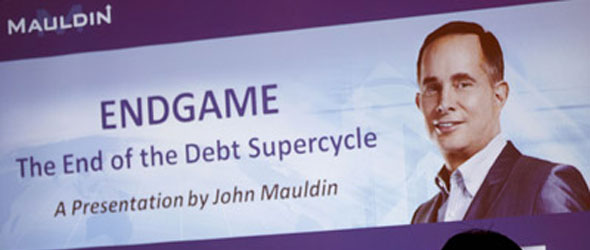
 John Mauldin treats us to another realistic analysis this week
  There are many fears that France will not follow the path of austerity and budgetary rigour, should the socialist Hollande win the elections. But the harsh reality is that the colour of the elected president and his electoral programme are not so relevant. Nor does it seem likely that in the second round Sarkozy will win the support of Le Pen's extreme right-wing voters, but even if Hollande were to win the Elysée, his capacity for manoeuvre would be very, very limited.
  We are in the eye of the storm. But not because of injustice or envy of our northern neighbours—no—but because of our own foolishness. That foolishness which has led us in the past to vote for governments of both political stripes, yet with one thing in common: an inability to manage the Spanish economy. We have missed a golden opportunity, given that economic growth and the surge in job creation in the Eurozone allowed us to boast of macroeconomic figures that made even those of France itself pale in comparison. And so Zapatero proclaimed on occasion, although today it is the Mercozy duo who must stifle their feelings in the face of the grotesque and surreal tragicomedy of the current periphery. «Spain is doing well,» we proclaimed to the four winds just a decade ago. Those were years when illusions of grandeur led the presidents of Spain and Portugal to meet in the Azores with the very presidents of the United Kingdom and the United States of America. Aznar, Barroso, Blair and Bush together shaping the plans that were to govern the New World Order. That was only nine years ago, but it seems so long ago…
 In many talk shows and in the press, we are hearing voices proclaiming the irrationality and delusion of the markets regarding the state of the Spanish economy. It is argued that the fact that Mr Market penalised Spanish bonds before the most austere budget in Spanish democratic history was made public, and continues to do so after the cuts, is irrefutable proof of the markets« madness. They say this is proof that this country’s economic policies must be set regardless of what the markets might think. That »the dictatorship of the markets’ is something we must ignore and fight against… But no. Let’s look at some of the reasons why we must not, and cannot, ignore Mr Market:
  It’s already a
  That exceptional measures should be taken in exceptional situations is pure common sense. And the
  Below is an article by a contributor who has asked us to publish some of her articles on this blog. Sofía Sánchez is a writer and a graduate of Florida International University, specialising in writing about politics, economics and labour market trends. Here is her article on these trends in the world of work: