
 We are in the eye of the storm. But not because of injustice or envy of our northern neighbours—no—but because of our own foolishness. That foolishness which has led us in the past to vote for governments of both political stripes, yet with one thing in common: an inability to manage the Spanish economy. We have missed a golden opportunity, given that economic growth and the surge in job creation in the Eurozone allowed us to boast of macroeconomic figures that made even those of France itself pale in comparison. And so Zapatero proclaimed on occasion, although today it is the Mercozy duo who must stifle their feelings in the face of the grotesque and surreal tragicomedy of the current periphery. «Spain is doing well,» we proclaimed to the four winds just a decade ago. Those were years when illusions of grandeur led the presidents of Spain and Portugal to meet in the Azores with the very presidents of the United Kingdom and the United States of America. Aznar, Barroso, Blair and Bush together shaping the plans that were to govern the New World Order. That was only nine years ago, but it seems so long ago…
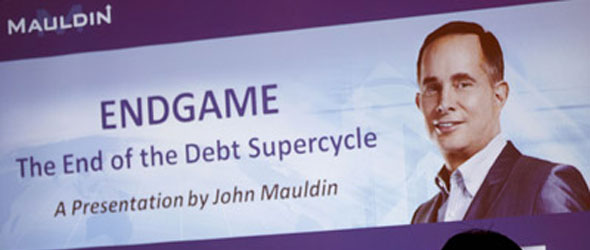
Today our situation is radically different and infinitely more real. But to make ourselves aware of the gravity of the situation, we often have to turn to external sources that are free from complacency. Some will say that we have no need to become aware of our critical situation. That it serves only to make matters worse and to lower the morale of the troops. Perhaps they are not entirely wrong, but personally I've always preferred to take the red pill. I sincerely believe it is vital for navigating, investing and safeguarding personal wealth in this financial «New Normal’, and that is, after all, what we are paid to do. I have therefore included below the full text of the article published yesterday by John Mauldin in his ‘Thoughts From The Frontline’, entitled ‘The War for Spain«, in which he also refers to information from tipicallyspanish.com. I recommend you subscribe to Mauldin’s free newsletter if you’re looking for an outside perspective. In that article, you’ll find statements as stark as reality itself, which I’ve highlighted in bold in the text below:
I fully intended to ignore Spain this week. I really, truly did. I had my letter all planned out, but then a few notes caught my eye, and the more I thought about them, the more I realised that the turning point which I thought the ECB had pushed back by at least a year with its recent €1 trillion LTRO is now hurtling towards us much faster than ECB President Draghi had in mind when he launched his massive funding operation.So, we simply must pay attention to what Spain has done this week – which, to my surprise, seems to have escaped the attention of the major media. What we will find may be considered a tipping point when the crisis is analysed by some future historian. And then we’ll return to some further details on the US employment situation, starting with a few rather shocking data points. What we’ll see is that for most people in the US, employment levels have not risen, even though overall employment has increased by 2 million jobs since the end of the recession in 2009. And there are a few other interesting points. Are we really going to see 2 billion jobs disappear over the next 30 years?
In my book *Endgame*, co-author Jonathan Tepper and I wrote a chapter detailing the problems Spain was facing. It was clear to us, as we were writing in late 2010, that there really was no easy way out for Spain. The end would come in a torrent of misery and tears. Tepper actually grew up in a drug rehabilitation centre in Madrid – as a child, his best friends were recovering addicts. (For the record, he has written a fascinating account of his early life and is looking for a publisher.) His Spanish is therefore impeccable, and he used to be asked to appear on Spanish programmes all the time. Until the day came when the government drew up a list of five people, including our Jonathan, who were effectively labelled «Enemies of Spain», and pointedly suggested that they should no longer be quoted or invited onto any programmes.
As it turns out, the real enemy was the previous government. We knew (and wrote) that the situation was worse than the official figures suggested, but until the new government came to power and began to reveal the true state of the country, we had no real idea. The previous government had falsified the accounts. So far, it seems it has even managed to do so without the help of Goldman Sachs (!)
In about ten days’ time I’ll be sending you a detailed analysis of all this, courtesy of some friends, but let’s take a look at some of the key points. The true Spanish debt-to-GDP ratio is not 60% but closer to 90%, and perhaps even higher when you factor in the various local government debts guaranteed by the central government, most of which will simply not be repaid. Spanish banks are deeply in the red, and that is with write-offs and mark-to-market adjustments on debts that amount to not even half of what they should be. If Spanish house prices fall as much relative to their own bubble as US house prices have so far (and they will, if not more), then valuations will fall by 50%. The scale of overbuilding was staggering, with one new home being built for every new person as the population grew. We know that unemployment stands at 23.1 per cent, with youth unemployment exceeding 50.1 per cent. Etc., etc. We could devote 50 pages (which is what I will provide you with access to) to detailing the dire straits in which Spain finds itself.
Which brings us to this week. It was only a few weeks ago that most people, including your humble analyst, thought the ECB had bought itself a little breathing space with its «shock and awe» €1 trillion LTRO. Many analysts suggested there would now be at least a year to put measures in place to tackle the looming crisis.

Yet we may now be fast approaching the moment of crisis when the markets simply refuse to believe in the financial firepower that whatever governmental bodies can muster. It happened with Greece, as it has in all past debt crises. Things go along more or less swimmingly until, as Ken Rogoff and Carmen Reinhart so articulately detail in This Time is Different, we wake up one morning to find that Mr Market has seemingly lost all interest in funding a country at a level of interest rates that is credibly sustainable. When interest rates soared to 15% for Greece, even European politicians with poor maths skills could see that Greece had no hope of ever paying off its debt.
When yields rose last year to almost 71% for Italy and 61% for Spain, before the ECB unleashed the full force of its monetary policy, they were approaching the limits of sustainability. Yields fell again as the ECB either bought the two countries’ bonds directly or arranged for their purchase. But now the LTRO effect appears to have worn off, and yesterday interest rates on Spanish ten-year bonds rose again to 5.991%. There is a major auction of ten-year Spanish bonds next week, which the market is clearly anticipating with some concern. Meanwhile, Italian interest rates are not rising in lockstep, which shows that the anxiety is now clearly focused on Spain. Ho-hum, move along folks, nothing to see here in Rome.
(What follows is a mixture of the facts as I understand them and my own speculation. I admit that, as I peer at this information at 3 am, I may be reading more into it than is warranted. But then again, there is a fair amount of historical evidence to suggest that I am not entirely off the mark…)
I came across this tidbit from typicallyspanish.com, and my antennae started to twitch (thanks to Joan McCullough). The key is the second paragraph. (Hacienda is the common name for the Spanish tax ministry, otherwise known as the Agencia Estatal de Administración Tributaria.)
«Spain saw the sharpest decline in the number of self-employed workers in Europe in 2011. One in two self-employed workers to lose their jobs in the EU that year was Spanish. Seven out of ten self-employed workers in Spain do not employ anyone else. In 2011, Europe lost a total of 203,200 self-employed workers, 0.61 per cent fewer than in 2010.
«Following the news that cash transactions exceeding €2,500 are to be banned, the Spanish tax authorities have stated that they will not fine anyone who admits to having made payments of more than €2,500 over the previous three months. The cash limit is part of the Government’s anti-fraud measures, which were approved today, Friday. Spanish citizens who hold a bank account abroad are now legally required to inform the tax authorities about that account. The Government hopes its anti-fraud measures will generate €8.171 billion.»
My fellow US citizens will be thinking to themselves, «So what? We have to declare our foreign bank accounts, and any large cash transactions are flagged.» But, dear reader, this is quite different. This is a new law for Spain – essentially currency controls on a massive scale – and alarm bells must be ringing all over Europe.
First of all, note that Greece never attempted to require its citizens to report cash transactions or to declare foreign bank accounts. This is the new Spanish government showing signs of serious desperation. The government has its back against the wall. They must know they will not collect the taxes they need to generate, but they are going to try anyway to demonstrate to the rest of Europe (read Germany) that they are doing everything they can.
On a side note, on Wednesday, Spain’s interior minister introduced new measures to thwart plots using «urban guerrilla» tactics to incite protests. And the local papers are publishing opinion pieces by economists arguing that the drive to meet German austerity demands will only make the economy worse, and that the government is failing to take into account the determination of trade unions to oppose them. «Germany is the problem.» It pains me to say this (truly it does), but this is what we were writing about Greece not all that long ago. We are seeing footage of demonstrations that are verging on riots. It is a familiar pattern.
Secondly, let’s look back at what I wrote a month ago. I noted that Spanish banks were using the LTRO funds to buy Spanish government bonds (and Italian banks were buying Italian government bonds, and so on). The intention was to help the two countries specifically, and Europe in general, to finance their debts and enable banks to bolster their capital as part of that effort. However, this has had the unintended consequence of making a break-up of the eurozone easier, as it helps remove Spanish and Italian debt from the balance sheets of German and French banks.
The only reason Germany, France and others took an interest in Greece was that their banks held so much Greek debt on their balance sheets – in many cases, more than enough to render them insolvent. Bailing out the banks directly would have been costly, so it was better (in the view of European leaders) to do so through bailouts from funds created with guarantees from the various governments (which is a roundabout way of getting the money from taxpayers) and the European Central Bank. A crisis was averted and there was a more or less orderly Greek default – which anyone who bothered to look at the figures saw coming well in advance.
On a further note: Spanish banks« borrowing from the European Central Bank doubled last month, »revealing a dangerous dependence on emergency funding that on Friday triggered renewed turmoil in financial markets.” (The Telegraph) And the Spanish stock market has fallen by some 30% over the past year.
So, in an effort to ensure that everyone pays their taxes and to stop tax fraud, the Spanish government is going to find out which of its citizens have moved their money out of Spain. And let’s be clear, money has been flying out of the banks of Spain and Portugal (and to some extent Italy) just as it did, and still is, in Greece.
And it will be easier to track that offshore money than you might think. I am sure some people converted their money into cash and then took it out of the country. But others simply transferred the money, thereby leaving a trail. Spanish banking regulators can easily require that information to be provided, and what bank would refuse the regulators? Spain does not collect taxes from its citizens if they are residents of a foreign country (as the US does), but it can tax everyone who lives in Spain. And if you live in Spain and decide to spread your risk across a few other countries? I am not sure about Spanish tax law, but I reasonably assume you are supposed to report all your income from whatever source. (Otherwise, no one would invest with Spanish banks, brokerages and investment advisers – if it were legal not to report foreign investments, then everyone would invest outside the country.)
Let me venture a modest prediction: We will see a rather sudden and substantial demand for physical cash in certain other «peripheral» countries, as their citizens may now wish to avoid leaving a paper trail when opening foreign bank accounts. What is to stop Italy from following Spain’s example? Or Portugal? Or France? Or Germany?
Let me be clear about one thing. I am not suggesting that people should not pay their taxes. If you choose to live in a country, you should pay the taxes that are required. What Spain is trying to do is simply ensure that all its citizens pay the correct amount of tax. If there were already full compliance, there would be no need for new regulations like Spain’s. And the same goes for the US. Our penalties for not paying taxes are rather severe, more so, I imagine, than in most of Europe. I have noted on more than one occasion that Italy’s national sport is tax avoidance.

My friends in Spain tell me that a lot of business is done in cash. But that’s the case in the US and almost everywhere I go. There are a lot of (ahem) «independent» taxi drivers, service providers, etc. who only accept cash. Perhaps they declare everything, but I don’t bother to ask. (When I was a waiter at university, did I declare all my tips? I was required to report a minimum amount of income for each hour worked, but did I report everything? Since it has been 40 years and the statute of limitations has run out by now, I might admit to missing a few dollars here and there.)
I imagine there are quite a few Spanish citizens who aren’t sleeping well this weekend. And more than a few people tossing and turning in other countries as well. If the next month comes and goes without any sign of unusual cash movements in Europe, then I will owe the people of peripheral Europe a big apology for doubting their willingness to pay their taxes. Or perhaps it will turn out that they were better at «avoidance» than your average American, and planned their moves well in advance… [Now we can better understand the reason behind and the urgency of the Government’s measures to monitor accounts held abroad, can’t we?]
Let’s get back to the main point. Spain is too big to fail and too big to save. The bond markets are clearly becoming nervous, much sooner than planned. Spain is clearly attempting to demonstrate that it will do everything in its power to comply with the new European austerity rules. Yet Prime Minister Mariano Rajoy has warned that the situation has created «a vicious circle that is strangling Spain.»
Rajoy delivered a strongly worded speech to parliament, insisting that it was «as clear as day» that Spain would not need a Greek-style bailout. But acknowledging that the country is losing market confidence, he appealed to other European leaders to be «careful with their comments» and to remember that «what is good for Spain is good for the eurozone.» (The London Telegraph)
One can look at the amount of money Spain will need to refinance in the coming year and assess its financial capacity, then consider how much the European Union might possibly raise—even under the proposed new arrangements—and readily conclude that there is simply not enough money to save Spain if the markets crash.
The only possible solution I can see is for the European Central Bank to step in with a new programme. ECB President Mario Draghi has shown a remarkable ability to come up with new, creative ways to kick the can down the road. Hopefully, finding the money to bail out Spain is one of his tricks up his sleeve. As fellow central banker Ben Bernanke has noted, Mario has a printing press. And the LTRO showed he knows where it is and how to use it.
«We Are Not Greece»
The German Bundesbank is shouting as loudly as it can, «QE? Nein!!» But I count only two German votes among the 23 that make up the ECB’s Governing Council. Spain is showing its European partners that it is doing everything it can. «We are not Greece» is the clear message. And «We need and deserve your help.» Yesterday, Rajoy pointedly reiterated that «What is good for Spain is good for the eurozone.»
One should not underestimate the willingness of politicians who are deeply committed to a particular cause (in this case, European unity) to spend other people’s money in pursuit of that cause. Especially if that money is a hidden tax in the form of debt monetisation.
The markets are bringing forward the timeline for the next major monetisation of Spanish (and eventually Italian?) debt. The Germans will claim that this is inflationary, and for them it probably will be. But much of the rest of Europe is in the grip of deflation. Spain is clearly in a classic Keynesian liquidity trap. This is what can happen when very different economies operate under a single monetary system. This is not simply a banking or sovereign debt crisis; it is about a massive trade imbalance and huge differences in labour productivity. The trade imbalance between the south – Portugal, Spain, Italy and Greece – and the north (mainly Germany) must be resolved before there can be any resolution to the economic crisis. This is Economics 101, which European politicians seem to have slept through.
There will be an attempt to set up some sort of fund to buy Spanish debt, but it will prove to be insufficient. And given recent market movements, it may not be possible to put it in place quickly enough. I wouldn’t be surprised if the ECB uses the promise of such a fund as a pretext for taking action sooner.
And yes, this will cause the value of the euro to fall. We will have to see how far Europe is willing to take this. Greece will soon default again (they are in a depression and have a general election in early May), Portugal is still heading towards a bailout, and the Irish are growing tired of having to repay the British, French and Germans for bailing out their failed banks. Think bailout fatigue isn’t growing among European voters? Stay tuned…
Meanwhile, the Spanish Head of State and the rest of the Royal Family are caught up in big game hunting and small game hunting, and are criticised for being professional practitioners of the sport of talonmano. As Spain sinks into economic and social ruin, and unless Germany generously steps in to prevent it, we are only just beginning to experience Spain’s darkest hours in many generations. May God find us prepared.