We look after your interests

(+34) 93 626 47 75

Torres Sarrià, Carrer de Can Ràbia, 3-5, 4ª Planta BCN 08017

(+34) 91 794 19 82

Pº de la Castellana, 93 2nd floor MADRID 28046

Category: gestion financiera

Institutional funds and hedge funds, the league in which retail investors cannot play.

Unfortunately, ordinary investors are almost completely unaware of the world of institutional funds. We are referring to retail investors, of course, but also to those who have several million and are looked after by the most luxurious private banking departments in Spain. Both are condemned to invest in a universe of national and international funds that are authorised for marketing in Spain, which leaves out practically no less than 90% of existing funds worldwide, as we have already explained in articles such as «The Spanish fund of funds", "The Spanish fund of funds" and "The Spanish fund of funds".«Investment Funds: There are still classes«We recommend you to read it.

.

As we have explained on other occasions, the most economical and viable solution for small and medium-sized investors is to have a own Luxembourgish vehicle. But even so, it will be very difficult for investors who do not have several million euros at their disposal to play in the Champions League of funds: Institutional funds and hedge funds. How do they differ from other international funds? Well, they do not have classes suitable for smaller investors, which makes these funds a select club to which only well-informed investors with enough millions to exceed the minimum investment in these funds and to have a properly diversified portfolio have access.

.

The minimum investment in these funds ranges from USD 500,000 to USD 1, 5, 10 or even USD 25,000,000. Not to be confused with traditional funds that have, in addition to retail classes, institutional classes, as these would not be considered truly institutional, but rather retail funds with commission rebates for the volume contributed. Truly institutional funds are those that do NOT have accessible classes with amounts that are affordable for ordinary investors. Some of you may be wondering why a fund manager would want to skip a retail class, thus disregarding the inflow of money from small investors. The answer is very simple: they are usually successful funds that sooner or later will end up closing their doors, even to institutional clients, because they have already reached the limit of assets under management that allows the correct execution of their different investment strategies. These successful funds and hedge funds have no need at all for the «traffic» of small amounts in and out of their portfolios constantly, simply because they already make enough money with their large and loyal investors. The question that should be asked is the reverse, why does a fund need to create retail classes and accept inflows and outflows of small amounts, which consume time and resources and are a real administrative headache for the fund managers. Obviously the answer is that they would not earn enough from their institutional or large investors alone, which leads to the conclusion that they are not successful enough in meeting the return expectations of their investors.

.
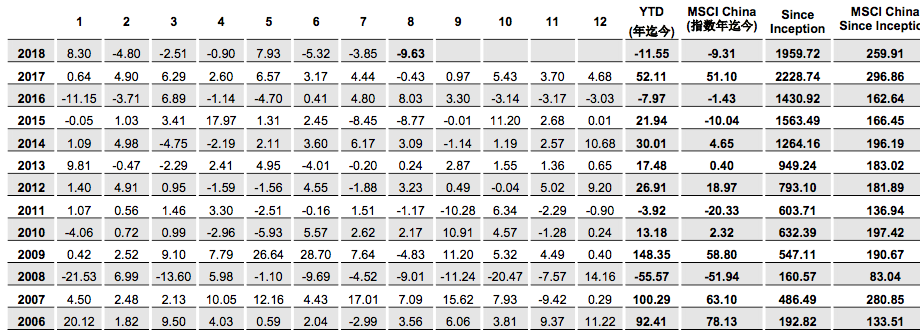
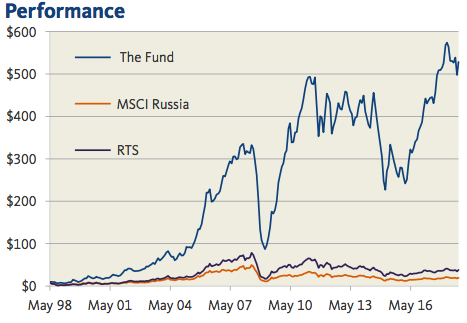
There are, of course, honourable exceptions of excellent funds whose managers do not give up retail investors as a matter of principle. And despite their proven success over decades, they continue to accept small inflows and outflows. But it is undeniable that many other extremely successful funds do not show such deference and decide to do without retail investors. It is in this Champions League of institutional funds and hedge funds that access to small and medium-sized investors is unfortunately denied to them as a matter of size.

.

Fortunately, there are funds of funds that «slice and dice» these investment minimums required by institutional funds in exchange for a fee on top of the original fee. In other words, the small investor can invest in these funds of funds, which in turn invest in institutional funds with prohibitive minimums, with tickets as low as 125,000, which is the minimum regulatory amount to be considered a qualified or well-informed investor. Not in all, but in some cases the potential of the underlying funds is such that it is more than worth paying the double commission toll. Or is it not worth being able to invest from as little as 125,000 euros in such inaccessible funds as the heirs to the famous Medallion, Bridgewater or emerging funds with such spectacular alphas as the ones we see in the images published in this article?


 

Is it worth holding on to an upgradeable investment in exchange for further deferring accumulated capital gains?

The simple and straightforward answer is NO. And to argue this, we will explain the calculations made by the platform below. InbestMe and that they have published in fundssociety.com. At Cluster Family Office we often see the reluctance of most investors to sell their current portfolios of funds or shares, in order to continue deferring the withholdings that would be applied to the capital gains accumulated in them over the years. On the face of it, this seems like a good decision, but it is not unless the portfolio's returns are at least minimally improvable. And that is the first surprise for the majority of investors hypnotised by the mediocrity of the funds sold by the big international fund managers in Spain, that there is life beyond the open architecture sales catalogues.

.

It is true that in Spain there is the possibility of transferring assets from one fund to another while maintaining tax deferral, with the corresponding registration with the CNMV, a minimum volume of unit-holders and that they are considered by the regulator as transferable. The disadvantage is that, as we have already explained in other articles such as «....«Investment Funds: There are still classes«The universe of investment funds registered in Spain is very limited compared to those existing worldwide. As limited as 10%, which means that because of the desire to take advantage of this tax deferral to infinity and beyond, investors are locked into an investment universe that ignores the 90% of existing funds worldwide. (The Spanish banks refuse to underwrite funds beyond their sales catalogue, for which we have also explained the solution in «...").«The advantages of investing from Luxembourg«). Let us now look at the example figures calculated by InbestMe:

.

For example, with an average annual return of 3.4% (return over the last 25 years), the difference in return between deferring capital gains to the end or taxing them every year is only one 4.2% cumulative over 20 years, or, in other words, a 0.21% APR. That is, if an investor is able to improve the performance of his portfolio by at least 0.21% per annum, by replacing mediocre funds with funds that consistently outperform their respective benchmarks in a clear and sustained manner, You should not mind the fact that the new funds are not transferable and you will have to pay tax on the capital gains on an annual basis. Here it is worth remembering that the tax cost of unrealised capital gains is money that is not ours but that we have borrowed from the Treasury and that has to be paid back sooner or later. Therefore, using the money we owe the Treasury to make a profit loses all sense if we use it in a mediocre way, condemning the rest of the money that is ours to mediocrity.

.

In the example above, improving returns by 0.21% per annum by being able to invest in 100% of existing funds and not just 10%, is not only perfectly possible but practically a must. In fact, the sooner you trade your bland investments for more powerful ones, the sooner you will recoup the withholding taxes on the sales of your mediocre portfolio. More importantly, once the sold portfolio is taxed, in addition to having the freedom to invest at a higher yield in any fund in the world, you will also be able to defer taxation forever if you have a Luxembourgish vehicle 300,000, even if you change funds or investments in the future and they are not transferable., as we have explained on other occasions.

.

So why so much fear of taxing latent capital gains if they are easily recoverable and surmountable with a portfolio of good funds that consistently outperform their indices? This is where Spanish banks come into play, of course. Firstly, no bank is going to propose to its client that he liquidate the funds it has sold him and take the money to another (Luxembourgish) entity in order to have an investment vehicle in which the best funds on the planet can fit - and be deferred indefinitely. And secondly, to avoid temptation, they warn their clients vehemently of the tax «axe» that they would get if they liquidate their positions. In this way they keep the investor captive in the institution, with mediocre portfolios that are perpetuated over time, with an enormous opportunity cost.

.

Certainly, the investor who has the capacity to invest beyond the 10% of funds registered in Spain to be marketed by Spanish banks would do well to seek to increase the quality of his portfolio and not be intimidated by his banker and his tax simulations. After all, just a few tenths of a point more return from higher quality funds will more than compensate you for the compound interest of the tax deferral. In other words, you would do well to stop deferring in order to invest better and return to defer indefinitely with a much stronger portfolio. Not doing so is bread for today and hunger for tomorrow, i.e. being trapped sine die in the mediocrity of the funds sold to you by the bank on the corner, very happy, of course, to be reinvesting. mediocrely the taxes owed to the tax authorities.

Daniel Lacalle and the nationalisation of the economy perpetrated by Central Banks

Although we may not entirely agree with some of his convictions, there is no doubt that Daniel Lacalle is one of the people who knows the most about macroeconomics. Not only because of his PhD in Economics but especially because of his approach to the abuse of central banks that we have been suffering for more than a decade.

.

Here is the article that lacalle wrote about this abuse and the end of the party a year ago in the website of the Mises Institute. As you will see, we agree very much with Lacalle in the analysis we made two years ago in our article «...".«Negative interests and Darwin«. And you might also be interested in re-reading «What to expect when you are waiting for... QE blackout»

.

It is now 2018 and the Fed is raising rates decisively. And the ECB is finally facing its reality. We hope you enjoy Lacalle's hard-hitting and realistic article:

.

The FT published an article stating that “major central banks now hold a fifth of total government debt”.


The figures are shocking.


1) Without any recession or crisis, major central banks are buying more than $200 billion of public and private debt, led by the ECB and the Bank of Japan.

2) The Federal Reserve holds more than 14% of the total US public debt.

3) The balance sheets of the ECB and BoJ exceed their respective GDPs by 351Tbp3T and 701Tbp3T.

4) The Bank of Japan is currently one of the 10 largest investors in the 90% in the world, and the Bank of Japan is one of the 10 largest investors in the 90% in the world. Nikkei.

5) The ECB holds 9.2% of the European corporate bond market and more than 10% of the total sovereign debt of major European countries.

6 The Bank of England owns between 25% and 30% of the UK sovereign debt.


report Nick Smith, an analyst at CLSA, warns of what he calls “the nationalisation of the secondary market”.


The Bank of Japan, with its ultra-expansionary policy that only expands its balance sheet, is on its way to becoming the largest investor in the Nikkei 225 majors. In fact, the Japanese central bank already accounts for 60% of the ETF (Exchange Traded Fund) market in Japan.


What can go wrong? In general, central banking not only generates greater imbalances and a bad outcome in a “zombified” economy, as extremely lax policies perpetuate imbalances, but also weakens the velocity of money and encourages debt and malinvestment.


Believing that this policy is innocuous because “there is no inflation” and unemployment is low is dangerous. The government issues massive amounts of debt and cheap money promotes overcapacity and misallocation of capital. Thus, productivity growth collapses, real wages fall and the purchasing power of foreign exchange also falls, driving up the real cost of living and debt to grow more than real GDP. Thus, as we have shown in previous articles, total debt has risen to 325% of GDP while zombie companies reach crisis levels, according to the Bank for International Settlements.


Government securities monetised by the central bank are not high quality assets, they are a promissory note that is transferred to the next generations and will be paid off in three ways: with massive inflation, with a series of financial crises or with high unemployment. Destroying the purchasing power of the currency is not a growth policy, it is stealing from future generations. The “placebo” effect of spending the Net Present Value of those IOUs today means that, as GDP, productivity and real disposable income do not improve, at least not as much as the debt issued. We are creating a time bomb of economic imbalances that is only growing and will explode at some point in the future. The fact that the obvious ball of risk is delayed for another year does not mean that it does not exist.


The state is not issuing “productive money”, but only a promise of more revenue through higher taxes, higher prices or confiscation of wealth in the future. The growth of the money supply is a loan the state gets but we, the citizens, pay for it. Repayment comes with the destruction of purchasing power and confiscation of wealth through devaluation and inflation. The “wealth effect” of rising stocks and bonds is non-existent for the vast majority of citizens, as more than 90% of average household wealth is in deposits.


In fact, a massive monetisation of debt is only a way to perpetuate and strengthen the crowding out effect of the public sector on the private sector. It is a de facto nationalisation. Because the central bank does not “go bankrupt”, it only transfers its financial imbalances to private banks, companies and households.


The central bank can “print” as much money as it wants and the government benefits from it, but it is the rest who suffer from financial repression. By generating the ensuing financial crises through loose monetary policies and always being the main beneficiary of boom and bust, the public sector emerges from these crises more powerful and more indebted, while the private sector suffers the crowding out effect in times of crisis and the effect of taxation and wealth confiscation in times of expansion.


It is not surprising that public spending relative to GDP is now almost at 40% in the OECD and rising, the tax burden is at record highs and public debt is rising.


Monetisation is a perfect system for nationalising the economy by passing on all the risks of overspending and imbalances to taxpayers. And it always ends badly. Because two plus two does not equal twenty-two. By taxing the productive to perpetuate and subsidise the unproductive, the impact on purchasing power and wealth destruction is exponential.


To believe that this time it will be different and that the states will spend all this huge “very expensive free money” wisely is simply an illusion. The government has every incentive to overspend, since its goal is to maximise the budget and increase the bureaucracy as a means of power. It also has every incentive to blame its mistakes on an external enemy. Governments always blame someone else for their mistakes. Who cuts rates on 10% or 1%? Governments and central banks. Who gets blamed for taking “excessive risks” when things go wrong? You and I. Who increases the money supply, calls for “credit to flow” and imposes financial repression because “there is too much saving”? Governments and central banks. Who gets blamed when things go wrong? The banks for “reckless lending” and “deregulation”.


Of course, governments can print as much money as they want, what they cannot do is convince us that it has value, that the price and quantity of money they impose is real just because the government says so. Hence the lower real investment and lower productivity. Citizens and businesses are not mad not to fall into the trap of low rates and high asset inflation. They are not amnesiacs.


It is called financial repression for a reason and citizens always try to escape the theft.


What is the trick to make us believe it? Stocks go up, bonds go down and we are led to believe that asset inflation reflects economic strength.


Then, when central bank policy stops working (either because of lack of confidence or because it is simply part of the sell-off) and markets are given the valuations they deserve, many will say it was the fault of the “speculators”, not the central speculator.


When it erupts, you can bet your bottom dollar that the consensus will blame markets, investment funds, lack of regulation and insufficient intervention. The mistakes of perennial intervention are “solved” with more intervention. The government wins either way. As in a casino, the house always wins.


In the meantime, the famous structural reforms that had been promised are disappearing like bad memories.


It is a clever Machiavellian scheme to kill free markets and disproportionately benefit states through the most unfair of powers: having unlimited access to money and credit and none of the risks. And pass the bill on to everyone else.


If you think it doesn't work because the government doesn't do much else, you are simply dreaming.


.


Types from the North. Types from the South (Part 2)

For those of you who have not yet done so, we recommend that you read  the first part of this article, in which we described a future that is much closer than some believe. In that near future, interest rates in the north of the EU could no longer be anchored to interest rates in the south. This break between the price of money in the rich countries and the price of money in the poor countries will inevitably lead to a different exchange rate for the other currencies. And as the old man said, if it walks like a duck, flies like a duck, swims like a duck and quacks like a duck, it is a duck. In other words, if it has different rates, it will have different exchange rates, and therefore the single currency will cease to be single, which means that we will have at least two Euros, if the nomenclature is maintained.

.

For the most sceptical we bring you today the article prepared by Yves Longchamp's Director of Analysis Yves Longchamp from Ethenea Advisors. In this article Longchamp quantifies the interest rates that economies as disparate as Germany's or Italy's can bear. And it is not just that they can bear different rates but that they must be able to have them, thus adapting them to the needs of each of their economies. No reader should be unaware of the terrible consequences for economies when the price of money does not adjust to the cycle and the needs of the economic machine. And unfortunately, economic convergence ceased to be plausible for northern and southern Europeans years ago.

.

Thus, Ethenea says that while Germany could currently operate with a rate range of between EUR 1.5 and EUR 1.5 per cent, it would be possible for the EU to operate with a rate range of between EUR 1.5 and EUR 1.5 per cent. 4,8-6,1%, Italy would not be able to withstand rates - at least - higher than 0,6-1,5%. The difference between one economy and another is abysmal, and three quarters of the same could be said about the needs of rates between other countries in the North and the South. I recommend that you read the aforementioned study Longchamp because for more than one person it will be a slap in the face of reality that will, at the very least, give them pause for thought.

.

The inevitable consequences of such disparate interest rate requirements (and moreover increasing day by day) are the breakdown of the uniformity of the price of the Euro. Germany will not be able to withstand rising inflation for many more years, while in the south of the EU we are mired in debt for many decades, which requires a quasi-free price of money in order to be able to continue paying the interest. Remember that in the south we are still running budget deficits, i.e. we owe more and more money every day, despite having negative interest rates for years! The consequence of this is that in the south it is not materially possible to keep up with the rate hikes that the north of the EU will soon be demanding, following in the footsteps of the US Federal Reserve.

.

We have warned many times over the last 7 or 8 years. The single currency is doomed to cease to be unique. And investors would do well to prepare their money, their custodian banks, their investment vehicles and of course its investments for such a scenario of different rates and prices, even if the bureaucrats continue to dissemble and come up with a creative euphemism for the break-up of the Euro. Studies such as the one by Ethenea's Director of Analysis can say it louder, but not clearer. And since Cluster Family Office We will never tire of warning of the risk unwittingly taken by investors in the South who do not prepare for their investments to be priced and priced in the North and to be geographically and qualitatively safe. As Longchamp says in his article: «Ignoring a reality does not make it less real».»


Is it worth investing in a pension plan in exchange for the tax benefits?

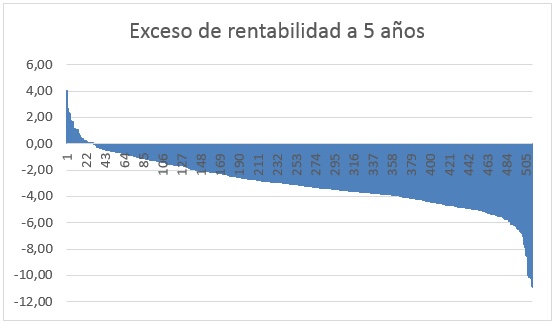
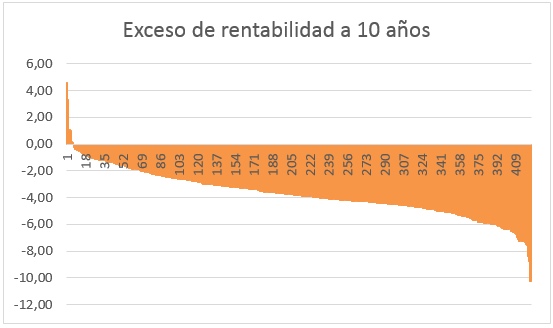
La respuesta es NO, a no ser que se tenga la rarísima virtud de escoger uno de los escasísimos planes de pensiones que superan a su índice de referencia a 10 años. Y aún así, 10 años son muy pocos si tenemos en cuenta que la vida inversora suele ser muy larga cuando hablamos de pensiones para la vejez. Pero la pregunta secundaria que debemos hacernos es: ¿Qué probabilidades realistas tenemos de invertir en un plan de pensiones que no nos condene a la mediocridad? Ahí es cuando la respuesta empieza a resultar más incómoda si queremos ser objetivos y sinceros. Y es que el porcentaje de fondos de inversión que no superan a sus respectivos índices de referencia es muy bajo, digamos que entre el 1% y el 12%, dependiendo de la fuente, el plazo y los sectores en los que nos fijemos. Pero si miramos la rentabilidad de los planes de pensiones respecto a sus índices, el porcentaje de los fondos que justifican su comisión es aún menor.

.

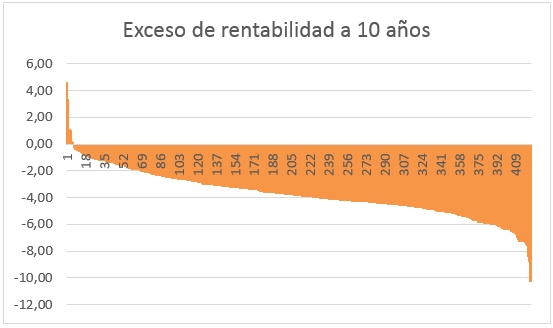
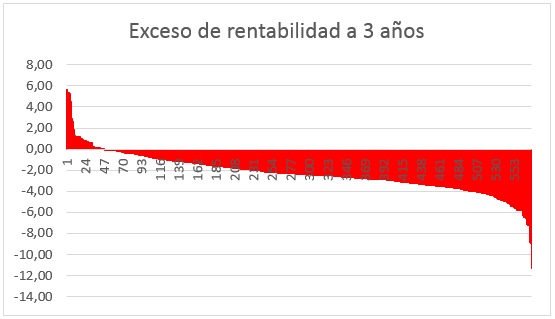
Veamos los gráficos del último informe que ha elaborado Morningstar de los planes de pensiones que superan en rentabilidad a sus respectivosa a tres, cinco y diez años. Demoledor:


Lógicamente, a mayor plazo más se minimiza el efecto Montecarlo del que ya hablamos hace una década. Fijaos que si nos centramos en el periodo de 10 años, lo cual no es ningún disparate ni mucho menos si estamos hablando de planes de pensiones que se supone que no vamos a utilizar hasta la edad de jubilación, el porcentaje de fondos que superan a su índice es inferior al 1%! Pero es que para la jubilación a muchos les faltan más de 20 o 30 años, con lo que el porcentaje de probabilidades de superar al índice a través de un plan de pensiones se acerca peligrosa e indignantemente a cero.

.

¿Cuál es la conclusión a la que debemos llegar con este bofetón de cifras? Pues que si en el universo de fondos invertibles desde España ya es difícil encontrar un fondo de inversión «normal» que supere a largo plazo a su índice, encontrar un plan de pensiones que lo consiga a más de 10 años vista es casi misión imposible para la mayoría de mortales. ¿Y cómo consiguen los bancos y demás vendedores de pescado colocar tantos miles de millones en planes de pensiones si éstos son tan mediocres? Pues para eso están las baterías de cocina de regalo, las smart tv, los porcentajes de dinero de regalo ingresados en cuenta y… las bonificaciones fiscales. Sí, esas mismas bonificaciones que muchos defienden como la panacea para ahorrar impuestos mientras preparamos nuestro retiro.

.

El problema de base es que quienes defienden que es fiscalmente más interesante invertir en un plan de pensiones que en un fondo de inversión al uso, a pesar del hachazo en renta cuando llega el momento de la verdad, no tienen en cuenta que el nivel de mediocridad en la gestión de los planes de pensiones es sustancialmente mayor que el de los fondos de inversión en general. Por tanto, el principal motivo para huír de los planes de pensiones NO es que pagaremos en renta el día de mañana los impuestos que ahorramos hoy en las exenciones de las aportaciones (podríamos discutir si compensa o no tal bonificación fiscal), sino que los equipos que gestionan planes de pensiones consiguen resultados aún peores que el promedio de fondos de inversión al uso que se comercializan en España.

.

Por todo ello, si un inversor es capaz de encontrar fondos cuyos gestores superen a su índice de referencia a largo plazo de manera consistente (haberlos haylos y os remitimos a este artículo que publicamos en COBAS hace unos meses), jamás debe sacrificar esa joya por un plan de pensiones cuya gestión sea peor, por muchos beneficios fiscales o regalos que le hagan sus comercializadores. Bonificaciones fiscales y regalos de dinero o en especies que, por muy tentadoras que sean, no dejan de ser un pan para hoy que nos condena a la mediocridad en rendimientos durante el resto de nuestra vida inversora. Otro tema es cómo conseguir poder invertir en fondos que superan consistentemente a sus índices y que pertenecen a ese universo del 90% de fondos que NO son invertibles desde España. Pero eso ya lo hemos explicado repetidamente en artículos como «The advantages of investing from Luxembourg«.

Which is preferable, a Spanish or a Luxembourg Investment Fund?

At last someone is speaking clearly and openly on the subject. And, of course, the information had to come from COBAS AM. Here is a summary of some of the paragraphs we consider most interesting from the article signed by Gema Martín Espinosa, which you will find below in this link to the Cobas blog. A bolg that you should certainly follow closely, and in which we have had the opportunity to publish some articles in which we talked about the differences between passive and active management (yes, now that ETFs are so fashionable).

.

So let's look at the real reasons why many Spanish independent fund managers, all international fund managers and most investors shy away from the Spanish fund format for their investment vehicles:

.

«The essential thing for the investor to know is that when a fund manager offers both Luxembourg law funds and Spanish law funds, it is in fact the same product. In other words, the same management team, the same philosophy, the same investment process and the same portfolio.

.

The differences come from the other actors that a collective investment vehicle must necessarily have. In both cases a custodian bank is necessary, and some investors, faced with political uncertainty or instability in their country, choose to invest in a fund whose assets are deposited in a bank in Luxembourg rather than in a local bank (...)

.

With the European passport, it is true that you can choose to incorporate funds in Ireland, Malta or other EU countries, but over the years the Luxembourg brand has led the biggest flow of funds for cross-border distribution, not only in Europe, but also in Latin America and Asia.»

.

Here it should be noted that Spanish and Luxembourg funds are governed by the same directives, either the well-known UCIT (for plain vanilla vehicles) or the lesser known AIFM (for alternative or professional investor vehicles). The crux of the matter is that investors from outside Spain cannot invest in Spanish funds through omnibus accounts., The use of the new technologies, which are widely used in the rest of the world.

.

«What are omnibus accounts and why are they so relevant?

.

The holder of the omnibus account is the trading entity and not the final customer of the account. It allows the total of customer subscription and redemption orders to be transacted in a single transaction, without the customer's details being known or shared (...).

.

The financial institution issues a global order for each fund manager. Likewise, end customers do not open an account with other fund managers, but can access third-party funds through their marketing entity and from their own account.

.

Since Spanish funds are not marketed through omnibus accounts, the international investor must necessarily open an account with a marketing entity in Spain or with the fund manager itself in order to invest.

.

This operational barrier makes the Spanish fund very unattractive to international and institutional investors outside Spain, which is why several fund managers choose to manage the same fund in Luxembourg in order to give access to foreign clients.

.

These accesses are usually provided by international platforms, the vast majority of which do not contemplate operations with funds under Spanish law because they cannot comply with the requirements of transferring the details of the end investor in the operation. In addition to the platforms, European central depositories and custodians provide direct access to institutional clients by operating directly with the transfer agents or fund managers.

.

The lack of omnibus accounts in Spain also has a negative impact on Spanish fund managers when marketing their funds through other entities in Spain. And this is fundamentally for two reasons.

.

The first, and most powerful, is that the largest Spanish fund managers are part of banking groups with distribution networks (branches) where it would be impossible to think of them offering a competing product.

.

Secondly, even if the barrier of selling competing products were overcome, the fact that the marketing of a Spanish fund would necessarily involve transferring key data on unit-holders to the fund manager would come into play.

.

Although it is the fund manager who would receive this data and would be subject to the strictest confidentiality and non-use of the data, in general the fear of transferring client data tends to block definitively the marketing of Spanish funds by third parties in Spain.

.

For this reason, some Spanish independent fund managers choose to manage only Luxembourg funds, which are then marketed in Spain through third parties and cross-border through marketing agreements with platforms and distributors, thus resembling an international fund manager which, curiously, Spanish distribution networks do not perceive as “competitors”.

.

It is also important to dispel legends and myths. A Spanish fund is no better or worse than its Luxembourg brother.. Both are options that asset managers offer to respond to their clients as a whole, and have nothing to do with tax havens, high net worth or the “glamour” that is sometimes implied by their English names (...)».»

.

The advantages of investing from Luxembourg personal vehicles and banks is clear about doing it from traditional Spanish banks, with or without a sicav, but we have already discussed this at length in the article: «...".«The advantages of investing from Luxembourg«.

.

We hope that this post will finally help to clarify the issue. By the way, to differentiate at a glance between a Spanish fund and a Luxembourg fund, it is enough to look at the first two letters of its ISIN code: ES (Spain), LU (Luxembourg), IE (Ireland), FR (France), HK (Hong Kong), US (United States), etc.

Northern types. Southern types.

Europa año dos mil veintipico. Después del trauma que supuso la negociación in extremis del Brexit, la UE tuvo que afrontar el siguiente elefante blanco en su habitación: La inflación. Aunque crecía tímidamente, era ya un tema que los tipos del norte no querían ignorar por más tiempo. La demografía y el crecimiento económico anémico, lastrado por la ingente deuda en toda Europa, había permitido aplazar la gran decisión a pesar de que en los EE.UU. ya habían normalizado el precio de sus dólares y el resto de su política monetaria.

.

Las comparaciones entre la economía norteamericana y el babel europeo eran odiosas. Y los tipos del norte, germánicos y escandinavos, con sus economías fuertes y saneadas no podían ni querían soportar el riesgo de una inflación descontrolada. Sus empresas multinacionales habían soportado admirablemente un Euro caro (que no fuerte), pero con la devaluación de la moneda única potenciada por unos tipos negativos, la inflación amenazaba ya muy seriamente la decisión del BCE de mantener la financial repression bajo cero.

.

Los tipos del sur, los mediterráneos, en cambio seguían necesitando que la inflación se les comiera un endeudamiento impagable. Rezaban para que un aumento generalizado de precios y sueldos, aunque acompañada de pérdida de poder adquisitivo, hiciera más pagadero un papel mojado que sólo el BCE les estaba comprando desde hacía ya una década. Pero los tipos del sur seguían sangrando déficit en sus presupuestos. Debían más y más, año tras año. Y ni sus gobernantes populistas ni sus niveles de productividad eran capaces de conseguir el equilibrio presupuestario necesario para detener la hemorragia.

.

Sin crecimiento económico consistente que incrementase los ingresos de los Estados del sur, y sin una inflación persistente que devaluase la deuda impagable, la única opción que quedaba para evitar el default masivo de los tipos del sur era el austericidio, pero esa vía se había demostrado también inútil para salvar a los griegos. La lata chutada desde hacía años, por fin topaba contra el muro que los tipos del norte y los del sur tenían ya frente a sus narices.

.

Los tipos del norte y los tipos del sur tenían idiosincrasia, productividad, datos económicos y necesidades opuestas. Pero paradójicamente unos tipos tan distintos tenían unos tipos iguales: Los tipos de interés. La cobardía y la obstinación de los euroburócratas de los últimos 25 años les había condenado a compartir moneda y tipos de interés a tipos muy distintos. Quizá había llegado el momento de que los tipos del norte y los del sur se adaptasen a sus respectivas economías.

.

Pero que nadie se equivoque llegado el momento de los tipos distintos: Aunque le sigamos llamando euro, si su precio es distinto para los tipos del norte y para los tipos del sur, cotizarán distinto y la moneda única será, de facto, historia. Y algunas pistas de ello no faltaron para los más suspicaces en todos estos años.

.

La pregunta del millón es si la separación de tipos norte y sur es inevitable o hay alguna opción más. Hace un par de años bautizamos como «The Big Write-down» y «Wtrite-down selectivo de deuda» la única forma de conseguir que los tipos del norte y los del sur siguieran compartiendo tipos, al menos durante algunas décadas más. Quizá en pocos años la UE esté ya muy cerca de tener que tomar la decisión final: Tipos distintos norte y sur, o bien write-downs selectivos del único acreedor que puede permitirselo, el BCE.

.

Hasta hoy la UE no ha hecho lo correcto sino lo necesario para aplazar el desastre, veremos a partir de ahora qué camino deciden tomar los tipos poderosos. Porque como bien dice Jonathan Tepper en este tuit, la decisión no la votaran los tipos del sur sino que la tomarán los tipos del norte cuando no tengan más remedio.

.

La segunda pregunta del millón es si los inversores están preparados, no sólo para evitar los efectos negativos de cualquiera de los dos caminos que la UE va a tomar, sino para aprovecharse de ellos.

Unit Link insurance with deferred surrender value and its exclusion from Wealth Tax.

The Luxembourg-based insurer Lombard International Assurance has recently published this article in Fundspeople in which he explains that the Spanish Directorate General for Taxation has responded favourably a few months ago to the binding consultations (V3070-17V2516-17) in which the possibility was raised of avoid Wealth Tax for unit-linked policies with no right of surrender for a certain period of time. Obviously, this novelty is extremely important for those people who reside in autonomous communities that are not subsidising, or will cease to subsidise in the future, this Wealth Tax.

.

In the aforementioned binding consultations, the D.G. of Taxes confirms that during the time in which the policyholder voluntarily establishes their explicit renunciation to redeem their money, this amount will not be taxed in their calculation of Wealth Tax. In other words, the inevitable and indefinite taxation of money that has already been taxed in the past and which is not going to be used and enjoyed in the present is a thing of the past.

.

The Luxembourg unit-linked savings insurance is also a versatile and cost-effective investment vehicle The fund is the only one of its kind, as it allows any fund in the world to be included in the portfolio, whether or not it is registered for marketing in Spain. This fact alone justifies the creation of the vehicle, as we have explained in «Investment Funds: There are still classes«, However, if we also add the savings in wealth tax during the years in which the money is not going to be used, and the legal and banking security of Luxembourg, the convenience of having a personal/family Unit Linked becomes a necessity for those who have at least 250,000 euros. The D. G. de Tributos could say it louder, but not clearer.

Investment funds: There are still classes...

A pesar de los esfuerzos regulatorios de la normativa MiFID II, los inversores retail, es decir los inversores de a pie que tratan de defender sus ahorros ante la voracidad del sector bancario y financiero, siguen estando condenados a la mediocridad de sus inversiones. La nueva normativa va a servir esencialmente para dos cosas: La primera es para dificultar aún más la labor de los asesores financieros independientes, manteniendo anémico su crecimiento y beneficiando así a los grandes players del sector, o sea los bancos; y la segunda para, además, blindar a estos grandes players ante posibles demandas por parte los sufridos inversores. Lo único bueno que puede aportar la normativa será la transparencia en los costes que se cobren a los clientes, aunque conociendo a la banca y la endémica connivencia del regulador, hecha la ley hecha la trampa.

.

El caso es que el inversor retail, bien sea de banca comercial o incluso el de banca privada, sigue condenado a invertir su dinero en fondos de inversión de inferior calidad que los inversores cualificados o institucionales. Quizá esto aún sorprenda a muchos inversores, pero la realidad es que el universo de gestores y fondos de inversión no se limita ni mucho menos a los fondos UCITS o AIFMD que están registrados en España para su comercialización a través de las entidades financieras y plataformas. Es más, el porcentaje de fondos registrados en la CNMV, y que por tanto son invertibles teóricamente por cualquier inversor de banca comercial o privada en España, es de tan sólo aprox. 10.000 fondos de inversión, el 10% del total de los más de 100.000 fondos existentes en el mundo. Y decimos que son invertibles «teóricamente» porque en la práctica las entidades financieras españolas ni tan siquiera ofrecen ese 10% fondos a sus clientes, sino que venden un catálogo de fondos de tres o cuatro mil fondos a lo sumo. ¿Por qué? Pues obviamente porque sólo venden los fondos con los que tienen cerrados sus acuerdos comerciales. ¿Va a cambier eso con la nueva normativa y las llamadas clases limpias? Se tendrá que ver. Pero en cualquier caso, que una parte del beneficio de las entidades venga por los mandatos de gestión (u otras vías imaginativas…) y deje de venir por las comisiones que cobran de los fondos, tan sólo aumentará potencialmente las opciones del inversor de a pie español hasta como máximo ese 10% de fondos existentes en todo el mundo que están registrados en España para su comercialización. Es decir, que en el mejor de los casos los inversores seguirán sin poder acceder a aprox. un 90% de los fondos que hay en el mundo mundial.

.

La culpa no sólo es de las entidades financieras que limitan su catálogo de ventas, ya que la CNMV es también restrictiva a la hora de autorizar los productos que se pueden comercializar, y sobre todo porque penaliza fiscalmente aquellos fondos que no comercializa la banca española y han pasado previamente el filtro regulatorio español:

.

Proteccionismo + Arbitrariedad = Perjuicio para el inversor.

.

¿Y cómo hacen los inversores cualificados o institucionales para tener acceso al 100% de fondos existentes, difiriendo la fiscalidad de las plusvalías igual que si invirtieran en sólo el 10% de fondos registrados en España? Pues mayoritariamente a través de sus propios vehículos de inversión extranjeros depositados en bancos internacionales. Los hay para todos los gustos pero lamentablemente no para todos los bolsillos… o casi. Veamos. Por ejemplo hay inversores que disponen de SICAVs o SIFs luxemburguesas cuyos costes anuales rondan los 100.000 euros, lo cual hace inviables estos vehículos si el inversor no dispone de al menos 8 o 10 millones de euros. Pero también existen vehículos de inversión como los seguros de ahorro luxemburgueses, también llamados Unit Linked, cuyos moderados costes hacen de ellos unos vehículos perfectamente viables para carteras de tan sólo 250-300 mil euros. Estos son sin duda los vehículos hoy en día más baratos que permitirán a los inversores pequeños (>250k eur) acceder al 100% fondos de inversión del mundo difiriendo su tributación como en cualquier fondo comercializado por el banco de la esquina. Podéis leer más sobre ellos en «The advantages of investing from Luxembourg»

.

Pero desgraciadamente las dificultades para los inversores de a pie no se resuelven totalmente con la creación de un seguro de ahorro luxemburgués. La mayoría de los mejores fondos de inversión del planeta están destinados a clientes cualificados e institucionales, y las inversiones mínimas aceptadas por estos gestores son prohibitivas para el ahorrador pequeño y medio. En muchos casos los mínimos ascienden a $500,000, $1,000,000 o incluso más. Y si tenemos en cuenta una razonable diversificación de la cartera, en la práctica nos podemos encontrar que disponemos de un vehículo de inversión accesible para un patrimonio pequeño como es el Unit Linked, pero dentro del cual no podemos meter los mejores fondos del planeta porque sus mínimos de inversión se escapan de nuestro alcance. Llegados a este punto, los inversores no institucionales o no cualificados que tengan un Unit linked, pueden optar por invertir sólo en fondos que dispongan de clases retail -pagando lógicamente mayores comisiones- o bien utilizar los cada vez más numerosos fondos de fondos institucionales que, a cambio de una comisión sobre comisión, permiten el acceso a una cartera diversificada de fondos con mínimos prohibitivos a partir de sólo 125.000 eur. Ni que decir tiene que esos fondos de fondos institucionales tampoco pertenecen al 10% de fondos accesibles para el inversor retail sin vehículo propio de inversión.

.

La pregunta del millón es si merece la pena pagar esa comisión sobre comisión de los fondos de fondos institucionales. Y la respuesta es que lógicamente dependerá del importe de esa comisión adicional y de la calidad de los fondos institucionales que tengan en cartera (como ya explicamos en nuestro artículo en el blog de COBAS: Gestión pasiva, gestión activa). Como ocurre en cualquier fondo, también en los fondos de fondos institucionales los hay malos, mediocres y brillantes.

.

En cualquier caso, disponer de un vehículo de inversión personal como un Unit Linked luxemburgués, dentro del cual podemos invertir en el 100% de fondos del mundo, difiriendo transparentemente la tributación, es vital para conseguir que el dinero del inversor pequeño y medio sea gestionado por los mejores gestores del planeta, al igual que gestionan el dinero de los más ricos y poderosos. Porque la lista de las primeras espadas mundiales de la gestión no se acaba con Paramés, McLennan, Guzmán, Mobius, Martín, Lanternier, Kirrage, etc. El mundo es muy grande y en ese 90% de fondos inaccesibles hay lógicamente una parte importantísima de gestores estrella que, desgraciadamente, jamás gestionarán el dinero del los inversores de banca comercial y privada españoles.


Bitcoin (BTC) and other forms of sudden wealth. The new fortunes of cryptocurrencies and their challenges.

After the rally and subsequent fall in the price of cryptocurrencies in the last 2 or 3 months, at Cluster Family Office we have received several potential clients who have generated very considerable sudden fortunes thanks to holding and/or trading all kinds of tokens: Bitcoin (BTC), Bitcoin Cash (BCH), Litecoin (LTC), Ether (ETH), Ripple (XRP), Cardano (ADA), NEO, Dash and many others that most of us mortals did not even know about. And most of them started from a modest financial situation, so they are facing totally new situations for themselves and their families.

.

The needs faced by these new millionaires are delicate, since the way to declare these enormous realised and potential profits to the tax authorities is still confusing even for Montoro himself. The fact is that the scarce information generated by most foreign online platforms through which transactions are carried out, together with the large number of operations and cryptocurrency crosses included in each movement, make the figures that must be presented to the Treasury a maze of spreadsheets that are difficult to defend against the voracity of a future requirement or inspection. In addition, it should be borne in mind that the holding of currency accounts (not cryptocurrencies, for the moment...) exceeding 50,000 euros must be included in the famous form 720.

.

Thank goodness that the profile of most of the cryptocurrencies« nouveau riche come from the tech world, and our tax professionals get this profile of Clients to provide them with this puzzle of necessary information quite thoroughly and diligently. However, there are many crypto-millionaires out there who are being much more careless and chaotic when it comes to compiling their trading trail. And their carelessness will cause them to incur serious tax problems in the near future, i.e. less than 4 years, before the statute of limitations expires in the tax year where they concentrate a large part of the crypto »buck".

.

But it is not just taxation they face that is difficult to defend. The million-dollar question these new cryptocurrency millionaires must ask themselves is, obviously, what to do with their fortune and how it will inevitably change their lives. Most of them want to keep a portion of their tokens or cryptocurrencies invested in anticipation of new highs and thus higher profits, but they have already made sales worth millions with which they must make decisions they have never had to face before. Not only that, but they are beginning to experience the harassment that banks, real estate companies and other predators are subjecting them to as soon as they smell fresh blood.

.

Our recommendation is similar to that of any profile of sudden fortune (tech entrepreneur who sells his company, lucky prize winners, etc.). lottery or chance, athletes elite or artists, heirs, etc.), i.e. they should postpone hasty decisions and design and implement, together with professionals, a balanced and tax-efficient distribution of their wealth. To this end, we propose a final picture of what their personal fortune should look like in a couple of years' time. For their part, they express their preferences in terms of the goals or dreams that they will now be able to realise. And they will do so with the help of a team that, above all, we are there to prevent them from making mistakes that they would regret in the future, costing them money and displeasure. The world is full of examples of sudden fortunes that have shattered the lives and happiness of their protagonists - and their descendants. And the envy-stricken circles of these crypto-millionaires may be eager to see how they squander their fortunes, and thus not feel so bad about not having been able to participate in the technological boom.

.

Some of the new millionaires may wonder when is the right time to sell Bitcoins or whatever crypto. The question is unfortunately not an easy one to answer as it will depend on the degree of greed, the volume achieved and the previous and present family and asset situation. But a good starting point to find that answer would be to «set aside» and conveniently diversify enough money to ensure a comfortable life for their families for the rest of their lives through sound financial and real estate income. Thereafter, any substantial increase or loss of cryptocurrencies still held in their wallets or purses will be seen in a different light.

.

There is no fortune more ephemeral and problematic than sudden fortune without proper advice. And as an anonymous sage once said:

«We don't learn to be sons until we are parents. We don't learn to be parents until we are grandparents. It seems that we don't learn to live until life is gone... So, obviously, we don't learn to be wealthy until we have lost most of our money.»

Shall we help you search?

Cluster Family Office

We care about transparency both in management and in our own way of working. Leading wealth management and family offices company

Do you need help in capital and wealth management?

How can I avoid the negative effects that my fortune may have on my children?

How and when should I talk to my children about family wealth, and what relationship should they have with money throughout their adolescence?

How can I measure the real risks of my investments and protect my assets adequately?

Do I have sufficient liquidity and stable income to cover my needs on a permanent basis?