
We look after your interests

(+34) 93 626 47 75

Torres Sarrià, Carrer de Can Ràbia, 3-5, 4ª Planta BCN 08017

(+34) 91 794 19 82

Pº de la Castellana, 93 2nd floor MADRID 28046

Category: Retirement

Bitcoin (BTC) and other forms of sudden wealth. The new fortunes of cryptocurrencies and their challenges.

After the rally and subsequent fall in the price of cryptocurrencies in the last 2 or 3 months, at Cluster Family Office we have received several potential clients who have generated very considerable sudden fortunes thanks to holding and/or trading all kinds of tokens: Bitcoin (BTC), Bitcoin Cash (BCH), Litecoin (LTC), Ether (ETH), Ripple (XRP), Cardano (ADA), NEO, Dash and many others that most of us mortals did not even know about. And most of them started from a modest financial situation, so they are facing totally new situations for themselves and their families.

.

The needs faced by these new millionaires are delicate, since the way to declare these enormous realised and potential profits to the tax authorities is still confusing even for Montoro himself. The fact is that the scarce information generated by most foreign online platforms through which transactions are carried out, together with the large number of operations and cryptocurrency crosses included in each movement, make the figures that must be presented to the Treasury a maze of spreadsheets that are difficult to defend against the voracity of a future requirement or inspection. In addition, it should be borne in mind that the holding of currency accounts (not cryptocurrencies, for the moment...) exceeding 50,000 euros must be included in the famous form 720.

.

Thank goodness that the profile of most of the cryptocurrencies« nouveau riche come from the tech world, and our tax professionals get this profile of Clients to provide them with this puzzle of necessary information quite thoroughly and diligently. However, there are many crypto-millionaires out there who are being much more careless and chaotic when it comes to compiling their trading trail. And their carelessness will cause them to incur serious tax problems in the near future, i.e. less than 4 years, before the statute of limitations expires in the tax year where they concentrate a large part of the crypto »buck".

.

But it is not just taxation they face that is difficult to defend. The million-dollar question these new cryptocurrency millionaires must ask themselves is, obviously, what to do with their fortune and how it will inevitably change their lives. Most of them want to keep a portion of their tokens or cryptocurrencies invested in anticipation of new highs and thus higher profits, but they have already made sales worth millions with which they must make decisions they have never had to face before. Not only that, but they are beginning to experience the harassment that banks, real estate companies and other predators are subjecting them to as soon as they smell fresh blood.

.

Our recommendation is similar to that of any profile of sudden fortune (tech entrepreneur who sells his company, lucky prize winners, etc.). lottery or chance, athletes elite or artists, heirs, etc.), i.e. they should postpone hasty decisions and design and implement, together with professionals, a balanced and tax-efficient distribution of their wealth. To this end, we propose a final picture of what their personal fortune should look like in a couple of years' time. For their part, they express their preferences in terms of the goals or dreams that they will now be able to realise. And they will do so with the help of a team that, above all, we are there to prevent them from making mistakes that they would regret in the future, costing them money and displeasure. The world is full of examples of sudden fortunes that have shattered the lives and happiness of their protagonists - and their descendants. And the envy-stricken circles of these crypto-millionaires may be eager to see how they squander their fortunes, and thus not feel so bad about not having been able to participate in the technological boom.

.

Some of the new millionaires may wonder when is the right time to sell Bitcoins or whatever crypto. The question is unfortunately not an easy one to answer as it will depend on the degree of greed, the volume achieved and the previous and present family and asset situation. But a good starting point to find that answer would be to «set aside» and conveniently diversify enough money to ensure a comfortable life for their families for the rest of their lives through sound financial and real estate income. Thereafter, any substantial increase or loss of cryptocurrencies still held in their wallets or purses will be seen in a different light.

.

There is no fortune more ephemeral and problematic than sudden fortune without proper advice. And as an anonymous sage once said:

«We don't learn to be sons until we are parents. We don't learn to be parents until we are grandparents. It seems that we don't learn to live until life is gone... So, obviously, we don't learn to be wealthy until we have lost most of our money.»
What to expect when you are waiting for... the QE blackout.

After more than a decade of monetary stimulus and financial repression where the tide of central banks around the world has flooded global debt with liquidity and demand, the music is beginning to stop playing. It is the chronicle of a death foretold but still astonishingly incredulous.

.

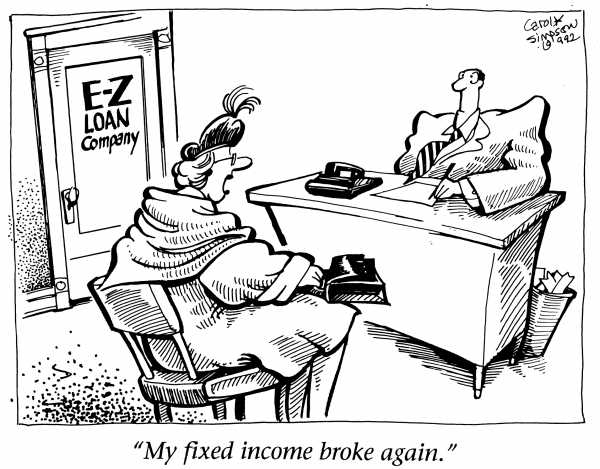
But despite the end of the road to QE, the vast majority of more conservative investors continue to complain about the poor performance of their fixed income portfolios, oblivious to the risk they have been taking for years and also to the scenario their assets will face in the new era of normalisation of rates and stimulus.

.

Paul Read, The co-manager of the Invesco Pan European High Income bond fund, Invesco Pan European High Income, warns in a surprisingly clear way, as his salary depends on investors continuing to trust the bonds he buys. «There is too much complacency in the bond market. Prices are rising steadily and yields are reaching ever lower lows. On the basis of clearly worsening yields, the euro high yield (or junk bond) market is currently yielding less than 2%. Circumstances are making it very difficult for us.»

.

And the most curious thing is that despite the fact that the shepherds themselves - at least the more honest ones - warn their sheep that the wolf is coming, the flock continues to demand that the shepherd offer them juicy pastures in which to continue frolicking, as they have done for as long as they have had the use of (no) reason. As Read rightly says, with the European QE tap being turned off: «...the European QE tap will be turned off.«Things become even more complicated considering how expensive fixed income markets are. With yields so low, the risk is much higher (...) Although neither bonds nor equities currently offer investors the best entry point, at current rates, equities have a very easy time beating bonds, both in terms of both appreciation and dividends.»

.

Indeed, the real disaster looming over conservative portfolios is not just that returns are low but that losses are beginning to take hold of assets that their owners, whether better or worse advised, bought precisely to avoid swings and negative returns. Because the fixed income funds that even today are still nonchalantly yielding precious points are doing so on the back of a wind of demand, trading and favourable interest rates whose days are numbered.

.

However, rates are not in a position to go up happily either, even in the US. dovish than was to be expected from his latest move at the helm of the Fed. Nor does it seem that economic growth is going to be the one that will pull the developed world out of the debt hole into which it has got itself - we have got ourselves - in exchange for postponing the hunger of insolvency and having hard bread for today.

.

In the following graphics from the presentation by Jeffrey Gundlach of DoubleLine Capital (via Gurusblog), you can see how the FED has already stopped increasing its balance sheet, the BoJ has softened its growth and the ECB has announced its brake for 2018.

If the forecasts come true, 2019 will not only see the end of money printing but also the beginning of the shrinking of central banks' balance sheets. And most of the developed world's fixed income portfolios are not prepared for that without suffering massive losses from write-downs, insolvencies and potential illiquidity. The relationship between the rise and fall of central bank asset purchases and their direct correlation with bond and equity prices can be clearly seen in the chart below. Imagine now this correlation with a closing of the taps that have watered with huge flows, the likes of which have never been seen before in all of history.

The million-dollar question is: Are there assets that are de-correlated from the end of the QE party and therefore «guarantee» positive returns in this tidal wave pullback scenario? The answer is yes. Unfortunately, however, these are alternative management strategies that are difficult to access for Spanish retail investors, who are condemned to buy the fish, fixed or variable, sold by Spanish banks. The reasons why it is so difficult to access good alternative multi-strategy funds from Spain, in addition to the lack of interest of Spanish banks in offering third-party products that do not share juicy commissions with their main trading platforms, are also regulatory. The liquidity of these multi-strategy funds is not usually daily or weekly, but monthly or even quarterly, which prevents them from being funds that qualify under the UCITS directive, which seems to be the only one that the CNMV considers suitable for Spanish retail investors. This, together with the fact that the transposition in Spain of the AIFMD (Alternative Investment Fund Managers Directive) is still conspicuous by its absence, condemns the poorly advised investor to an obsolete and reckless portfolio distribution based essentially on fixed income and equities.

.

Alternative management handles a wide range of investment strategies, from bonds linked to meteorological catastrophes, buying and selling mortgages, life insurance, etc., etc. And the right combination of these strategies ensures that the non-stock part of the portfolios gain a few points of return while remaining completely unaffected by the falls that stocks and bonds may suffer in the coming years.

.

But it is not enough to open an account abroad for an international bank to agree to buy good alternative funds from us and accept their relative illiquidity. It should be borne in mind that most multi-strategy alternative funds are designed for institutional investors and require minimum investment amounts prohibitive for retail investors, with figures of €500,000, €1,000,000 or even more. In addition, Spanish taxation penalises funds not marketed in Spain (purely for the protection of the sector and not the investor), while those registered with the CNMV are rewarded through the deferral of capital gains and the transferability that every investor would like to see. Here it is worth remembering the need to have a personal investment vehicle such as the Luxembourg, The investment is suitable for investors starting from as little as 250,000 or 300,000 euros, thanks to which we obtain the deferral and transferability of any fund in the world, whether or not it is alternative or not, and whether or not it is registered in Spain for marketing.

.

All this means that in many cases, even within the Luxembourg vehicle itself, we have to resort to funds of funds of alternative management, which in exchange for their corresponding commission fee allow us access to a diversified portfolio of strategies, truly decorrelated from the financial markets, with amounts of 125,000 euros. A real treasure in these current and future times.

Elite athletes and their money. The simple lesson of Shaquille O'Neal.

In the following video we see a Shaquille O'Neal in his maturity, giving advice that is as simple as it is important to other professional colleagues, i.e. elite sportsmen. Logically, his advice is only useful for sportsmen, artists or any other person who has a sudden fortune (lotteries, technology entrepreneurs, heirs, etc.) large enough to never have to worry about their future or that of their children and grandchildren. Watch the video of this tweet and then we'll give you some thoughts:

Surely following this simple advice, for which every human being is potentially qualified, would have prevented the vast majority of sportsmen and women from going bankrupt in the course of their busy lives. Notice that neither education nor knowledge is necessary to avoid disaster when a certain level of million-dollar contracts is reached. All that is needed is common sense and rigour. Unfortunately, most elite sportsmen and women, uneducated and from humble origins, drunk on fame and money, often lack both virtues.

.

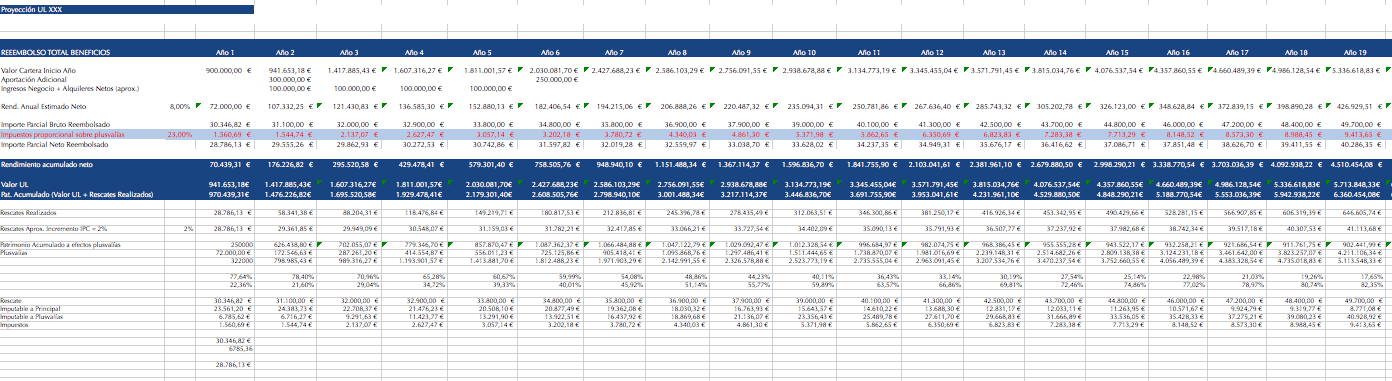
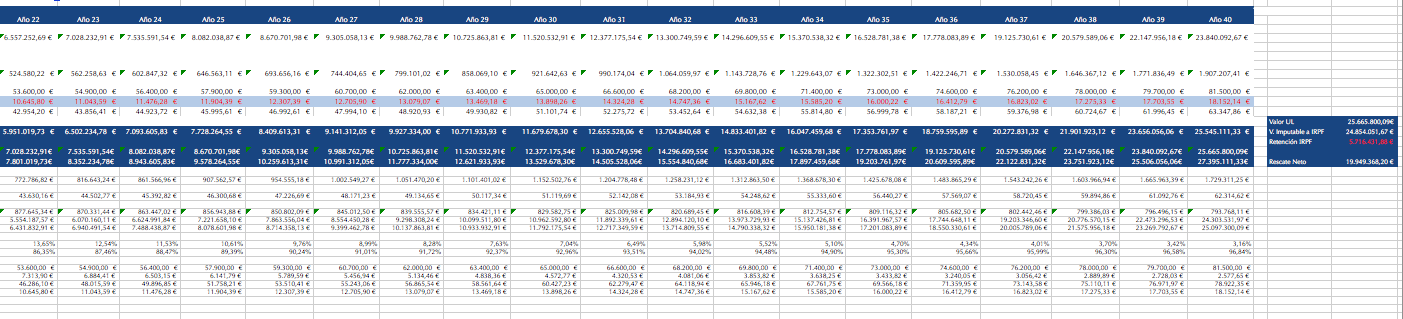
However, most mortals do not reach those income levels, obviously, and need to fine-tune much more than the simple norm of Shaq their wealth progression throughout their lives. Every wealthy life is different. Circumstances in terms of professional income, income from financial and real estate investments, necessary or desired expenses, family burdens and, in short, the lifestyle that each person or family chooses, together with the uncertain future that each human being faces (separations, illnesses, deaths, disabilities, addictions, fraud, accidents, etc.), make each case practically unique. And logically, some tool is needed that allows a glimpse of the wealth projection that can be expected in the face of a more or less prolonged life. This is where everyone can make their own «old-age account», or go to a wealth management professional to get an idea of the progression they may have in the future, and adjust or modify any calculation or lifestyle errors they may be making accordingly. Here is an example of a wealth projection table that we use with some of our clients at Cluster Family Office:


In projections such as those in the image above, we try to incorporate some of the variables that can be intuited from the data and knowledge of our Clients' circumstances. In the projections we make at CFO we handle data such as professional and non-professional income, expected length of working life, present and future income consumption, inflation, financial and real estate yields, personal taxation, taxation of the investment vehicles that each family has in Spain and abroad, etc.

.

However, it is obvious that the further out in time the projection is made, the less reliable the predicted data will be, as deviations multiply over time with a greater effect on the result than compound interest itself. But despite the impossible accuracy, this tool is always a great help in resituating the lifestyle of families and, above all, in opening our eyes to the uncertainty of living a long wealthy life in the ever-changing world we face. And the uncertainty of progression is particularly revealing. when the proportion of real estate is abused in equity or when the era of conservative fixed-income portfolios is more of an asset trap. potential losses from which very few will escape.

.

The evolution over time of an unbalanced estate that makes the wrong decisions, compared to the evolution of a balanced estate of financial, business and real estate assets, with the correct optimisation of each of them, is totally different after 5 years. But if we project the errors with respect to what would be the correct distribution of assets and liabilities and their management, beyond 15 or 20 years, the difference is abysmal. What today may appear to be a minor imbalance or inefficiency, a minor deviation, over time is the key to success or failure in our old age and for the well-being of our children.

Shall we help you search?

Cluster Family Office

We care about transparency both in management and in our own way of working. Leading wealth management and family offices company

Do you need help in capital and wealth management?

How can I avoid the negative effects that my fortune may have on my children?

How and when should I talk to my children about family wealth, and what relationship should they have with money throughout their adolescence?

How can I measure the real risks of my investments and protect my assets adequately?

Do I have sufficient liquidity and stable income to cover my needs on a permanent basis?