

The well-known Bloomberg editor Tracy Alloway explains in an article published this week what has happened in the markets with the price of the famous company GameStop and its chain of -obsolete?- physical videogame shops. Below we summarise Alloway's reflections and add some more from our point of view.
.
It seems inevitable that the democratisation or populisation brought about by technology will also reach the financial markets. But the impact of trading by small speculators through platforms such as Robinhood Markets is causing a real earthquake in which the strong hands of the markets are immersed without knowing or being able to do anything about it. Organised through various social networks, amateur investors/speculators have been able to make the share prices of meme stocks such as GameStop take off, while large hedge funds are suffering the consequences of having analysed these companies in more depth and betting against them.
.
Some fear that this war of money flows between small amateurs and big professionals, which generates infinite and further increases in the share prices of mediocre businesses, will collapse the system at some point. It may not go that far, but what is undeniable is that it takes away one of the basic premises of capital markets: the efficient allocation of capital.
.
- What happened to GameStop and how did it all start? The online broker RobinhoodMarkets, along with other similar platforms, have flooded the market with new amateurs. Many of them from their own homes, some of them unemployed, some of them studying and all with a lot of time on their hands because of the pandemic. It seems as if financial investment has become just another video game for this already gigantic niche. Tremendously crowded forums have sprung up, such as Reddit's WallStreetBets, whose slogan reads something like «Making money and having fun while doing it». These forums have made it their goal to exploit a financial system they have historically been unable to access. And the traditional market players, the establishment, are horrified at how they are managing to bend the system in their favour.
- How are they changing the way the market works? Traditionally Value investing has looked for undervalued companies to buy at a relatively cheap price in the expectation that it will go up. For the new amateur traders on such platforms, Value is not nearly as important. Some of the stocks these traders have their eye on are far from profitable or attractive to a traditional investor. But once the price starts to rise, the collective magnet is activated and the attraction of more and more interconnected traders on r/wallstreetbets begins. So far so good, since traditionally a company's share price can rise to a point where, relative to its earnings multiple, book value, etc., it is no longer attractive to investors. As a result, demand begins to be outstripped by supply and the share price moderates to more or less reasonable levels. But with the massive irruption of these new small speculators, prices can go far beyond what pseudo-fundamental or even technical analysis has historically tolerated.
- Why? Because flows dominate over professionals. The flows of money in and out are more important in this segment than the fundamentals themselves. And small traders have more capacity to detect and take advantage of the flows in and out of shares, with tools such as forums and the detection of the majority opinion of their colleagues in the purest social network style, than the professionals trying to properly delimit the value of these businesses. Paradoxically, professionals, at least in the stock segments targeted by these crowded platforms, are being relegated to the crumbs that retail investors used to have, and are sailing small boats at the mercy of the storms and big swells generated by the huge mass of amateur traders. The world upside down (finally?).
- Who were the professionals in the GameStop case? Short sellers, i.e. funds that borrow shares to sell them, hoping that their price will fall before they have to buy them back and return them to those who lent them to them for a small rental fee. These funds used to publicise their bearish bets and negative fundamental analysis on a company in order to convince the rest of the market that it is bad business to hold the stock and generate sales to drive the price down. But that strategy of professional investors going public with a short sale may now be history, because these days what this news generates is unbridled bullish interest from the unconditional mass of r/wallstreetbets. It is like a red alert that throws amateur traders into buying options on these stocks en masse, turning the traditional predators, the big funds and hedge funds, into prey.

- What is the strategy? The guys at r/wallstreetbets usually pick stocks that have weaknesses they can exploit. For example, some have taken to buying options on stocks to force their prices up. As many of you already know, options are contracts that give the holder the right to buy or sell the underlying stock at a certain price within a certain period of time. And new commission-free trading platforms, such as Robinhood, have made options trading much easier. The key idea is that buying options en masse forces market-makers to hedge their own exposures by buying shares of the underlying company. That dynamic can be enough to drive the price up, which generates more buy orders, feeding back more and more of the dynamic: The stock goes up, the short sellers give up and have to buy back the shares they need to return, and those forced purchases drive the price even higher.
- Can the small speculators really beat the big whales of Wall Street? What we should be looking at is not the amount of money retail speculators spend, but the amount of leverage inherent in those bets. Let's take an example:
- Pol has a Robinhood account. He bought a call option strike $3,250 on Amazon on 14 August for $1,500. That option is crossed by a market-maker, let's say her name is Lola, who works at a large bank. But Lola does not want to take on the risk as Pol's counterparty; she wants to be merely a neutral facilitator. Her job is to facilitate trades in the market, not to bet on it, so she wants to hedge her position. She does this by buying Amazon shares, calculating what is called the delta of her position. The delta is how much the value of the option will change based on the price of the underlying stock. In this case she calculates that she must buy $66,100 worth of Amazon stock to maintain her neutral position. If Amazon's share price rises, she would have to pay for the option sold to Pol, but at least she would be compensated by the profit she would make on her Amazon shares.
- A few days later, Amazon shares do indeed rise, and do so by 5%, so Lola needs to rebalance her books to maintain her neutral position. This time, because Lola's delta has increased, she will need to buy even more underlying shares. In fact, she will need to buy $230,000 worth of Amazon shares already. Et voilà! Pol's small bet has resulted in a purchase of $230,000 worth of Amazon shares.
- By targeting broker exposure in a coordinated and massive way, retail traders are taking advantage of what is known as the «gamma squeeze». That is, as Amazon's share price approaches the strike price of the option, brokers and counterparties who want to remain neutral must buy more and more of the company's shares.
- What about hedge fund shorts? Gamma squeezes can be most effective when short squeezes of the company's shares are added. Traders at r/wallstreetbets have often identified companies with a lot of short interest and a small number of shares listed on the market. This further complicates matters when short sellers must buy back shares to close out their short positions. This dynamic also contributes to the rising price of outstanding shares as supply is scarce and demand, although forced, is more and more increasing. Hedge fund Melvin Capital announced on 25 January that it had accepted a $2.74 billion injection from competitors Citadel and Point72 Asset Management after its short positions generated a 30% loss for the year.
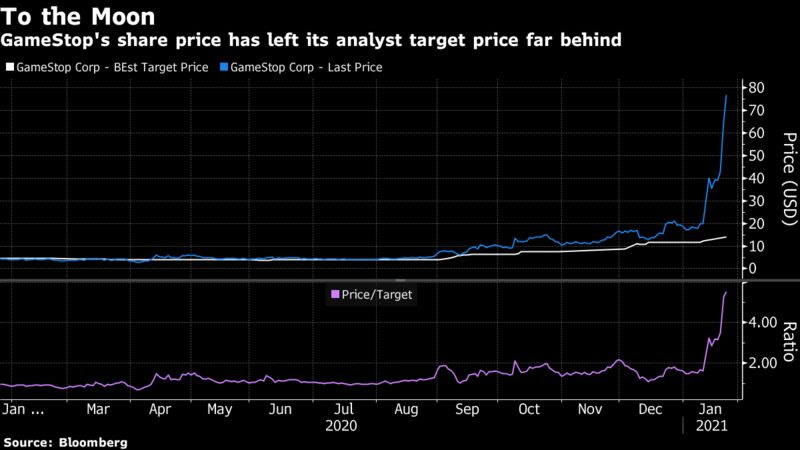
- Is this phenomenon a simple game? We might call it a simple gambling game were it not for the fact that these dynamics affect real companies, with real managers and real employees. Shares in GameStop, after all a retail software business, have soared exponentially this year. And the current price is such a cash injection that ideas have begun to emerge of what GameStop's management could do with all that capital raining down from the sky. Think of the strategic acquisitions, expansions and diversification of the business that are now within their reach. So these arbitrary flows also end up affecting the fundamentals of companies. AMC Entertainment Holdings, another meme stock whose main business is cinemas and theatres, avoided the bankruptcy to which the pandemic seemed to have condemned them at the end of January, by capitalising on the rise in its shares promoted mainly by retail traders. And in turn, some hedge funds may be selling some clearly bullish stocks to cover their losses, which will work against their returns.
- How long can this last? No one knows. It is difficult for the US regulator to fight comments on forums that generate such large movements because it is difficult to prove that such posts are part of an illegal orchestration to manipulate the market. In December the Massachusetts regulator made a formal complaint against Robinhood alleging that they had aggressively advertised their platform to attract novice investors and had not taken sufficient safeguards to protect them. Not very consistent, but that's all the regulator could do.
.
Big market squeezes tend to end abruptly and dramatically, and that will probably be GameStop's ultimate fate. But when that time comes, most fans of r/wallstreetbets will take their huge cash flows to their next target.
.
But we must not forget that amateur traders, most of them young people with or without university careers, who are causing these financial earthquakes are merely playing by the same rules of the game as the other players. The consequences of their flows are as morally reprehensible or irreproachable as the consequences of the flows of traditional strong hands. They have not invented anything, except that their strategic decisions do not stem from an investment committee or the Machiavellian complicity of several of them, but from investment trends or fashions that are transmitted through what we might call socio-economic networks, and whose execution is as atomised as it is massive and disciplined.
.
The big loser in this game is the efficient allocation of capital. Because although the rise in share prices can save companies from bankruptcy or provide businesses with money that, if well used, can make them take off in profits and improve their fundamentals, let us not forget that capital is being showered on those who do not deserve it. Companies that over the years have not been able to attract the capital of investors seeking value do not know how to generate it. And probably, the fact of providing them with capital that does not seek Value but rather to take advantage of inefficiencies in the system (not in the market), will not only perpetuate mediocre managers in their posts but will also give them, at least temporarily, more power.
https://twitter.com/ScotchStocks/status/1354630176806678529?s=20
An INefficient allocation of capital that comes on top of what we have been suffering since 2008, with state interventions to keep zombie companies and managers alive with free debt at negative rates, and against which it is very difficult to navigate. Therefore, although it is perhaps fairer that not only the strong hands take advantage of the failures of the system (don't miss the video-analysis by Tucker Carlson above), the market must increasingly handle more and more players who do not seek efficiency in the placement of their capital but other things. And that makes the market more inefficient and for longer, which is not necessarily as bad as it seems for those who navigate it with the search for value as their only compass.