
 The medium to long term horizon for investors is very dark. A report by McKinsey Global Institute (download here) hits the nail on the head in concluding that investment returns in general over the next two decades (at least) will be very low. Historically well below what the markets have offered over the last 30 years, and I would add, well below what has been achieved on average over the whole of the 20th century, Great Depression included. There are plenty of reasons for this if you open your eyes and look at the numbers. Let's see.
The Keynesian policies implemented by central banks around the world have prevented – and are preventing – the collapse of the markets and the financial system that should have occurred in 2008. At first glance, this seems like good news, but the side effects (which a pharmacist would call ‘undesirable’) will be devastating for the population, especially for those who dare to aspire to a life of dignity. As Keynes said, business decisions in the private sector can sometimes lead to inefficiencies that the state (via the central bank) must correct. But an intervention as massive as the current one is not a correction but a brutal distortion that produces enormous inefficiencies due to the public sector’s intrinsic inability to allocate resources efficiently. For example, with negative interest rates, banks are effectively being forced to lend money in return for risk premiums that are insufficient – indeed, laughable. Inefficient companies have access to cheap credit despite not managing their affairs properly and having no future. And this ultimately takes its toll in the form of bubbles bursting here and there.
The driving force behind the economy cannot be money created easily by the state, but rather money derived from savings. This money must be priced in line with supply and demand and must be worth the risk involved. There should be no major state-induced distortions beyond monetary policy adjustments that accompany – rather than force – economic cycles. Only in this way can resources be properly allocated; in other words, only then does money flow towards efficiency and away from inefficiency. A form of business and economic Darwinism that makes the market a robust system in the long term, with its cleansing cycles that must be accepted when the time comes. Smoothing out these cyclical contractions and bolstering expansions is a public task, one for central banks. But attempting to eliminate these contractions with ever-increasing debt—which floods both the efficient and the inefficient—is bread for today but hunger, great hunger, for tomorrow and the day after tomorrow.
We must not forget that the financial repression imposed by central banks penalises saving (to the investor), who, as the Austrian School rightly points out, is the driving force behind the economy. At the same time, the massive debt incurred hinders future growth, since this debt must be repaid in the future in the form of taxes and at the expense of savings, and the consequent use of those resources in the private sector. In other words, this pernicious massive debt not only means suffocating taxes for our children, which will prevent them from consuming and living better lives, but also hampers economic growth and diverts resources from the private to the public sector, with the resulting inefficiency that has been evident for centuries.
As we can see from the chart below, the McKinsey study estimates that returns on equities will fall by between 2% and 4% over the next 20 years compared with historical returns over the last 30 years. And between 3% and 6% for fixed income (note that fixed income is set to suffer more). If you read the report, you will see that the authors outline two scenarios: optimistic and pessimistic. Well, the fall in returns in the optimistic scenario – that is, assuming that economic growth will recover over the next – five? – years – is already devastating. To give you an idea of the scale of the tragedy, a reduction in returns of just 2% (optimistic scenario) in the investment portfolio or mixed pension scheme of a saver in their thirties would mean they would have to retire seven years later, or save almost twice as much throughout their life to retire at the same age. But if we consider the less optimistic scenario, the reduction in returns over the coming decades would average 3.5% (in mixed portfolios), which would force that 30-year-old to work 16 years beyond retirement age or to save more than double the amount if they intend to retire at 65. And all this assumes that his life expectancy remains the same over the years, but it is highly likely that life expectancy will increase due to medical and scientific advances.
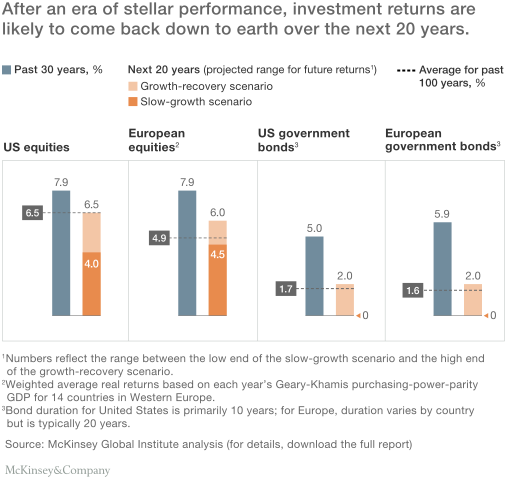
As you can see, the side effects of this unprecedented expansion of debt and the financial repression imposed by the banks through their negative interest rates are devastating in the long run. Because the consequences of growing old with fewer savings will also persistently hamper growth the future of the future: Lower consumption amongst the (ever-growing) retired population, coupled with greater social and healthcare needs amongst that population, which will require higher taxes; these, in turn, will erode the savings of those who will by then be of working age, who in turn are likely to take on excessive debt, and so on, and so on. In short, a radical shift from a virtuous economic cycle that creates wealth to a vicious circle of extremely low growth, excessive and constant debt, and inefficient use of resources that will persist for many years. Looking more to our children’s future than to our recent past, would it not have been better to have cleaned up the financial system when the bubble burst in 2008? Yesterday’s bread will not compensate us for the famine that awaits us.
Here you go a summary from the McKinsey Global Institute study on its own website. And here you can download the full report.