
 I know this isn’t exactly news, but I simply cannot resist publicly denouncing a particular advert that has been flooding the media of late, and which I find particularly sickening, reprehensible, immoral, dangerous, vile, despicable—and who knows how many more adjectives I could come up with. It is not just misleading advertising, like so many others, but this one also distorts the harsh reality and misleads savers on a subject as sensitive and sacred as their families’ money.
 Misleading advertising that may lead people to buy unnecessary items, by convincing unsuspecting buyers that these products will solve all their problems and make them happier, is reprehensible. And the same can be said of advertising that pretends the products it sells are of good quality, when in reality they are nothing more than gimmicks I'll try whilst I'm on the phone, as my grandmother used to call them. In both cases, the advertising will bring nothing but profit to the sellers and disappointment to the buyers who, after being dazzled by such misleading advertising, will be a little poorer, a little more consumerist, and perhaps some of them a little wiser. But buying a useless English course, a faulty hearing aid, a household appliance that becomes a nuisance after a few days, a trip to an idyllic destination that turns out to be utterly mundane, or a dairy product that fails to regulate your bowels properly. Not even something as expensive as buying a car on convenient instalments, which spends more time in the garage than on the road, really jeopardises the financial future of those families and their heirs. Therefore, misleading advertising is reprehensible because it harms the interests of the unwary buyers of these negligent products and/or services, but viewed in perspective, it is unlikely to ruin their lives, let alone those of their children.
However, when the aim is not merely to peddle fleeting prejudices but to ruthlessly peddle highly damaging consequences—which can directly affect families’ well-being in the medium and long term—the matter is far more serious. If, moreover, such misleading, false and repugnant advertising is carried out by abusing the trust that citizens still place (believe it or not) in institutions once considered as sacred as the State or a major Spanish financial institution, its effects can be lethal and far-reaching.
Most of you will already have seen the two videos below on television; they’re both cut along the same advertising lines: images designed to inspire trust, with text appearing at the bottom of the screen to reinforce the message.
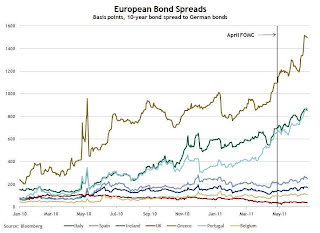
In the first one, you’ll see how Spanish government debt (yes, the very same debt that the ECB has been forced to buy up in bulk behind the scenes for months now because nobody else wants it) is touted as a safe, tried-and-tested investment that brings happiness and will make investors a little bit richer. No big deal. And this is happening at the same time as The European Banking Authority (EBA) is proposing to downgrade Spanish and Italian sovereign debt by 20%, as well as a 40-50% in Greece, Ireland and Portugal. It is likely that, until very recently, the Irish, Portuguese and Greek Treasury campaigns were putting out a message similar to that advertising campaign. The politically correct slogan is «until the party’s over and the lie becomes untenable». And it matters little that, along the way, entire families lose their savings on investments that are far riskier than the advertising claims.
The second video shows a father watching over his sleeping son in his arms. It is a tender image that exudes security and protection, and the message serves to convey the paternalistic and idyllic relationship that La Caixa claims to offer its customers. Nothing could be further from the truth. Just ask the investors in mortgage-backed securities who are waiting their turn to get their money back (which today would be a lifeline for their businesses and/or household finances), despite the promises of immediate liquidity that the bank’s staff have made to them over the years. Or just ask the property developers who, when they manage the epic feat of selling a flat, find that La Caixa (and almost all other financial institutions) not only refuses to transfer the mortgage to the new lark Not only does he take advantage of these new buyers by using the mortgage that’s already been granted to the developer, but he also tries to sell them one of his own flats, leaving the developers looking like complete fools—and then some. This is what happens to developers who have been and remain creditworthy, whilst also being excellent customers of the bank, and that is precisely why the «paternalistic» La Caixa would rather have the mortgage owed by its solvent «little boy» than by a couple of strangers, who these days are nothing more than potential defaulters to us. And the bank will continue to shackle its best customers in perpetuity and bleed them dry until the very heart of its balance sheets stops beating.
So it will have no choice but to seek out new customers through even more aggressive advertising campaigns, selling all manner of dubious investments disguised as models of the most overprotective security. After all, perhaps the phrase «being by your side» actually means «preying on you».
It seems that anything goes when it comes to survival. But, at the very least, the underhand tactics that exploit people’s most sacred emotions are reprehensible. Especially when they tug at people’s heartstrings to sell investments that could ruin the lives of savers and their heirs. Someone ought to remind them that they are not peddling worthless English courses, trips to hotels of a lower standard than promised, or vacuum cleaners that do nothing but make noise. They are gambling with the future well-being of citizens and their heirs. And when what is at stake is more than just a service or consumer item, the demand for truthfulness in advertising should be absolute. You don’t mess about with the essentials, but it seems that today the situation of banks and governments is already so desperate in this country that ethics have vanished from our society, from the government and from the regulators. We are in a minefield, and what’s more, some bastards are starting to push those closest to them aside just to survive. It will be a matter of getting as far away from them as possible, even though this obvious fact is still beyond belief for many.