
Every day we see examples of exultant bettors who think they are seasoned investors, just because their bets have been winning for a few months, even a few years. They confuse investment criteria with the criterion of the winning bet. And they believe that making money in the short term on the stock market or in government bonds is synonymous with being a good investor. I regret to tell them that nothing could be further from the truth.
The fall will be hard, very hard. With permanent losses, meaning that they will not be able to recover until decades from now, when inflation has eaten away the lost value and therefore they will settle for a false recovery. But there are the bettors, buying Spanish bonds more expensive than the very same Norwegian bonds (you can see a quick and illustrative comparison of the fundamentals in this Gurusblog article); American stock markets trading at more than 20 times earnings, or the brand new holders of subordinated debt or mortgage bonds of pseudo-rescued banks on the brink of disaster. It seems that for these gamblers anything goes as long as the result is positive. It doesn't matter that they are buying assets at prices that only the aberrant manipulation of central banks can generate. It doesn't matter how far their price is from the real intrinsic value of the asset, be it profits and annual business growth in the case of the stock market, or the macroeconomic fundamentals of the state in the case of sovereign bonds. All for the sake of the winning bet.
But this artificial distortion generated by central banks and governments in developed economies will eventually come to an end (in fact the FED is already reducing its heterodox measures in the last year). And then valuations will return to reasonable levels based on intrinsic value, or even go too far and we will once again see what the Anglo-Saxons call «once in a lifetime time» opportunities, i.e. those that do not happen every decade.
The million-dollar question is when will that happen? And the answer is that at any time, if we want to be conservative, The rational valuation of assets is a universal law that will be fulfilled in the markets sooner or later. Let us not forget that we have a lot at stake, as much as the money that should ensure the welfare of our people in the future. Another thing is that we want to be reckless, in which case we can blindly trust that central bank distortion will continue to keep prices in the stratosphere for a few more years. Indeed, the greed of previously won bets and the need to achieve returns in times of zero interest rates tends to turn many conservatives into reckless ones., who throw themselves into the arms of the financial repression and of the infinite interventionism (sic) of central banks. But we must not lose sight of the fact that in that case, we are gambling and not investing.. Because Investment in capital letters does not need political artifices or central banks to make us money.. That is its greatness and what has made the richest investors on the planet great. Is it not preferable to exchange our money for assets whose value is intrinsic and far greater than their price, rather than placing it in expensive assets that only with external distortion can maintain or even increase their value?

For all these reasons, and speaking of fixed income, it is reasonable to say that in general nowadays it is much more conservative to invest in emerging countries than in developed economies. Of course, it is necessary to distinguish one emerging country from another, since it is not the same to invest in Russia as in Argentina, Thailand, Korea, Lithuania, Brazil, Nigeria, etc. But it is less risky in the long run to buy bonds from a country that is growing and with low debt (Russia 13% GDP) than from a country that is the opposite (Spain 100% GDP).. Along the way we find economies with intermediate indebtedness such as Korea with 37%, Mexico with 46%, or Brazil, which despite its current political and social problems in 2000 was dangerously close to 80% of GDP, but today has moderated its indebtedness back to 66%. And if we focus on equities, it is also reasonable to say that in the medium to long term It is much more conservative to invest in markets whose companies trade at low earnings multiples than in expensive stock markets: Russia x5, China x7, rather than in the US or Spain where the multiple exceeds x20.
In this graph you will see how future returns are absolutely dependent on the prices (relative to corporate earnings, in this case CAPE) at which you invest in the stock market. This is also a universal law, despite the fact that in the short term or even for a few years the central banks generate aberrations in prices, which some ludopath may temporarily take advantage of.
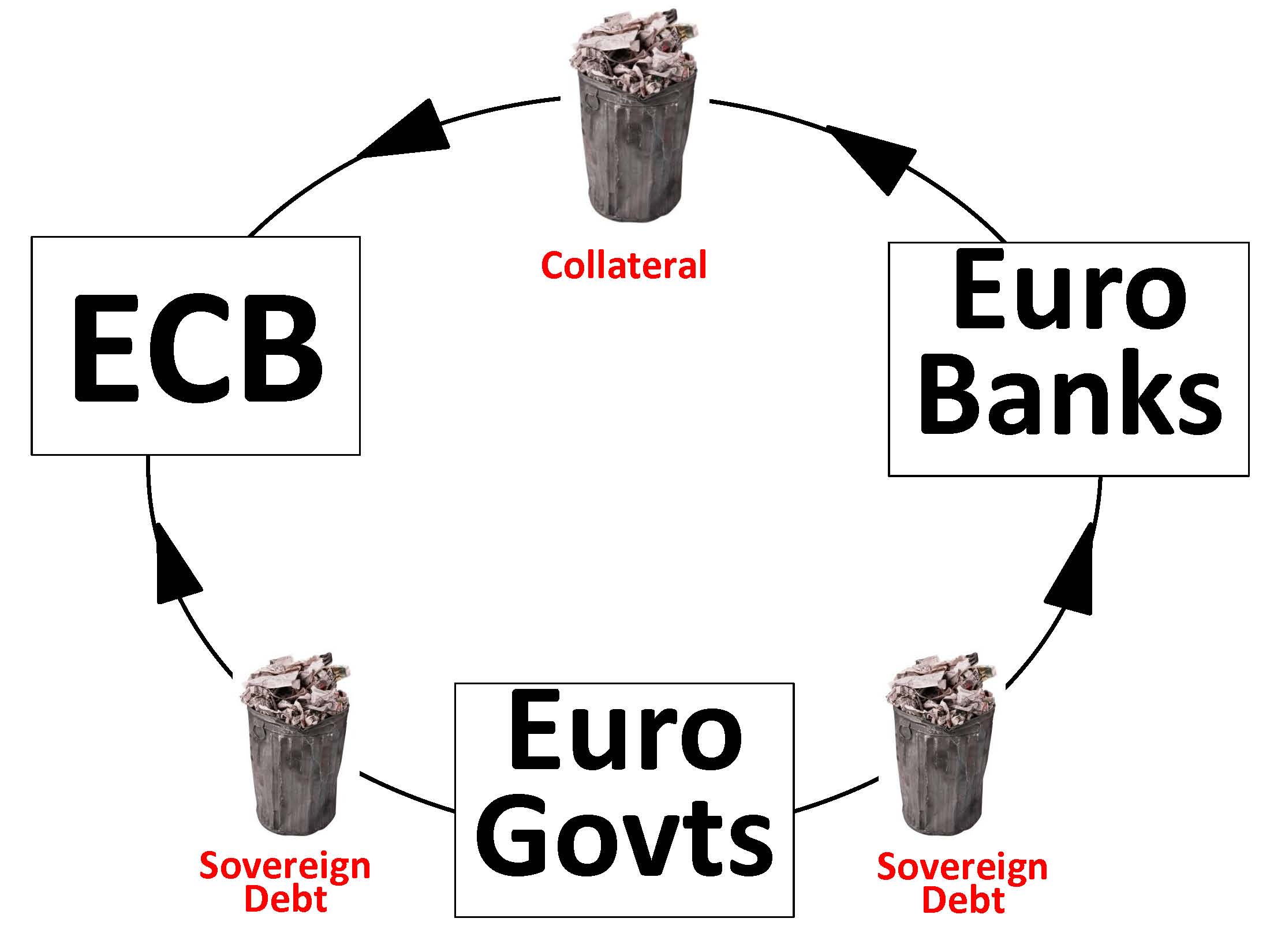
This has been the aberrant scenario in the last 2 years in the European peripheral economies. Spanish stock exchange and bonds (among others) on the roulette table, where the croupier Monsieur Draghi is giving game to the gamblers who do not care about anything but their «good run». They go to sleep every day so happy with their «investments», hoping that the next day the croupier will continue to play them. And so did many buyers of US debt, until last summer when the price started to rationalise a little. For its part, the US stock market continues to rise and rise in tandem with the Spanish stock market (at least the US GDP is already growing at 4%, unlike here).
For a couple of years now, betting has been paying better than investing.. And a good symptom of this aberration is that indices such as the S&P are now outperforming the vast majority of star US investment managers. Because the best investors do not bet on assets that are distorted to the upside. Not yesterday, not today, not ever.
Whatever the stakes pay today, at any moment the croupiers will change their unsustainable attitude. And at that moment, investments will once again protect and increase our wealth, and gambling will once again ruin those who have confused the casino with the markets. And for those who excuse themselves in the absence of alternatives to fixed income in order to continue betting on expensive and insolvent bonds, I would like to tell them that there is life, i.e. investments, beyond peripheral, US, German, etc. debt. There is no excuse to justify the gamble. Never.