Much has been said and written about the surreal figure of the bad banks. This strategy of creating or designating a bank to take on all the toxicity of the rubbish that has been securitised over the last decade has been a recurring theme over the last three years.
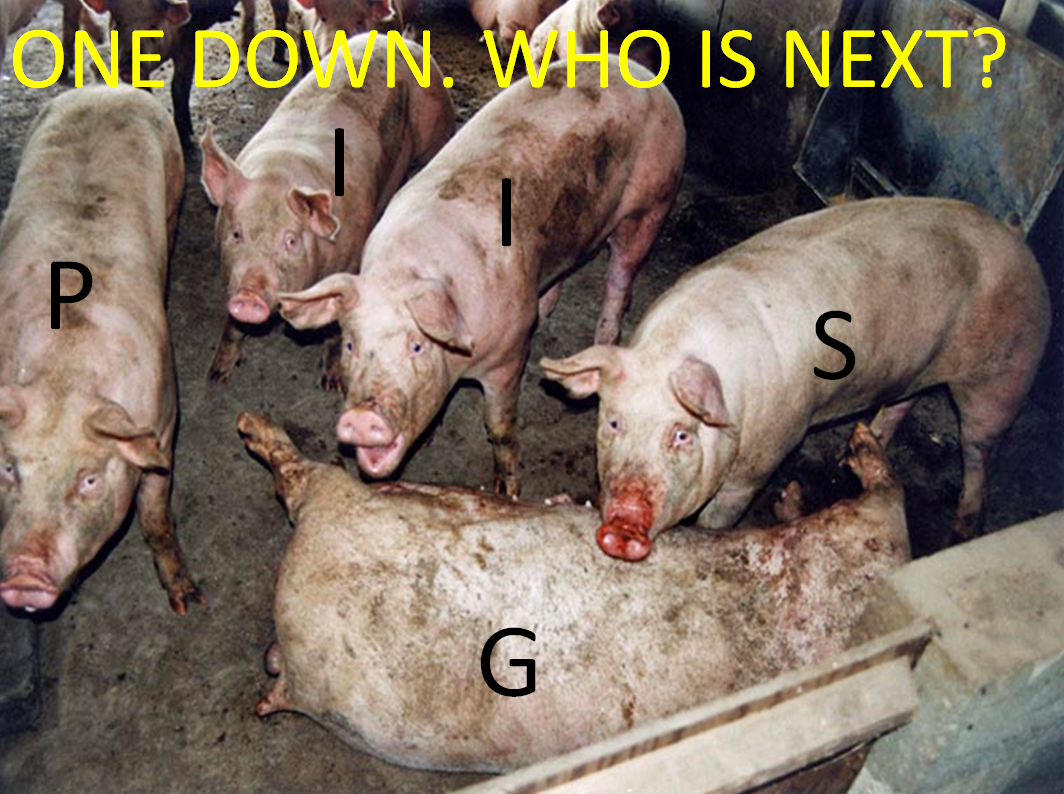
 It is like being able to concentrate the illnesses of many in a single dying person, bury him and... live the dolce vita again, which is two days. A Machiavellian transfer of insolvencies whose aim is to free the balance sheets of the financial system (banks) whose collapse would have systemic or very harmful effects for the longed-for economic-financial recovery. It is like digging a hole to bury a large accounting hole concentrated in certain entities created ad hoc. Pure «liquidators»The "Chernobyl and Fukushima" countries, which sacrifice their future so that others can survive. Purely a transfer of problems between accounting communicating vessels, such as debts and toxic assets.
Well, if we stop to think about the role the Euro is playing in the world's major currencies, the situation seems to me to be strangely comparable to the above. Currency exchange rates are just another communicating vessel, but this time it is not about balance sheets but about currency cross rates. Because as we have been saying for many years now, all developed economies have needed to reduce the value of its currency as the air they breathe, and by a ma-tan external devaluation.
More than two years ago, we christened it as «The Era of Devaluations«and a few months ago this financial phenomenon was popularised in the media as a «currency war». No matter the name, the essence was the same already at the end of 2008, and today it is clear to everyone that the strength and weakness of the currency are concepts that the New Normal has been responsible for turning upside down. As we said in that article: «....and that's what the currency war is, it's a Darwinian warfare in which there is not a moment's hesitation in making firewood out of the fallen tree. No more today for you and tomorrow for me. It is, unfortunately, a case of it's either you or me. And in troubled waters, devaluators win.«
 That fallen tree is none other than the Euro, with its now undisguisable peripheral insolvency, and the communicating vessels of huge amounts of insolvent debt fatally cross-billed by irresponsible politicians. And the «strength» from which the major developed currencies are fleeing must be concentrated in the rising price of some nerd to infinity and beyond. A fallen tree shot into the sky for the convenience of the rest, who need to devalue against someone or something that plays the same role as the aforementioned sinkhole. A perfect bad currency to enable the recovery of the developed economies that are not yet evicted.
Obviously, for those of us who have the Euro as a currency, this role of bad currency, bad currency, a catch-all, blow-up doll or whatever we want to call it, is nothing more than the chronicle of a long and painfully foretold death. That's what it is to spit up our bad currency.
You may also be interested in:
The Era of Devaluations (y2)
More information at http://twitter.com/ClusterFO
You can also join our social network at Facebook and our professional network at Linkedin.

 The financial situation of countries such as Greece, Portugal and Ireland (to name a few of the politically correct examples) is unsustainable. And by this we do not merely mean that it cannot sustain itself – in other words, that these economies are insolvent in their own right – but also that it is unfeasible for them to be sustained by third parties, as has become apparent in recent months, with bailouts that are clearly ineffective.
 The EU has a glorious past. The project of a United Europe has slowly and flawed but exemplarily overcome the nationalist barriers and reticence of its components. It has been the example of concord and voluntary union of peoples (diverse as they are) who only a generation before were fighting a world war, when the world was limited to being Western and there were only two sides.
 Bankia’s brand-new chairman, Rodrigo Rato, spoke at the 18th Financial Sector Conference, where he made a joke that was not only unfortunate but also completely unfunny. The economic comparison of Europeans is odious, and on the one hand we lambast those who refer to the EU’s periphery in terms of the PIGS, whilst with the other, the chairmen of Spanish banks publicly recall the old joke: «…a German, an Englishman, a Frenchman and a Spaniard are on a plane…» You can see the joke recalled by Rodrigo Rato in the following
 Well then, what Mr Rato sees as an enviable situation – one that would make the British, Italians or French gladly parachute into Spain to enjoy our favourable financial conditions in terms of assets and liabilities – it is clear to everyone that this is nothing more than a distortion resulting from the precarious state of the Spanish financial system. Pure desperation to keep bankrupt balance sheets afloat. Yet according to the chairman of the new bank (formed by merging former savings banks and their toxic assets), the favourable terms offered by our banks are the envy of the rest of Central Europe. Who are they trying to fool? Well, yes, I know, they’re fooling savers who entrust their money to them in all sorts of banking products in exchange for tempting interest rates. But who else? The fact is, their business is kept afloat by the public trust which, paradoxically and surprisingly, they still enjoy. That is why any opportunity, quip or media appearance is a chance to repeat the sole mantra that keeps them afloat: the Spanish financial system is not bankrupt, property prices will not fall any further, and a whole string of well-worn lies.
 Because it seems that the Portuguese, the Irish, the Greeks and probably the Spanish take it for granted that bailouts will be provided promptly and efficiently. And we’re willing to accept the impossible – that is, de facto intervention in our domestic economic management – in exchange for being kept in the Eurozone despite being bankrupt. At this stage, we must remember obvious truths such as the fact that the markets wouldn’t give us a penny without the support of ‘Mummy EU’. And it seems that yesterday the Portuguese did not even consider the possibility of being relegated to mere prey for the sharks. How easy (and irresponsible) it is to vote ‘NO’ to tightening the belt when you are convinced that the Seventh Cavalry (in its German version) will come to the rescue.
 «The world seems to have gone mad,» a friend remarked to me following the disaster in Japan and NATO’s imminent military intervention in Libya. Indeed, the familiar parameters are turned upside down in every sense: the parameters of the financial system, the concept of risk, ways of preserving wealth, trust, solvency, debt, terrorism, natural disasters, and so on and so forth. But this is not madness; rather, it is a set of new rules, a ‘new normal’ which, for the time being—with no historical cycles to draw upon—seems chaotic to us.