 I’m sure we can all agree that it’s very important to start building up assets as early as possible so that the power of compound interest can work in our favour for as long as possible. Countless calculations have been published showing the huge difference it will make to our financial situation in later life if we start saving a few years earlier than usual.
 If we imagine our finances in an environment of low or zero taxation, we could treat the returns on equities as net, thereby multiplying the effects of compound interest over the years. So far, it all seems quite obvious. But let’s see what happens with investment products offering moderate returns of around 5 or 7%. These products would then be returns worth considering, as they would more than offset the loss in the purchasing power of our money. Logically, such instruments are safer than those generating higher returns, and would therefore allow us to PGR very tight, with very solid foundations and objectives that are virtually guaranteed over time. This is a sound and common strategy amongst major international fortunes. We are not suggesting that large fortunes do not pay tax, but rather that they do so in a manner and through legal structures which, although costly, alleviate to a greater or lesser extent the tax burden that would otherwise apply.
In accordance with the law, we must remember our obligation to declare to the tax authorities any money or investment made in countries where there are no double taxation agreements with Spain.
In cases where a client’s asset structure allows for the lowest possible tax liability – and thus makes it feasible to strategically utilise the safest products, albeit those offering lower returns – long-term planning is a piece of cake. At this point, other factors come into play that must be taken into account when making the decisions that will steer these fortunes in one direction or another: family and business planning, life and generational goals, and a extremely long etc. – matters to be discussed in detail with the owners, who will determine the guidelines to be followed over the coming years. This comprehensive wealth management advice will be provided by a family office .
But let’s get back to «real life». An upper-middle-class family fortune of, say, €600,000 – including the value of property (their home), business assets (if they are self-employed) and liquid assets (savings, investments in securities, etc.) – has been paying tax since the very beginning and has no choice but to continue doing so in the future, because their wealth and tax liabilities have grown in tandem and can no longer be separated. We’ve all heard the saying that ‘I’ve got a partner who takes the xx% of my profits… In fact, almost everyone works well into May to pay their taxes. But once you’ve reached this level of wealth, it’s already too late, because it would be difficult to justify paying less tax on assets that the State knows you possess – not to mention that it would be illegal.
And I wonder: what would happen if, whilst there’s still time, we could dissociate legally our fledgling wealth growth over the financial year? As well as being a gradual and imperceptible shift, we could obviously make use of the investment products with moderate returns that we referred to earlier. And that would allow us to base the initial growth of our wealth on something other than pure, unadulterated risk. To our wealth-building strategy—which is based on the well-known speculative property investments, the stock market, high-risk financial products and non-speculative property investments aimed at generating passive income—we could add a growth in fixed-income investments low-risk investments that would underpin our long-term growth. This would broaden the strategic possibilities we are all familiar with, much like those available to many large international fortunes. But the reality is often quite different, particularly for those with modest capital. Fixed-income investments barely beat inflation after tax, forcing us to take excessive risks if we want to grow, because We must achieve growth that outpaces inflation and exceeds fiscal targets.
On the other hand, we must look at the positive and supportive side of this effort: The more tax we pay, the more and better public services we will have – healthcare, education, infrastructure, etc. 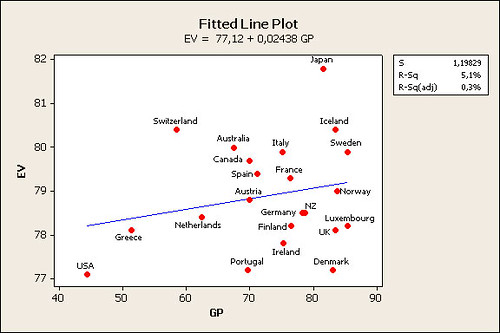 To give an example, I honestly believe that the precarious state of the US public health system is very dangerous and unfair. The graph shows the relationship between life expectancy and public spending per per capita in terms of health, although, naturally, other factors such as diet and healthy habits also play a part in longevity. I therefore believe that the taxation It is necessary to maintain a certain standard of living, but this must not prevent the middle class from achieving financial independence. A policy that curbs compulsive consumerism and provides tax incentives for saving and passive income as a whole would help to achieve that independence. This would, for one thing, partially relieve the state of its responsibility for supporting pensioners. Unfortunately, it seems that pensions for the elderly are already evicted when they reach our generation, and of course for those who come after us as well. Anyway, we always have the option of making tax deductions for a pension scheme so that we «only» lose the purchasing power of our money. But we’ll talk about that another day.
In short, it is just as bad for our long-term financial well-being to start too late in seeking our independence financially, just as it is to do so in a stifling tax environment. And what for the rich is a strategy for structuring their assets within the legal framework is, for the poor, economic fiction. But what will happen to the poor who are young and potentially wealthy?