

According to the World Bank, an income of less than $1.90 per day means that a person is statistically and officially poor by global standards. Xi Jinping's government, on the other hand, raises the bar to $2.30 per day, i.e. below this income, China's population is officially considered to be poor. Even so, the Chinese government has achieved the goal set in 2012 of lifting 100 million people out of the poverty line in the last decade.
.
As you can see from the BBC graph below, according to the World Bank the number of poor people in China, mostly rural, was over 750 million in 1990. In just 20 years, up to 2010, that figure fell to just over 100 million. And in the last decade, the number of poor people in China below the poverty line has fallen to just 5 million. In other words, in the last 30 years China's planned capitalism has lifted 745 million people out of extreme poverty.
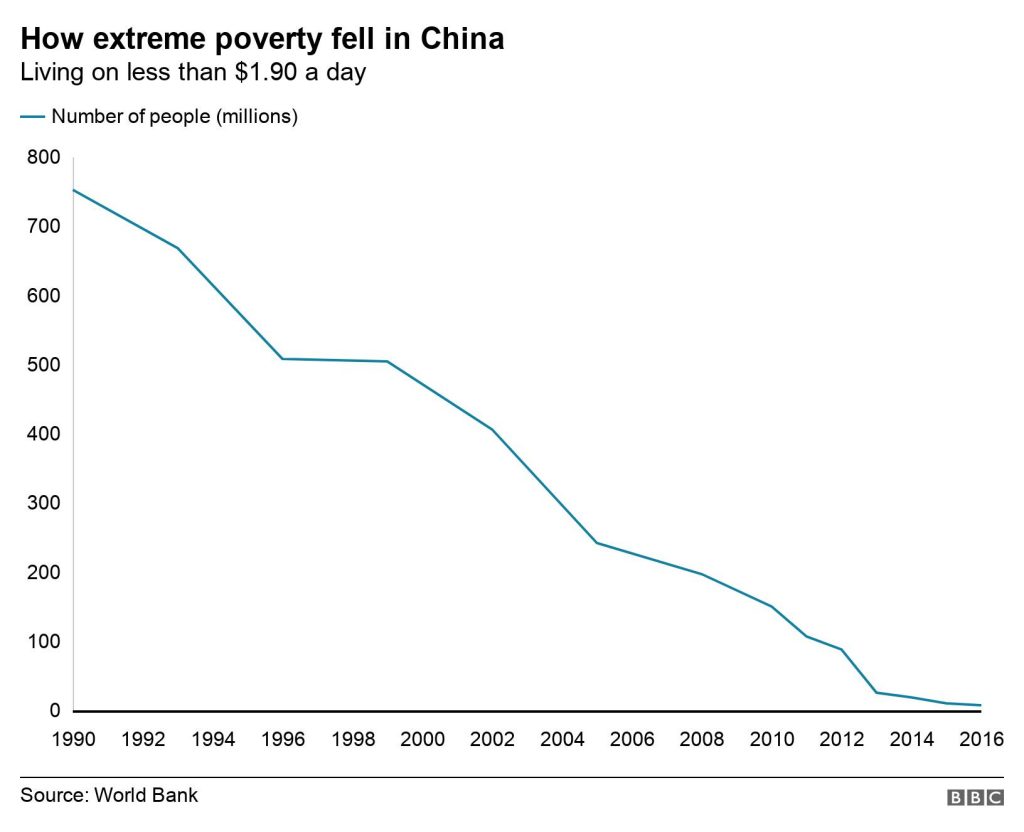
Other countries such as Vietnam have also dramatically reduced their poor population, yet India still maintains levels of close to 20% of the population below the World Bank's threshold of $1.90 per day.
.
But of course, the consideration of extreme poverty must increase as the economy also grows, and by the standards of developed countries such as Spain, the extreme poverty line is severe poverty 11.83 euros per day or in some statistics at 40% of the average citizen's income. Therefore, in Spain we have 2.2 million people at risk of severe poverty (4.7% of the population), and what is even worse is that this figure is rising instead of falling as it is in China.
.
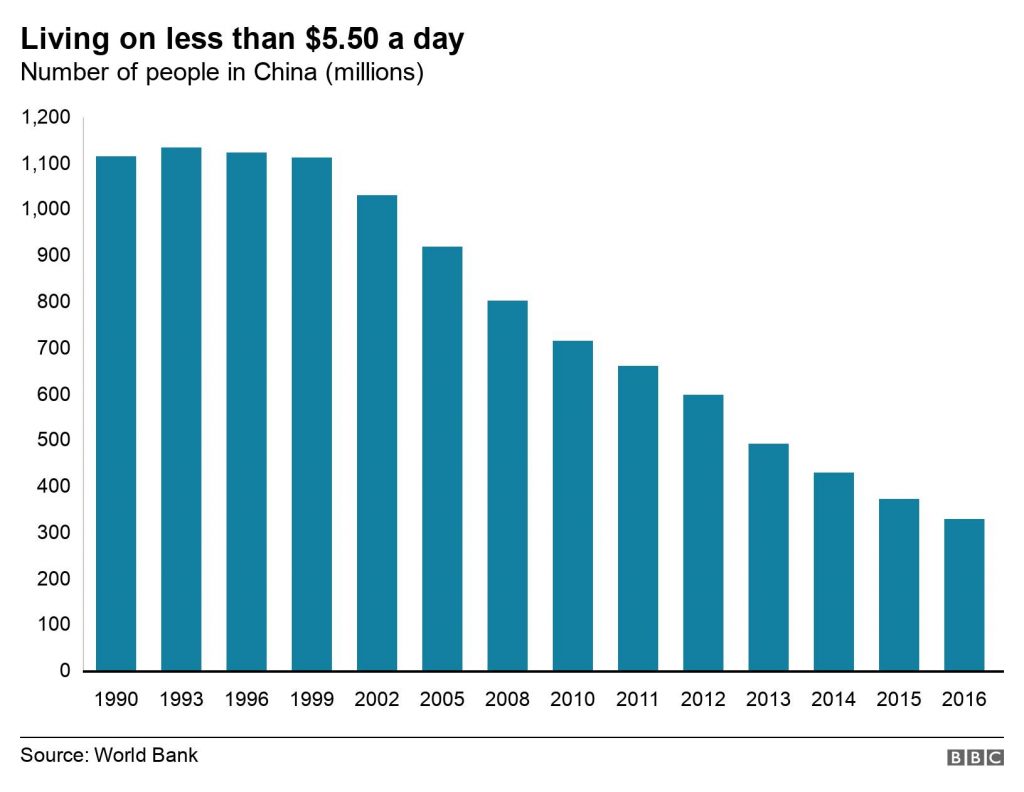
Some would argue, and rightly so, that the extreme poverty line in China today should not be set at $1.90 or $2.30, as its economy has grown enormously. Internationally, the World Bank sets $5.50 per day as the poverty line for upper-middle (not high) income countries. And in this category of countries we should already consider China as a whole, both in its urban and rural areas, if we want to be fair with the assessment of its poverty reduction. Well, in 17 years, from 1999 to 2016, according to the latest data published by the World Bank, poverty in terms of upper-middle income economies has also been reduced by almost 800 million people in China.
.
This can be clearly seen in the graph below, and projecting its economic growth over the last 5 years, there are probably no more than 150 million people in China today below this threshold, i.e. barely 10% of its total population. At these levels, China's income growth would already clearly exceed that of countries such as Brazil. Y the pandemic points the way because it is obviously further accelerating the comparative growth process between China and the rest of the emerging or already emerging countries.
Another thing is the economic inequality, China is invading the lists of billionaires at the same time as it lifts hundreds of millions of people from the poverty line. But this may be the necessary evil, the toll that growing economies must pay in order to lift millions upon millions of people out of severe poverty. Contrary to what many believe, the most realistic and efficient way to reduce poverty in the medium and long term is probably not through a utopian, more equitable distribution of existing wealth, but through greater wealth creation. In other words, powerful economic growth, even if it leads to greater economic inequality among the population.
.
If, in addition, the state, with extreme care and subtlety, combines social measures to help the most disadvantaged, while at the same time maintaining or even improving the conditions for the rich to continue expanding their fortunes within the domestic economy, we may be looking at solid and sustainable economic growth for decades to come. For inequality is necessarily bad only in the absence of economic growth, but need not be bad when more and more wealth is created in the aggregate.
.
Economies, like companies, get better or worse, but they hardly stay the same. And the same is true of economic policies, they equalise or unequalise, but hardly maintain the differences in wealth among their population. In short, there are four ways of dealing with economic differences in population through the application of economic and fiscal measures: equalising upwards, equalising downwards, inequalising upwards or inequalising downwards.
.

There is little point in reducing inequalities (equalising) if we thereby kill economic growth by raising taxes out of all proportion and demonising our rich until they leave for other countries with smarter governments that welcome them with open arms - and open taxes. It is preferable that our rich get richer and richer every day so that, along with them, our economy grows and our poor are lifted out of poverty, otherwise we will run out of rich people and become poorer across the board. In other words, upward unevenness is preferable to downward equalisation. Because equalising downwards through unsustainable public spending, involving tax extraction and confiscation, has historically been shown to undermine incentive, productivity and economic growth, plunging the poor who were intended to be kept afloat in the short term into misery in the medium and long term.
.
Finally, downward disparity This is what African dictatorships and other banana republics do, and therefore it is obviously of no use either. The ideal, of course, would be to be able to equalise upwards, But that is only a chimera that capitalism (and certainly not socialism) has never achieved, not even with China's planning and not even with American efficiency. In short, welcome the growing inequalities that lift millions of people out of poverty.
.
Source: BBC.com/news