
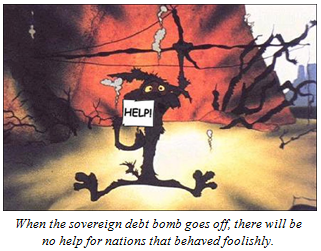
 The concept of risk, as it relates to long-term wealth preservation, has undergone a widespread and extremely dangerous shift since the bursting of the credit bubble. And our duty as a family office is to warn and protect our clients and followers from the risk that is taking hold of assets which, until recently, were considered (and are still considered by most) to be «safe».
When, at one of our conferences, we mention that in this new financial world (The New Normal) in which we find ourselves, the concept of risk and capital preservation has changed radically; some of those present look at us sceptically. But when we tell them that risk is taking over traditional fixed-income asset allocation and that, in this ‘new normal’, wealth preservation must be achieved – now more than ever – by buying good, undervalued companies on the stock market, their scepticism turns to widespread disbelief. And their question—or rather, exclamation—is as follows: How can there possibly be greater risk in a bank deposit, a guaranteed product, subordinated debt or public and private bonds than there is on the stock market?
At this point, we must distinguish between risk and volatility, understanding risk as the possibility of losing our assets beyond the short term – in a way that is, shall we say, permanent or long-term (in relation to the investment life, for example). In other words, the opposite of the long-term preservation of wealth, which should be the primary objective of managing a family fortune. In fact, in Cluster Family Office We mainly use the concept of «potential short-term losses«, rather than the distorted and misrepresented concept of risk confused with volatility. And in the New Normal, this is truer than ever. Because confusing volatility with risk when discussing wealth management today means losing sight of the bigger picture.

In wealth management (which goes far beyond simply managing a portfolio and its performance as at 31 December), the possibility of temporary short-term losses should not be regarded as a risk, provided we are certain that our assets will recover the lost value and generate gains in the medium to long term. In fact, we should invest exclusively in assets whose value increases the longer our time horizon. In that case, our assets may suffer potential short-term losses, but In the medium and long term, the risk is reduced to the point of being virtually eliminated.
However, the fact that the best way to grow and preserve wealth in the long term is to investing in shares of excellent companies at excellent prices, is not merely the result of the recent abuse of debt (fixed-income securities and other bank-guaranteed instruments). In the face of events such as Argentina’s ‘corralito’, or any unpredictable ‘black swan’ event, history has shown since the last century that corporate assets are the ones that best weather financial and geopolitical debacles. Take a look at the chart below to see what has happened over the last decade with fixed-income securities and the Argentine stock market following a credit event. Obviously, Argentine bondholders have experienced less volatility, but I would prefer to be in the position of stock market investors, accepting greater volatility and a higher risk of short-term losses. Poor bondholders, who bought into the sense of security peddled to them by naive, unwary and/or unscrupulous advisers. Note that in the first few months of the chart, before the summer of 2001, bondholders felt very well advised, shrewd, comfortable and at ease, watching as the rest of the Argentine stock market investors suffered losses in excess of 20%. But unfortunately for them and their heirs, his advisers failed to prevent them from continuing to confuse volatility and potential short-term losses at risk. And in an attempt to avoid this, by foregoing higher capital gains, they accepted it for good, suffering as a result irreversible disabilities (like someone who bought a property in Spain in 2006/7 at an exorbitant price)

It is obvious that the volatility associated with company share prices on the stock markets is high. It is also true that, if we are talking exclusively about volatility, traditional fixed-income assets have historically maintained greater price stability – even in the case of the Argentine default mentioned earlier, where prices remain «stable» at less than half par. I recommend you re-read the article where you can download the full presentation we gave a few months ago on this subject: «The Unbearable Lightness of Fixed Income«.
But for those sceptics who remain entrenched in their disbelief until the crowd pushes them to follow the herd, we’ll give you a sneak preview of a gem that, for the time being, is simply yet another economic study – though one produced by none other than the Research Department (quite a statement of intent) of the People’s Bank of China. Its director, Jing Xuecheng, has acknowledged that he submitted the report commissioned by to «relevant authorities» within the Government the people at the top in which the following possibility is examined: To convert, at least in part, China’s accumulated US dollar reserves held in US sovereign debt and US Treasuries into shares in listed companies. According to data from the US Treasury, the value of Treasuries held by the Chinese government stood at $1.1449 trillion (Spanish billones) as at the end of March 2011. The total value of foreign exchange reserves stands at $3.0447 trillion (and rising due to its trade balance), and in political circles, the Chinese government’s concern about securing better returns and capital preservation through newly created sovereign wealth funds appears to have intensified.
A word of warning to sceptics and those who blindly follow the rhetoric of bankers and their outdated concepts of risk and asset allocation: the Chinese government is increasingly concerned about the growing risk posed by holding fixed-income assets as traditionally reliable as US Treasury bonds. Imagine, then, the risk posed by peripheral European debt and that of the rest of the developed world, or by corporate debt with high debt-to-asset ratios – in other words, the bulk of the debt currently circulating amongst investors. The recent statement by Jing Xuecheng, Director of the Research Department at the People’s Bank of China, is damning: «We need to safeguard and increase the value of our investments in America. In this context, »debt holdings’ refers to all types of bonds, including US Treasury bonds. I wish you sweet dreams.
Charts: Cluster Family Office
You may also be interested in:
The Unbearable Lightness of Fixed Income
Heritage Preservation in the New Normal (2)
Heritage Preservation in the New Normal (1)
Bill Gross: «We’re selling now»
How to get back to the way things used to be
Be careful with fixed-income investments…
The global economy and chaos theory
Merry Christmas and a Happy New Chaos
Who has taken away my normality?
More information at http://twitter.com/ClusterFO
You can also join our social network at Facebook and our professional network at Linkedin