
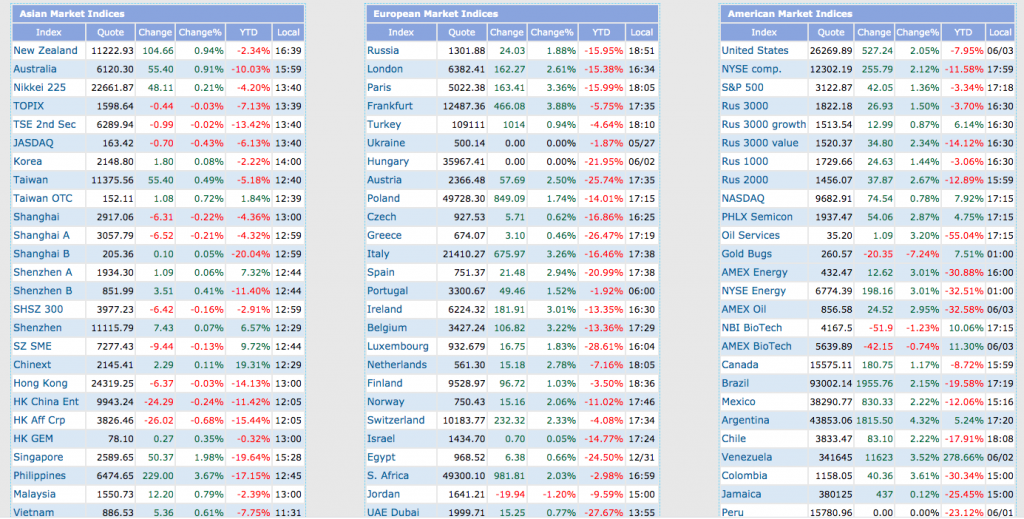
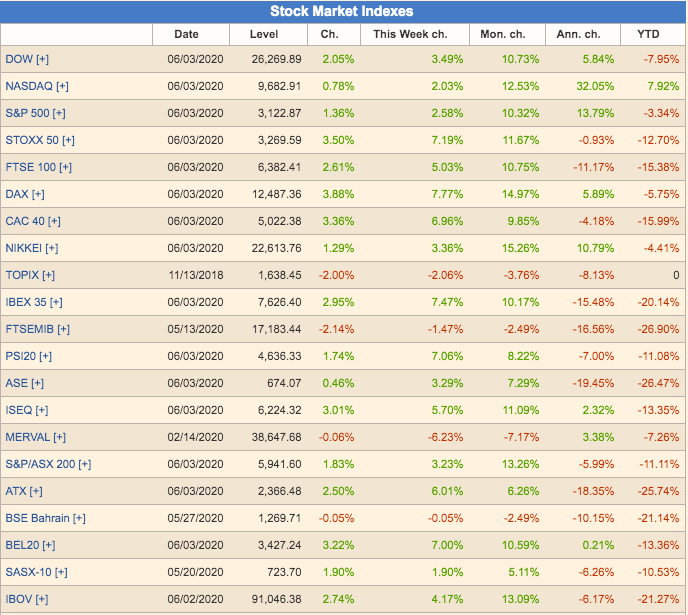
It is true that as of 3 June 2020 the S&P 500 is at -4% from the start of the year, the Dow Jones is at -9%, the German DAX is at -7% and the Hong Kong stock exchange is still at -15% YTD. It is also true that the stock markets of other countries are even further behind, such as those of Brazil, India, Russia, Indonesia or European countries like France, the UK, Italy or Spain. However, there are others which, to the surprise of many, are already at -2% levels, such as Japan or clearly in positive territory, such as Denmark.
.
And not all investment possibilities are limited to matching the general reference indices of the countries, which as you can see on any website like this one, are still quite red in general. We can find some sectoral indices such as the Healthcare, Biotech or the very same Nasdaq with positive returns, despite the travails of this fateful year.
.
But of course, having a portfolio full of international index funds or etfs, replicating only consistently winning sector indices, is almost as difficult as choosing a portfolio of world stocks that outperforms the market year after year.
Another possibility for the investor is to choose good actively managed funds that have managed to outperform their respective benchmarks for many years and are therefore already making money, net of fees, for their investors. The problem is that for the vast majority of retail investors (according to the unfortunate nomenclature used by Spanish regulation), finding funds that achieve substantial alpha and outperform their indices on a consistent and sustained basis over time is often as difficult, if not more so, than getting winning stocks or sector indices right.
.
Here it is worth recalling what we explained in «Why big international investors don't invest in the same funds as you do»The "outperformance" of funds that consistently outperform their benchmark indices. There are some, but investors must have a portfolio size of several million to exceed the minimum requirements of these funds for professional or institutional investors.
.
Fortunately, they can also be accessed through the back door, i.e. through the luxembourg funds of funds 125,000, as Luxembourg law considers a professional (non-retail) investor to be a professional investor above this minimum investment amount, and they aggregate sufficient volume to meet the minimums required by each institutional fund. Logically, the composition of these portfolios of funds of funds for professionals or institutional investors may be of higher or lower quality, outperforming or not the respective benchmark indices, since they obviously involve a fee in addition to the net returns obtained by the underlying institutional funds. It should not escape anyone's attention that being a fund for professional investors does not guarantee that it will outperform its respective index, as mediocrity is also rife among institutional funds. That said, the Luxembourg fund of funds that we have been using for our smaller Clients has also entered positive territory this week, in terms of net returns for the investor of course.
Therefore, those who are still negative so far this year could have done better, as there are options to invest a minimum of 125,000 euros and outperform the major international indices in terms of net returns. And that outperformance, that systematic cutting back in days weeks or months in the recovery period of losses generated by sell-offs like the one last March makes a huge difference to the performance we will achieve in the long run.. Because the quality of a fund or a portfolio management is not - only - measured by a lower fall in periods of crash or a higher rise in periods of euphoria, but above all by the quality of the fund or portfolio management. the speed of recovery of losses after a generalised drawdown. That is the key to those that consistently and permanently outperform the indices, and the degree to which they achieve this is critical to our earnings performance in the years ahead (of course it would also be critical to our performance to invest more in crash periods at rock bottom prices, but we have already discussed that). in the middle of a storm stock market).
.
That is why it is not the same to start making money in 2020 as early as 3 June, before the major general indices of the world's main stock exchanges, as it is to start making money at the end of the month, during the summer or even later. Y Market conditions in 2020 are the best test to take the pulse of the quality of our portfolios.. Obviously the markets will go up and down and up again in the coming weeks, and every day the numbers will dance enormously. But whoever is still in negative YTD today, either with portfolios of self-selected stocks, or with portfolios of passively managed sector funds or actively managed funds, should not be cheating himself, he could have done better.