
As Mark Mobius, former executive chairman of Templeton and founder of Mobius Capital Partners, said in an article from March: We need to invest in the stock markets of what are still known as emerging economies. And this time it’s the financial think-tank Gavekal Research who has published a report entitled «Wealth transfer to emerging markets» which is well worth reading. It states that the Keynesian era, that is to say, an era of financial repression and quantitative easing (QE) – or, in short, the era in which the world’s major central banks (the Fed, the ECB, the BoJ, etc.) have been lowering the cost of borrowing to revive the anaemic growth of Western economies across the globe, They are like shots of economic growth straight into the veins of emerging economies.
.
When the performance of gold outstrips that of the world’s major developed currencies, the world enters what is known as a Keynesian era. If we add to this coordinated action by the central banks of developed economies, the current policies of quantitative easing and rock-bottom interest rates amount to the death knell for rentiers. The question is, who stands to benefit from this inevitable demise? Emerging markets, without a doubt. And we can see this clear transfer of money from developed to emerging markets in Chart 1:
.
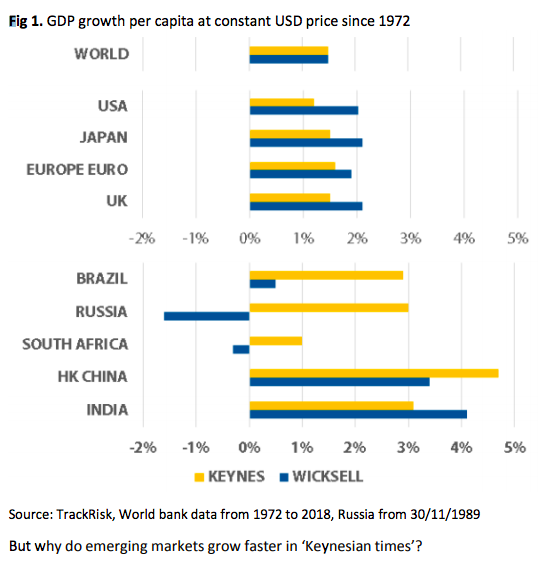
The lower axis shows the growth in GDP per capita (at constant US dollar prices) since the end of the gold standard. We can see that, in both Keynesian and Wicksellian periods (named after Knut Wicksell, who advocated interest rates that followed the trend of economic growth rather than acting as a corrective tool), growth is the same when we consider the world as a whole. But note that if we distinguish between emerging and developed countries, the picture changes radically. Here, the growth of emerging economies is clearly favoured by Keynesian periods, in stark contrast to what happens in developed countries. And also contrary to what Keynesian policy is, in principle, intended to achieve.
.
Why is this happening, when intuitively it would seem that loose monetary policies in Western currencies should favour the recovery of developed economies rather than those of emerging economies? The first reason is that emerging economies, many of which are commodity exporters, see their profits rise due to higher export prices. This is because commodities tend to become more expensive when Western currencies depreciate against other assets and currencies, which is what happens during Keynesian eras of low interest rates.
.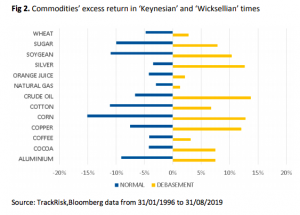
This is clearly illustrated in Figure 2, where, by contrast, Wicksellian cycles spell nothing short of ruin for commodity exporters.
.
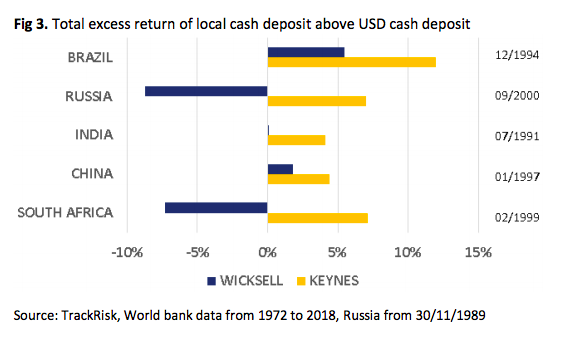
The second reason is that the external debt in US dollars held by companies in emerging economies becomes cheaper under the low interest rates of Keynesian eras, which generates additional profits for these companies. This is particularly true of those based in countries with sound, low-debt and highly productive economies, where their currencies remain stable or even appreciate.
.
Chart No. 3 measures the premium paid on local-currency deposits relative to the US dollar. In other words, it shows the savings in funding costs for these companies compared with the costs they would have incurred in local currency during Keynesian periods. Specifically, the additional cost of local currency financing ranges from 4% to 12% per annum in the BRICS countries. The savings are very significant for emerging markets, just as the reverse is true for developed markets, which in turn will benefit from this Keynesian era by investing their capital in emerging economies whilst assuming the local currency risk. In other words, capital is flowing into emerging economies through various channels in these times of ‘free money’ in the West. Among other reasons, this is because it is ‘free money’ for which there is nowhere in the West itself to invest it so that it yields even the slightest return.
.
.
To further reinforce the case for investing in certain emerging markets, TrackMacro also reports that, according to key macroeconomic indicators, major commodity exporters such as Russia and Brazil offer an attractive risk-reward ratio. If we add to this the positive measures being taken by various emerging-market governments – such as the cut in corporation tax in India, made possible by the country’s low debt levels and a productive demographic – the case for investment becomes even stronger. We should invest in emerging economies with the same natural confidence and the best prospects as developed markets once had. But, of course, we must do so through the best local investment fund managers, who have a thorough understanding not only of companies in their own country but also of their legislative, accounting, tax and even cultural intricacies.
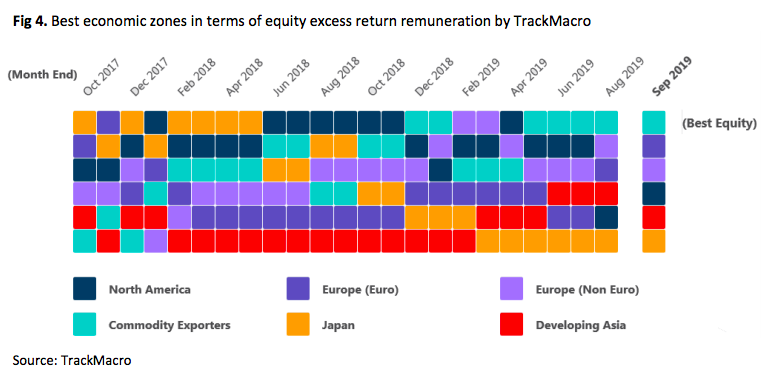
Investing whilst emerging markets have the wind in their sails and avoiding headwinds (debt, demographic trends, recession, low productivity, etc.) will be key in the coming years. For holders of typical Spanish share portfolios, here is a damning statistic: today, the Ibex 35 stands at the same level as in 1998, whilst the German stock market has risen 2.5-fold over the same period, the US market 2.7-fold and the Indian market 10.5-fold. But what is the worst for some and the best for others is yet to come.
.
Conclusion: Keynesian policies in the major developed economies should, in theory, combat deflationary pressures, stimulate domestic growth and strengthen Western companies in the face of competition from emerging markets. However, the outcome of such a policy of quantitative easing and sub-zero interest rates may be exactly the opposite. The depreciation of Western currencies leads to a massive influx of capital into emerging economies (which, incidentally, are natural magnets for investment in their own right, even without such desperate measures in the West). Investors today find themselves in an asymmetrical situation, where their major currencies have ceased to be safe-haven assets due to low interest rates. This ‘Age of Central Banks’ favours, in principle, gold, real assets and shares in emerging-market companies, to the detriment of developed economies, sovereign debt and shares in Western companies.
.
As Mark Mobius rightly pointed out in the article cited, in the late 1980s emerging economies accounted for just 5% of the global market, but now they account for more than 40%, and the figure is rising rapidly. Back then, investors could only invest in no more than half a dozen stock exchanges; yet now we have more than 70 markets open to growing foreign investment, fully equipped with state-of-the-art technical facilities and supervised by highly professional regulators. This now allows for enormous diversification and security, and shows us the way forward: now is the time to invest in certain economies emerging - or already emerging where there is a tremendous economic recovery and growth. Furthermore, the US-China trade war is nothing more than a golden opportunity to do so at reasonable prices. And anyone who continues to peddle fears about investing in emerging markets is either misinformed and out of touch, or is simply following orders from their superiors to peddle a deflationary, recessionary product that has smelled rather foul ever since central banks turned on the tap to keep zombie economies and companies afloat.