We are delighted to announce that we have entered into a partnership with the asset management firm Cobas AM, led by the well-known Francisco García Paramés, so that we can contribute our articles to their blog. We recently published the following post on the Cobas AM blog, entitled «Passive management, active management«.
We know that more and more money is flowing into ETFs and passive and quantitative (with or without AI) portfolio management every day. This increase in the volume of passive management reduces market efficiency, which allows Investors (with a capital ‘I’) to capitalise on these inefficiencies and find value at a good price. In other words, fortunately, most of those who buy and sell in the markets are not looking for value but for profits (sic), which they tend to seek out in a cyclical and reckless manner, lurching from one loss to the next. They are not looking for good businesses to buy, but for winning tickers to bet on. And to do so, they use fleeting crystal balls which they discard one after the other as soon as the future proves them wrong.
.
Furthermore, active management fails to outperform the markets in more than 8 out of 10 cases. And this dismal statistic gets even worse the longer the investment period. All of this contributes to increasing market inefficiencies, which a good “value” fund manager (and there are some) capitalises on over time. The key for investors is obvious: knowing how to select that small percentage of active fund managers who consistently and sustainably outperform their benchmark indices over the years.
.
Then, amongst that small percentage of brilliant active fund managers, we can choose between different approaches, depending on the investor’s preferences or circumstances: deep value, value, long-only, long/short with a long bias, etc… But they must always outperform their indices with relatively concentrated and locally focused portfolios and fund managers, as diversification and distance are inversely proportional to one’s knowledge of the businesses in which one is investing.
.
That in-depth understanding of the businesses in which one invests is the foundation upon which results are built over the years. And to achieve this, it is not enough simply to study the balance sheets published periodically by companies (many active fund managers tend to limit themselves to that, at best). You have to travel, to get to know the companies first-hand – their management, facilities, suppliers, competitors, the local market and customers, and so on.
.
That is why, decades ago, we realised that, as investors and managers of our own and our clients’ assets, we would be far more efficient by specialising in the selection of fund managers and funds rather than in the selection of individual shares in which to invest. Because, however capable our team may be, it is impossible to match the level of knowledge possessed by these select fund managers, whose teams are constantly on the move, personally visiting executives and corporate premises throughout the year.
.
This select group of star fund managers, who have stood out from the crowd for decades, have teams of dozens of analysts at their fund management firms; some even have private jets, enabling them to visit in person and on a regular basis the companies and management teams in which they invest their own money and that of their investors. In this way, they regularly scrutinise business plans, future strategies and all manner of corporate decisions, which go far beyond the thorough analysis of balance sheets carried out at the fund managers’ headquarters.
.
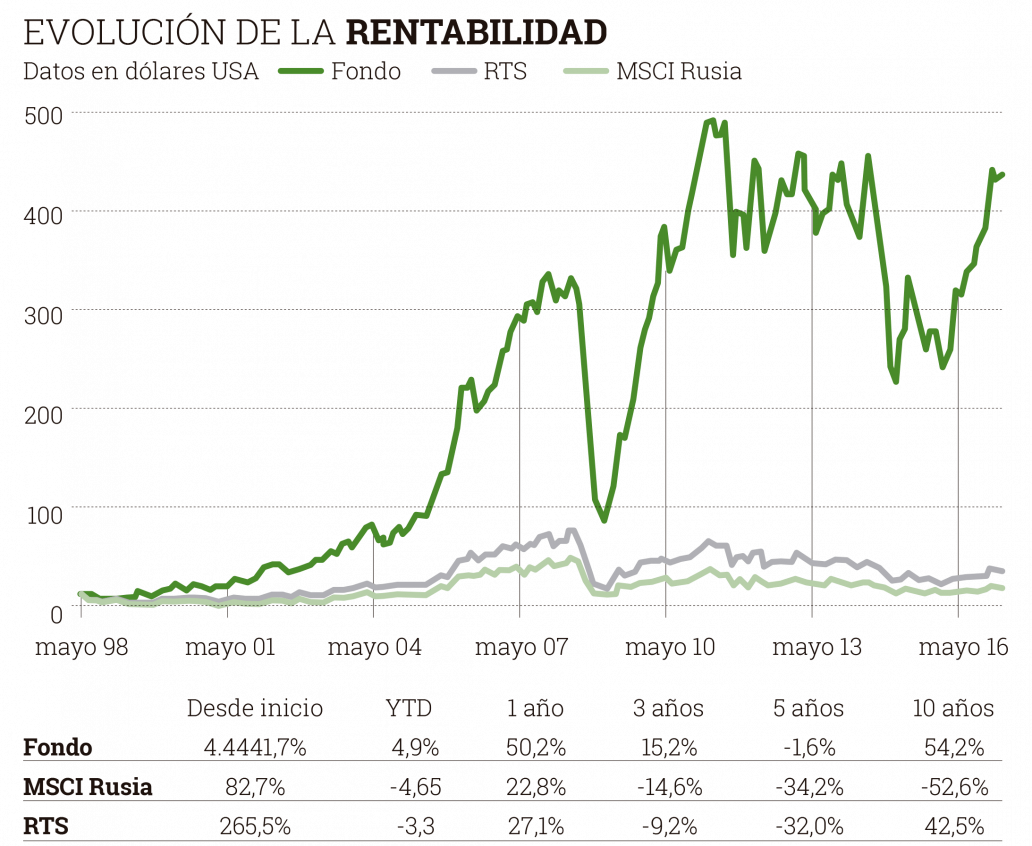
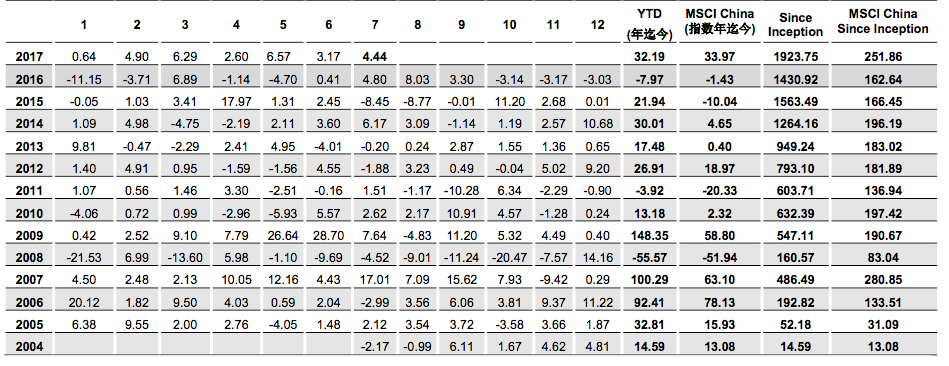
To give readers an idea of the scale of what we are discussing, one particular management firm in our portfolios carried out 2,200 face-to-face visits to various companies last year (not including telephone calls). This forms part of their standard routine in prospecting for and conducting exhaustive research into the businesses in which they are, or may become, partners through their investment funds. Below, you can see a sample of fund returns where their “value” managers have been consistently achieving extraordinary alphas over more than a decade, in extreme markets such as Russia or China (where they have, unsurprisingly, found greater exploitable inefficiencies and volatility than in fully developed markets):
.
.
But the difficulty of finding these fund managers amongst the sea of actively managed funds – which private banks tend to promote – is what leads many investors to turn to passive management, tired of paying management fees only to fail to even match the benchmark index. Unfortunately, it is very difficult to find good fund selectors in the financial sector, whose product ranges are limited to funds registered with the CNMV that pay them hefty commissions, but which have little track record and management teams that are as transient as they are anonymous.
.
Fortunately, actively managed funds – with stable teams comprising named individuals and a track record stretching back more than 10 years – still focus on results, consistently and sustainably outperforming indices, ETFs and semi-passive or fundamental ETFs.
.
The proper analysis and valuation of companies is, and must be, a true art form. And there are certainly those who are masters of this art, and they are the very reason for the existence of a good fund manager.
Note: The table showing the returns on the China fund does not appear in the article on the Cobas website because it was not compatible with the mobile operating system.
We have been made aware of phishing and spoofing attempts involving fraudulent email addresses and domains that closely resemble our official company communications. These unauthorized communications are not sent by our company and may falsely impersonate our employees or representatives.
Our company is not responsible for communications, requests, or transactions originating from fraudulent or unauthorized email addresses or domains. Please verify that all communications originate from our official email domain before responding or sharing any information.
If you receive a suspicious email claiming to be from our company, please do not respond, click any links, or provide any information. Contact us directly using the contact information published on this website to verify its authenticity.