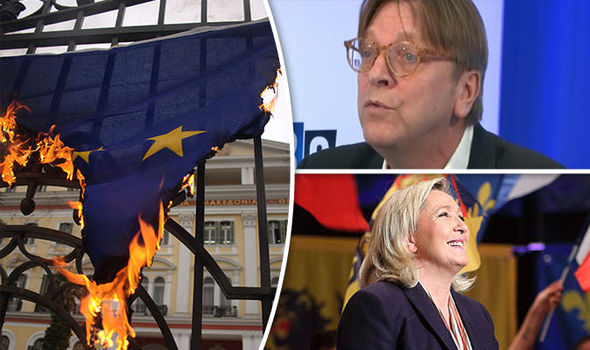
Yes, yes, we know that Marine Le Pen's proposals are often extreme and even dangerous, at least as far as the model of society advocated by her party, the Front National, is concerned. But any analyst with two fingers of economics in his or her forehead should recognise that the current EU, with its single monetary policy and its North/South divergences growing beyond the point of return, is a dead end. A real cul-de-sac, in spite of the Europeanist financial denialism suffered by Eurobureaucrats, who by the way increasingly defend the current EU with less and less conviction and monolithism. We would therefore do well to recognise that, as far as monetary policy proposals are concerned, Marine Le Pen seems to be handling the drift of the Eurozone more realistically. Her proposals are thus more transgressive but at the same time more courageous, and time will tell if they are also more beneficial for the French and other EU neighbours. Let's see what he proposes in this article of Bloomberg:
.
Essentially what Le Pen is promising is the takeover of French monetary policy. A return to monetary sovereignty by restoring the powers of the Bank of France and issuing new francs anchored, albeit to a basket of European currencies, as was done for a time with the ECU (European Currency Unit), Do you remember? This basket of currencies set the value of the ECU according to various parameters such as GDP or the weight of the respective countries in European trade. And from its creation in 1979 until the definitive freezing of its value in 1995, various adjustments were made according to the needs of the diverging economies of the member countries. Logical, isn't it? The problem came in 1995, when the intention was to fix this relationship between the ECU and the other currencies immovably (later the real currency, the EURO, was introduced as a 1:1 parity with the ECU). Obviously, since that freeze, the seams of the single currency have only cracked and have been stoned by seas of freshly printed money, suffering all the economic divergences that the North/South reality has shown over the years.
.
So Le Pen's proposal for a return to the Franc (new French Franc) semi-pegged to a basket of European currencies (new ECU) with a margin of fluctuation makes much more economic and financial sense than the current situation, and it is nothing that those of us of a certain age have not seen before. According to Le Pen, the French state would commit itself to maintaining this fluctuation within a band of +/- 20%. In other words, if the other countries were to do the same, the new Deutschmark would naturally appreciate in value against the currencies of other weaker economies. In other words, the currencies of the South would devalue against the stronger economies of the North. In fact, such a scenario would allow more recessionary and deflationary countries to devalue their respective currencies and revive their economies, generating growth and positive inflation. Et voilà!
.
The candidate has not yet proposed a timetable for the rest of the Eurozone countries to also adopt the anchoring of their new currencies to the basket/new ECU, but she does warn that if the rest want to continue with the Euro as we know it today, her government would allow the new Franc to fluctuate freely, without even this 20% limit. Warning to sailors north and south,,,,
.
The Bank of France could issue up to 5% of the money supply annually (similar to the increase that the ECB has been applying proportionally to France, according to Bernard Monot, Le Pen's main economic advisor). About 100 billion new Francs per year, equivalent (just for a start) to 100 billion Euros. This would finance the needs of the French economy and its debt commitments. A sovereign debt that would be redenominated in new French Francs, and which the state would buy back from foreign holders as far as possible.
.
Monot assures that the French risk premium with respect to the German one would increase but not disproportionately. He believes that the yield on the French 10-year bond would be around 2-3%. France would honour its commitments, as would any other eurozone country that followed in its footsteps. It goes without saying that the French candidate's proposal would make much more sense and reliability if it were applied by the entire eurozone in a coordinated, albeit not simultaneous, manner.
.
For all those who still think that Le Pen's proposal is yet another of her extremist follies and that the chances of such a future materialising are slim, I am sorry to contradict them, but in Germany there are more and more voices, and very authoritative ones at that, that are increasingly being heard that call for a break with monetary policy in unison with the French policy. And it is not only the «demonic» Franco-German front, but also the Belgian Guy Verhofstadt, The European Parliament's elected Brexit negotiating representative, no less, also calls for the financial break-up of the Eurozone., at least in two parts. Therefore, investors should not forget that, although today our Euro is worth exactly the same as the German Euro, the golden dream of those of us living in the highly indebted and recessionary periphery, i.e. to have the equivalent of Deutsche Marks in our current accounts, is not likely to last much longer. take appropriate measures to avoid such potential devaluations. of southern currencies and assets relative to those of the north.