 «What would happen if credit rating agencies ceased to exist? It is a question that few of us ask ourselves today, but one that leads to some fascinating reflections.»That’s how it began" the article which we published over a year and a half ago. Unfortunately, this debate is now dominating the media headlines for very sad reasons, as the role of the credit rating agencies is being called into question solely because they have downgraded Portugal’s rating. In other words, because their ratings are a thorn in the side of those of us who are still members of the Eurozone. We invite you to re-read that short article from 16 December 2009 – it feels like it was only yesterday – and afterwards we’ll offer some thoughts on the matter.
«Firstly, it must be said that if credit rating agencies had not existed, it would have been far more difficult to abuse the issuance of all kinds of debt securities on a global scale. And that is something that would have largely prevented the widespread proliferation of toxic assets that have infected the entire financial system, as well as the pockets of countless investors and «investor-addicts’ (it’s interesting to re-read the article ‘Financos and Inversópatas: An explosive mix»written two and a half years ago – now more than four – just before the financial collapse began).
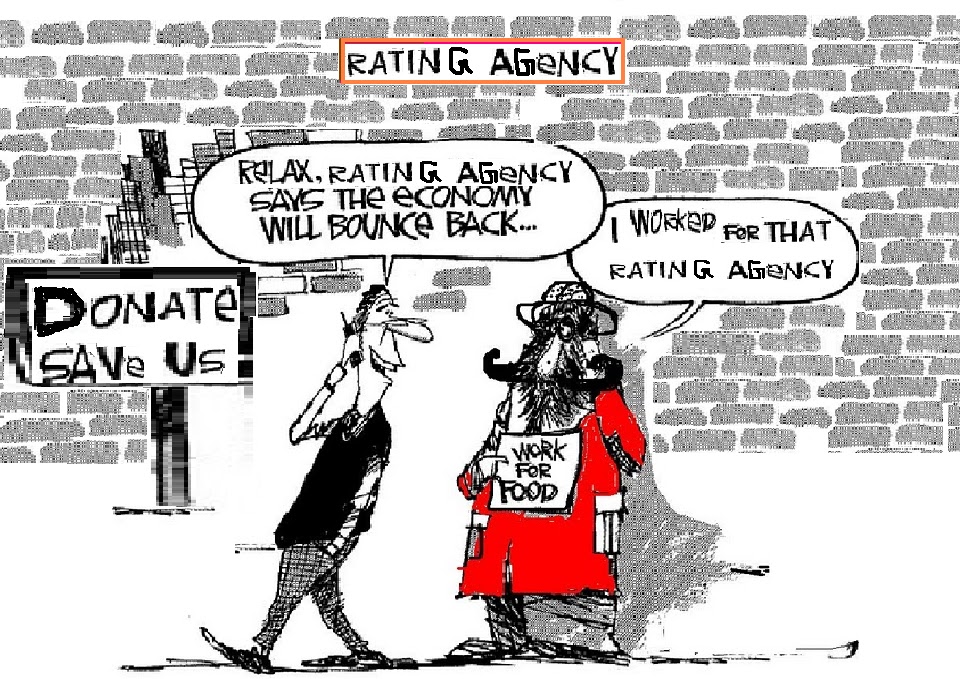 This article, written in late 2009, is certainly a highly topical and regrettable read. Today, the debate over the inappropriateness of credit ratings is back on the table due to the discomfort felt by the Eurozone following Portugal’s downgrade. Nothing more. Unfortunately, no one is questioning whether it is appropriate to have private companies quantifying something as complex and subjective as risk – no. The only suggestion is to set up another rating agency – this time a European one, or at least not an American one – that would be more lenient towards the critical situation of European peripheral countries on the brink of bankruptcy. There are political calls from Europe for the creation of more ratings that are just as fraudulent, corrupt and compromised as the American ones, but this time of a ‘colour’ that favours us. Arguments are put forward on the grounds of nationalism, financial stability, lack of diversification, and so on. But in no case, unfortunately, is the validity or very existence of the rating agencies as such called into question.
Let us remember that, at present, credit rating agencies are not registered as such, nor even as auditors. Their ratings, which serve as a blind guide for the entire global financial system, legally speaking, they are nothing more than journalistic opinions. In other words, they carry no greater legal weight than any opinion expressed by an ordinary columnist. Consequently, their legal liability for such incompetent and/or corrupt characterisations as those endured over the past four years is nil. The absurdity is so profound that the foundations of the system are laid in a carefree and reckless manner merely «journalistic opinions» from a legal point of view, which have been shown to be complete con artists since the sub-prime crisis. And I am certainly not one to advocate elevating credit ratings to the status of universal laws – which is how they are perceived and treated by the majority of the global financial system – no, I would not even elevate them to the level of mere audits. The path we must follow is quite a different one.
 Does it really seem logical to us that something as complex as risk quantification could be reduced, across the board, to a simplistic and rudimentary code of A, B or C? Risk measurement in the financial world is, and must be, an extremely complex art. And yet the rating agencies, in a display of sophistication, merely add to the basic A, B and C ratings other secondary ones such as a, b and c, or numbers like 1, 2 or 3, and other such symbols that do nothing more than refine the aberration of mediocrity. It is madness that this code, derived from «journalistic opinions», should govern the concept and the art of measuring risk across the system as a whole. And the worst thing is that we don’t realise what a surreal world we live in.
The question one must ask is, as the ‘universal Portuguese’ would say (and I’m not referring to Durao Barroso), ‘why?’. How is it possible that the System with a capital ‘S’ relies on risk ratings that seek to reduce the complexity of life itself, of risk, and of predicting nothing less than future events to a handful of letters and numbers? The answer is that it is cheaper and infinitely more convenient to have others with prestige measure the risk for us. It saves on analysis costs (a priori), simplifies the work and, most importantly if that’s possible, disclaims liability. And we must all acknowledge that these three arguments I have just mentioned are far too tempting for the majority of humankind, particularly in the financial world, which includes advisers, fund managers, investors, and so on. And if something then goes wrong, Blame it on the boogie! Because human beings, by nature, always tend (barring a few honourable exceptions who end up shining far brighter than the rest) to absolve themselves of all responsibility, blaming others for their misfortunes. For this reason, and also because of their malleability (the noun form of the verb to tamper with…) of the credit rating agencies: these have been elevated to the status of saints by governments and powerful figures, with the approval of the rest of us mere mortals involved in the financial system, including investors and savers.
It has been years since ratings ceased to be meaningful in our analyses as a family office. It is true that we are swimming against the tide and that we often come up against constraints and coefficients based on those journalistic opinions, which have been elevated to the status of articles of faith by all financial institutions. It is a frustrating and never-ending struggle against walls of mediocrity. But as Warren Buffett said, it is only when the tide goes out that you see who was swimming naked. And the tide began to go out as early as the summer of 2007. What’s more, It is possible that, in this ‘New Normal’, we will no longer have tides to cover our shame.
Many seem to prefer to take the blue pill and call for the creation of a European agency to hammer out whatever suits us. And perhaps in this way their hallucinations will make them believe that, as was the case in the Old Normal, the tide is rising and covering their miseries. Maybe when the water reaches their necks they will realise that they should have taken the red pill, and that should never have allowed others to quantify the risk taken by them.
Finally, I leave you with the advertising slogan of Standard & Poors, which is not to be missed, pay attention to the words in bold:
 “Standard & Poor's is the world's foremost provider of independent credit ratings, indices, risk evaluation, investment research and data. We supply investors with the independent benchmarks they need to feel more confident about their investment and financial decisions.”
Standard & Poor's.